
Operation Market Garden
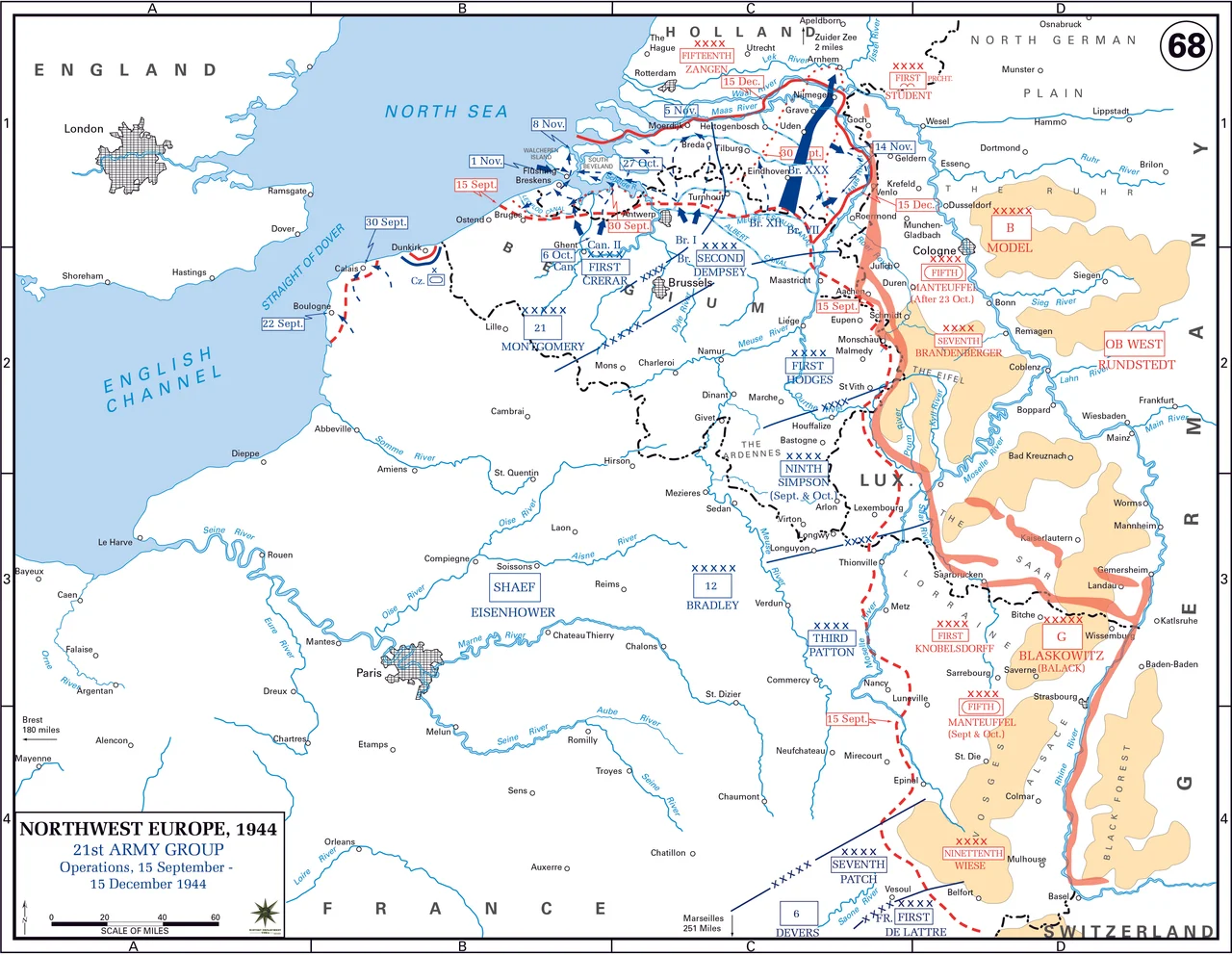
On the afternoon of Sunday 17 September 1944, the sky over the southern Netherlands filled with parachutes. More than thirty-four thousand American, British, and Polish airborne soldiers fell out of fourteen hundred transports onto Dutch fields and woods. Below them lay a single ribbon of road running 62 miles north from the Belgian border through Eindhoven, Veghel, Grave, Nijmegen, and finally Arnhem, where a steel bridge crossed the Lower Rhine. Nine bridges in all had to be seized and held for forty-eight hours while a British armored corps raced north up that single road to reach them. The Germans called the road Hells Highway by the end of the week. The British called the operation a bridge too far. Both sides remember the people, on every side, who paid for it.
The Plan
Field Marshal Bernard Montgomery wanted to end the war by Christmas. His proposal was a single concentrated thrust around the northern end of the German Siegfried Line, across the Rhine, into the industrial heart of the Ruhr. Market would seize the bridges from the air. Garden would race XXX Corps up the road behind. The U.S. 101st Airborne Division under Maxwell Taylor would drop near Eindhoven and Veghel to take the southernmost bridges. The U.S. 82nd Airborne under James Gavin would land near Grave and Nijmegen for the long crossings of the Maas and Waal. The British 1st Airborne Division under Roy Urquhart, with the Polish 1st Independent Parachute Brigade under Stanislaw Sosabowski, would drop at the very end of the corridor and take the road bridge at Arnhem. The plan asked the British paratroopers to hold their bridge for two days against whatever the Germans could bring to bear. They held it for four.
The Drop and the Highway
The first day went almost too well. The American 101st and 82nd dropped accurately, took most of their bridges quickly, and made early contact with XXX Corps surging north out of Belgium. Lieutenant General Brian Horrocks's armor launched its ground assault at 14:35 hours and was in Eindhoven by the next day. Then the friction began. The bridge at Son was blown by the Germans just as American paratroopers reached it, forcing engineers to throw up a Bailey bridge that cost a critical night. The huge highway bridge at Nijmegen, the second-to-last crossing, was meant to be taken on the first day. It was not, partly because General Gavin had decided the Groesbeek Heights had to be secured first, partly because of a delayed and confused attack by the 508th Parachute Infantry Regiment. By the time the 82nd reached the bridge, German reinforcements were already arriving. The advance ran behind schedule from the second day onward, and at Arnhem, behind schedule meant deadly.
The Bridge at Arnhem
The British 1st Airborne dropped 13 kilometers from the Arnhem bridge, much farther than any of the American drops. Their radios did not work; some were set to the wrong frequencies, others could not transmit through the thick woods of the Veluwe. The reconnaissance squadron that was supposed to race for the bridge in jeeps was halted within sight of it. Only the 2nd Parachute Battalion, under Lieutenant Colonel John Frost, made it through. About 740 men reached the northern ramp of the great steel bridge by Sunday evening and dug into the houses around it. They held for four days against the 9th and 10th SS Panzer Divisions, which had been resting in the area and were not supposed to be there at all. Allied intelligence had known about them. Major Brian Urquhart, the corps intelligence officer, had been ordered onto sick leave for raising the alarm. By Thursday morning, Frost's men were out of ammunition, food, and water. The buildings around them were burning. The wounded lay on the floor of a cellar, and a truce was arranged to evacuate them into German captivity. The bridge fell to the Germans on 21 September.
Oosterbeek
The rest of the 1st Airborne never reached the bridge at all. They were pushed back into a shrinking perimeter at the village of Oosterbeek, three miles west, between the railway line and the Rhine. For nine days, paratroopers, glider pilots, and Royal Engineers held a thumbnail-shaped pocket against constant shelling, mortaring, and infantry assault. The Polish brigade dropped late, on the wrong side of the river, and tried to ferry across in rubber boats under fire. Of about 10,000 men in 1st Airborne, around 8,000 were dead, wounded, or captured by the end of the week. On the night of 25 September, the remnants, fewer than 2,500 men, slipped down to the Rhine in rain and dark and crossed in boats. They left their wounded behind, in the care of the Dutch. The Dutch civilians of Arnhem and Oosterbeek paid heavily too: their city was systematically looted and burned by the Germans, and the entire population was forced to evacuate, walking out of their homes that autumn into the long Hunger Winter that followed.
What It Cost
Market Garden killed, wounded, or captured between 15,000 and 17,000 Allied soldiers. German losses are harder to pin down but were also heavy, perhaps 6,000 to 13,000 men. The Dutch died too, in numbers that did not appear in any operational tally, in homes shelled by their would-be liberators and in the famine that came after, when the Germans cut food supplies to the still-occupied west in retaliation for Dutch railway strikes. Arnhem itself would not be liberated until April 1945, almost seven months after the bridges had been within sight. The Polish brigade was unfairly blamed for the failure at the time, and Sosabowski was relieved of his command. He died decades later working in a London factory; the British apology came much later still. Antony Beevor's verdict has hardened into the historical consensus: Market Garden was a bad plan right from the start and right from the top. But the men who jumped, on every side, were not bad. They were ordinary, and they did what was asked of them, and many of them did not come home.
Hells Highway Today
Drive the old Highway 69 from the Belgian border north through Valkenswaard, Eindhoven, Son, Sint-Oedenrode, Veghel, Grave, and Nijmegen and the bridges are all still there. The Son bridge has been rebuilt. The Nijmegen highway bridge, with its long approach causeway across the polder, still carries traffic. The Arnhem road bridge, John Frost Bridge since 1977, was destroyed in 1944 and rebuilt to the same Allied-era design. The Hartenstein Hotel in Oosterbeek, which served as 1st Airborne's headquarters during the pocket battle, is now the Airborne Museum. Every September, in the Oosterbeek war cemetery, Dutch children scatter flowers on the graves of the British and Polish soldiers buried there, a tradition begun in 1945 by parents who never forgot the men who had tried to free their towns and the people, civilian and soldier, who never lived to see the end of the war.
From the Air
The Market Garden corridor runs roughly south to north from the Belgian-Dutch border near Valkenswaard (51.35 N, 5.46 E) through Eindhoven, Son, Veghel, Grave (51.76 N, 5.74 E), Nijmegen (51.84 N, 5.86 E), and Arnhem (51.98 N, 5.91 E). From altitude the route is still visible along the modern A50/A73 motorways and the Maas-Waal canal complex. Key bridges: the Maas at Grave, the Waal at Nijmegen with its long causeway, and the John Frost Bridge across the Lower Rhine at Arnhem. Nearest airports: Eindhoven (EHEH) on the southern end of the corridor, Weeze (EDLV) just across the German border, and Niederrhein near the Dutch-German frontier. The Dutch military operates exercises in this airspace; check NOTAMs. The terrain remains flat, ditch-laced, and lined with the same tree-topped dikes that gave the corridor its character in 1944.
Nearby Stories
- Geertruidenberg Castle 4.8 km away
- Castle of Westerlo 7.6 km away
- Binnendieze 9.8 km away
- Hoogstraten Castle 9.9 km away
- Steyl 14 km away
- Kleve 17 km away
- Heinsberg-Lindern Railway 17 km away