.jpg)
Operation Steinbock
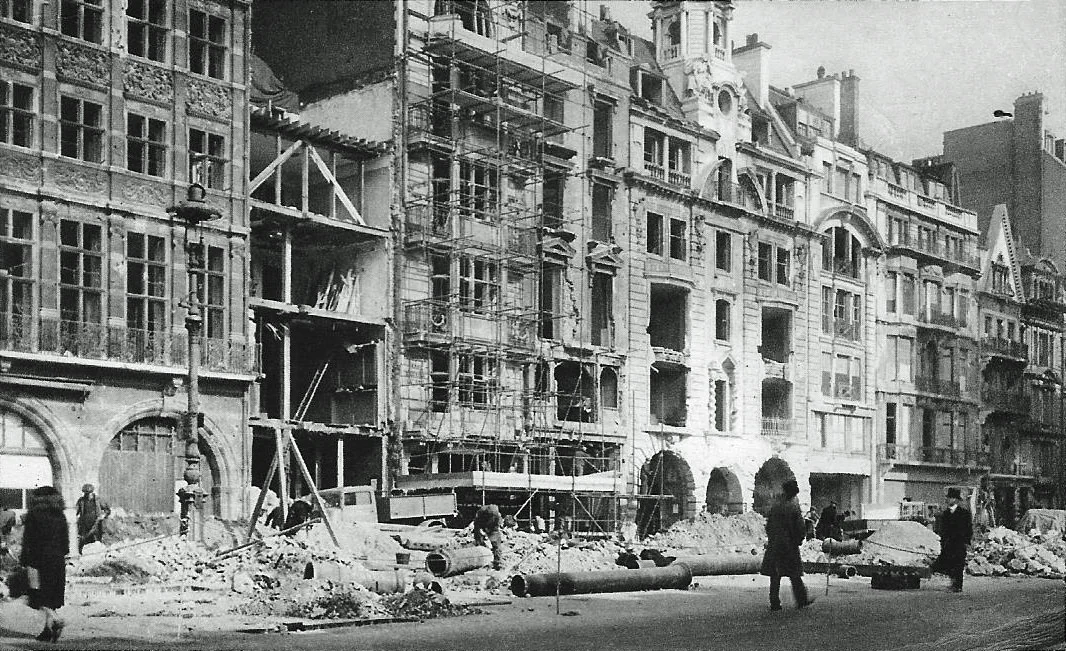
On the night of 21 January 1944, twenty-four hours after nearly 800 RAF bombers had laid waste to Berlin, the German Air Force launched its retaliation. The Luftwaffe assembled 474 bombers across fourteen airfields from Soesterberg in the Netherlands down to Montdidier near Paris, and gave parts of London codenames borrowed from already-devastated German cities: the first target, Waterloo, was München. The campaign that began that night would last until 29 May 1944, would be remembered in Britain as the Baby Blitz, and would cost the Luftwaffe 329 aircraft and irreplaceable bomber crews it could not spare. It would kill 1,556 civilians in southern England. And by the time it ended, the German bomber force had been hollowed out so completely that when the Allies came ashore in Normandy a week later, there was almost no German bomber response.
The Bombs That Mostly Missed
Steinbock was a strange campaign because its failures kept arriving on schedule. On the first raid of 21/22 January, the Luftwaffe was supposed to mass over Waterloo Station and ignite London. The pathfinders' markers fell badly. Most of the bombs fell on Kent, Sussex, or in the Channel. On the night of 3/4 February, German propaganda claimed 210 of 235 bombers struck their targets. British records showed bombs as far as Gloucestershire, Wiltshire, Bedfordshire, and Suffolk — meaning German navigation had spectacularly miscarried. Only 25 of the 190 tonnes of bombs released that night fell on London. Fires were started in Hackney, Wimbledon, and Tilbury. Seventeen people were killed in the capital. Five civilians died in Wimbledon, six seriously injured. The Upper Slaughter village in Gloucestershire — three hundred miles off-axis — received two thousand incendiary hits because a bomber, lost, dropped its full load over Cotswold meadows.
Numbers and the People Behind Them
The official total — 1,556 killed — was an under-reported metric of the campaign's human cost. Behind every figure was a row of suburban houses, a small block of flats, a family eating supper. Six children and four adults died on the night of 4/5 January in Westcott, Surrey, before Steinbock had even been formally declared. In Wimbledon five civilians were killed and six seriously injured by bombs that should have landed on central London. On 29/30 April, twenty-seven civilians in Plymouth died in a raid aimed at a battleship that was successfully obscured by smoke and mist. The campaign hit cinemas, farms, holiday resorts. A farmer at Clacton-on-Sea lost six horses, thirty cows, and seventeen ewes. The point of Steinbock was reprisal — Hitler had ordered the bomber force into the air to give the German public a sense that they were striking back at the air raids destroying their own cities — and the lives traded in this exchange of revenge were ordinary lives in ordinary streets.
What Killed the Luftwaffe's Bombers
The campaign destroyed the wrong force. Britain had spent four years preparing for exactly this kind of night attack. Airborne radar, ground-controlled interception, the Beaufighter and the Mosquito night fighter — by 1944 the British air defence system was the most sophisticated in the world. Of the bombers committed to Steinbock, 70 percent never returned. The Luftwaffe lost 270 Junkers Ju 88s, 121 Dornier Do 217s, 35 Junkers Ju 188s, 46 of the troubled new Heinkel He 177A heavy bombers, 27 Messerschmitt Me 410s, and 25 Focke-Wulf Fw 190s. The He 177 was particularly disastrous: its engines tended to overheat and catch fire even before the bombers reached the Channel. On the night of 13/14 February, eight of thirteen He 177s aborted with burning engines before they crossed the coast. The bomber crews were experienced men, and they could not be replaced at the rate they were being lost.
Steinbock's Last Card
By April 1944 the German invasion-coast reconnaissance units could no longer see what was happening in the English Channel ports because RAF Fighter Command had masked them by day. The Luftwaffe sent night raids over Portsmouth on four consecutive nights starting 25/26 April, hoping reconnaissance crews could photograph the damage. The raids failed even against a coastal target that was easier to find. The last major raid, on Bristol on 14/15 May, fell apart in the same familiar fashion. Only a third of the crews were tracked even crossing the British coast; eleven bombers were lost; the city was essentially untouched. By the end of May the campaign was over. Hitler turned to V-1 cruise missiles and V-2 ballistic missiles — neither needed trained pilots or air-worthy bombers, and both would arrive over London later that year. Steinbock had ground down the Luftwaffe's last conventional bomber strike force. When the D-Day invasion began on 6 June 1944, there were almost no German bombers fit to oppose it.
How London Remembered the Baby Blitz
The Baby Blitz earned its diminutive name because of the disproportion between scale and effect. The Blitz of 1940–41 had killed more than 40,000 people and destroyed vast areas of British cities. Steinbock, despite mobilising more aircraft than any German raid since 1941, killed about a fortieth as many. London had grown used to night-time threats and largely absorbed this one. The blackout was already universal, the shelters already familiar, and most Londoners came up from their basements at dawn to find that this latest raid had hit somewhere else. The fifteen hundred lives lost still mattered — and the wreckage of homes in Hackney and Tilbury and Wimbledon would take years to rebuild — but the campaign had, by the end, the air of an old war effort going through familiar motions. Its real consequence lay in what it cost the side that had launched it. Within three years the city it had tried to destroy would be its conquerors' capital, and within a decade a tunnel under Hyde Park would carry tourists into the same shelters that had absorbed the bombs.
From the Air
Steinbock targeted Central London, with raid markers concentrated around 51.508°N, 0.128°W — the area between Waterloo Station and Westminster, codenamed München by Luftwaffe planners. The bombers approached from forward operating bases in northern France and the Low Countries, crossing the Kent coast and turning north toward London. London Heathrow (EGLL) lies west; London City (EGLC) east-southeast; Biggin Hill (EGKB), once a key Fighter Command station, sits southeast. RAF Northolt (EGWU) — operational during Steinbock as a night-fighter base — is to the northwest.
Nearby Stories
- Stevenage 5.7 km away
- Malling Abbey 5.7 km away
- 1952 Farnborough Airshow Crash 7.7 km away
- Ingatestone Hall 8.2 km away
- Hellfire Caves 9.1 km away
- The Carrington Event: The Solar Storm That Could Happen Again 9.8 km away
- Bletchley Park 16 km away
- Castle Hedingham 23 km away