
Orchomenus (Boeotia)
Homer reached for the grandest comparison he knew. To convey the wealth of Orchomenos in Boeotia, he placed it beside Egyptian Thebes — a city whose hundred gates and prodigious gold were the ancient world's standard for opulence. The epithet stuck: πολύχρυσος, "rich in gold." This was not the Thebes in Boeotia that Orchomenos rivaled through much of the Bronze Age; this was the Nile city, the capital of pharaohs. That Homer found the comparison apt tells us something about what Minyan Orchomenos was at the height of its power, before the Bronze Age Collapse reduced it to rubble and memory. Note well: this is Boeotian Orchomenos, not the later city of the same name in Arcadia — two distinct places that share a name and nothing else.
The Minyans and Their Golden City
The founding myth attributed the city's origins to the Minyans, a people who followed their leader Minyas south from coastal Thessaly to settle the Boeotian plain. In the fourteenth and thirteenth centuries BC, Orchomenos flourished into one of the most powerful centers in Mycenaean Greece. It controlled a significant agricultural hinterland, and the Minyans undertook an engineering project of considerable ambition: they drained the marshes of Lake Kopaïs, converting the shallow lake into productive farmland through an elaborate system of drainage channels. Homer's Catalogue of Ships lists Orchomenos and Aspledon together contributing thirty ships to the Trojan War — a substantial fleet, indicating real regional power. Whether that power derived from the drained land, from trade, or from political dominance over surrounding communities, the Homeric epithet suggests the result was wealth on a scale that made an impression.
The Treasury of Minyas
In 1880, Heinrich Schliemann — already famous for excavating Troy and Mycenae — turned his attention to Orchomenos and uncovered what he called the Tomb of Minyas. It proved to be one of the finest tholos tombs of the Mycenaean world, comparable in construction and scale to the Treasury of Atreus at Mycenae. The dromos leading to the entrance extends thirty meters. The entrance itself was built of dark grey Livadeia marble and once had a wooden door. The six-meter lintel, still in place, weighs several tons. The interior chambers were decorated with bronze rosettes, of which only the attachment holes remain, and the ceiling of the side chamber is carved with spirals and floral motifs in relief. The tomb was probably built around 1250 BC for members of the Orchomenos royal family. It was plundered in antiquity, and in the Hellenistic period a rectangular burial monument was added at its center — the old royal tomb repurposed as a new sacred site. Pausanias visited and described it in detail in the second century AD.
Rival of Thebes, Victim of Thebes
Orchomenos and Thebes were natural competitors — the two strongest cities in Boeotia, separated by the lake and by ambition. In the Classical period, Orchomenos often looked for allies against Theban dominance: it sided with Agesilaus II and Sparta in the 390s BC, and when the Boeotian League sacked Orchomenos in 364 BC — Theban retribution for its disloyalty — the destruction was politically motivated. The Phocians rebuilt the city in 355 BC after the Third Sacred War gave them regional leverage; the Thebans destroyed it again in 349. This cycle of destruction and rebuilding reflects a pattern familiar across Boeotia: cities that took the wrong side suffered the consequences, but the sites themselves proved resilient because the agricultural land that sustained them did not disappear.
The Plain Where Macedonia Won Greece
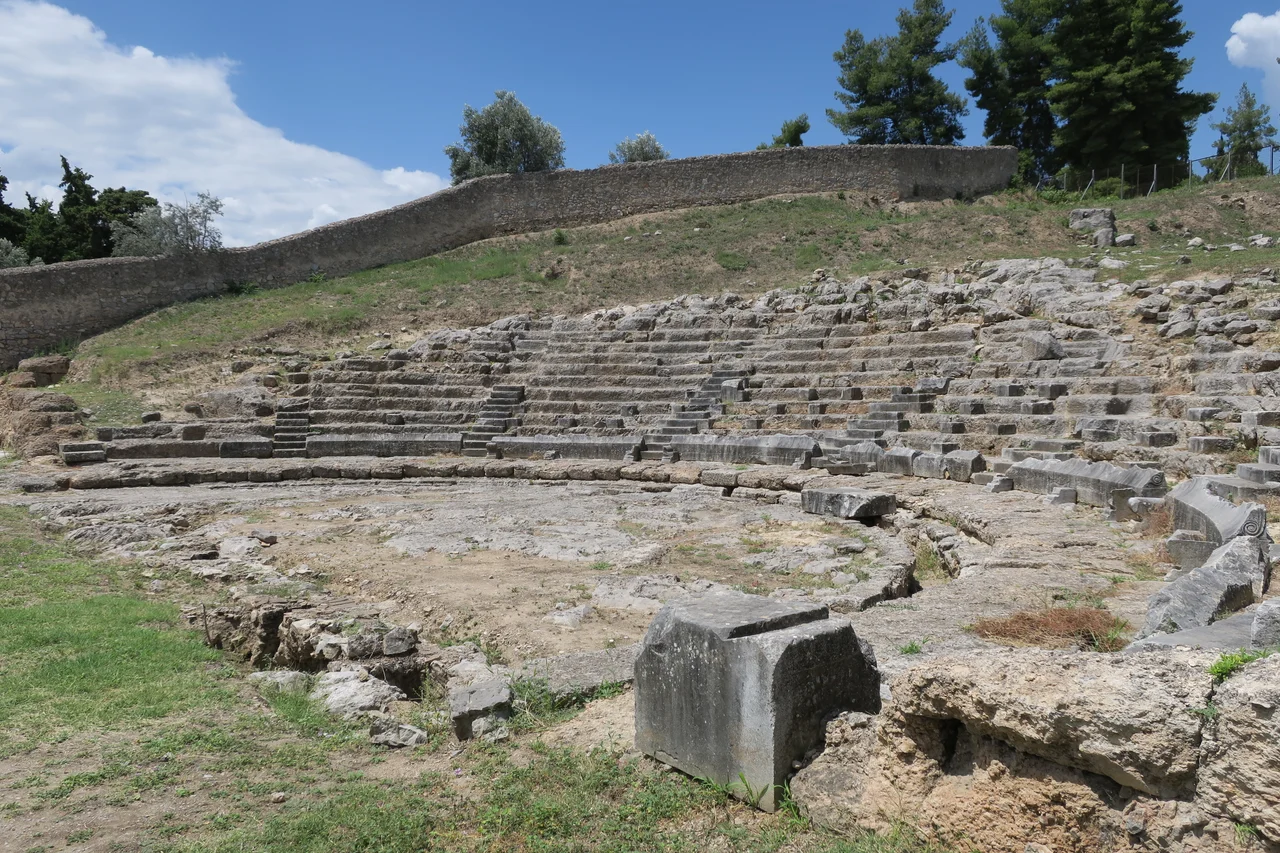
The broad flat ground between Orchomenos and the acropolis of Chaeronea, a few kilometers to the west, hosted one of the most consequential battles of antiquity. In 338 BC, Philip II of Macedon swept south through central Greece and met the combined forces of Thebes and Athens on this plain. The Macedonians won decisively, establishing Philip's supremacy over the Greek city-states and demonstrating to the world the military genius of his eighteen-year-old son Alexander, commanding the Macedonian cavalry on the left wing. Orchomenos had sided with the Macedonians; Philip and Alexander rewarded the city by rebuilding it, constructing the theatre and the fortification walls that are still visible today on the acropolis of Mount Akontion.
The Church Built from Bronze Age Stones
Opposite the ancient theatre — itself built at the end of the fourth century BC and used until the fourth century AD — stands the Byzantine church of the Dormition of the Virgin Mary, known as Panagia Skripou. Inscriptions date it precisely to 873/4 AD, naming its sponsor as Leon, a Protospatharios serving the emperor Basil I. The church was built largely from stones quarried from the ancient Mycenaean palace nearby, which lies partly beneath the building. Archaeologists have identified three wings of the palace, some decorated with frescoes, destroyed around 1200 BC. The sanctuary of the Charites — the Graces, whose cult at Orchomenos was the oldest in the city, instituted according to legend by King Eteocles — probably occupied the same location before the Byzantine church. Three layers of sanctity, stacked on the same spot across three thousand years: Mycenaean palace, ancient shrine, medieval church. The stones of Orchomenos passed from hand to hand, but they never left.
From the Air
Orchomenos (Boeotia) lies at approximately 38.49°N, 22.97°E, on the northern edge of the Boeotian plain in central Greece. This is Boeotian Orchomenos — distinct from Orchomenus in Arcadia, which is in the Peloponnese. From the air, the site is visible at the base of Mount Akontion, with the fortification walls crowning the eastern end of the ridge and the drained basin of Lake Kopais spreading to the east and north as flat agricultural land. The Treasury of Minyas (tholos tomb) and the Byzantine church of Panagia Skripou are visible at the lower level near the modern town. The plain of Chaeronea, site of Philip II's decisive 338 BC victory, lies a few kilometers to the west. Recommended viewing altitude: 1,500–3,000 m. The nearest major airport is Athens International Eleftherios Venizelos (LGAV), approximately 90 km to the southeast.
Nearby Stories
- Aulis (ancient Greece) 4.3 km away
- Pleistos 4.6 km away
- Doris (Greece) 5.9 km away
- Corinth Rail Disaster 6.9 km away
- Daphni Monastery 16 km away
- Loutraki 19 km away
- Saint George Monastery, Aidipsos 23 km away
- Skopelos 51 km away