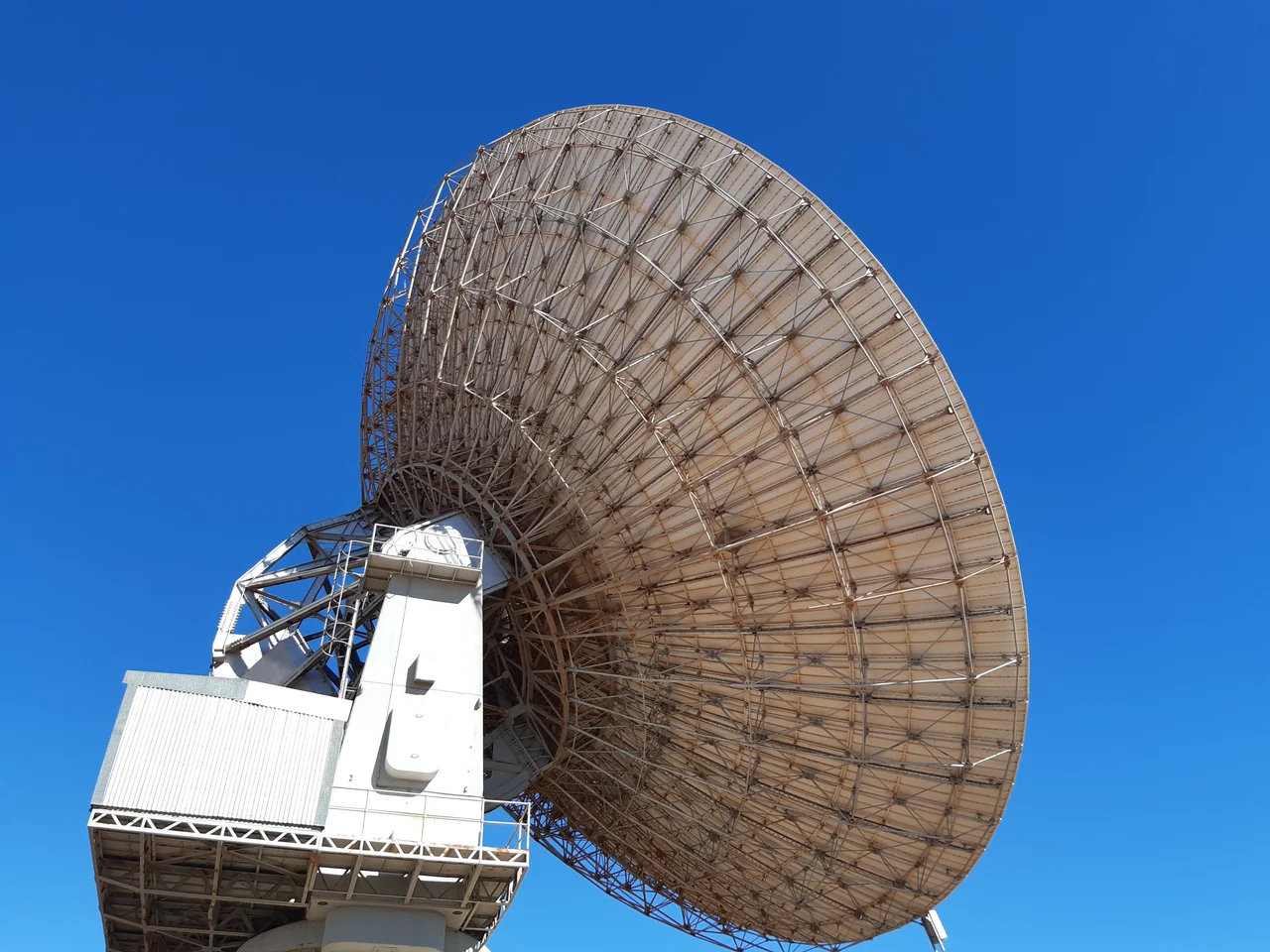

OTC Satellite Earth Station Carnarvon
It looks less like a telescope than like a giant tin scoop tipped up toward the sky, all hard angles where the famous dishes nearby are smooth curves. Locals call it the sugar scoop. Built in the scrub outside Carnarvon in 1966, this odd antenna gave Western Australia its first live pictures from the other side of the world, linked weeping families across oceans, and on one July night in 1969 helped carry the most-watched broadcast in human history. It is said to be the only antenna of its kind still standing anywhere on Earth.
Why It Was Built
The sugar scoop, properly a 12.8-metre Casshorn antenna with interlocking parabolic and hyperbolic reflectors, existed because of the Moon. NASA's Carnarvon Tracking Station, just down the road, needed a faster, more reliable link back to mission control in Houston than the old undersea cables and radio circuits could provide. So NASA contracted Australia's Overseas Telecommunications Commission to build a satellite earth station nearby, and paid for three Intelsat-2 communications satellites to be launched to carry the traffic. When the first of them, Intelsat-2A, launched on 26 October 1966, the new antenna sprang to life on 29 October as engineers tested it against the drifting satellite, even as the craft failed to reach its intended orbit over the Indian Ocean. For Australia, a country at the far end of every communications line, this was the beginning of the satellite age.
Faces Across the World
Before the Moon, the sugar scoop did something quietly extraordinary. On 24 November 1966, it carried the first successful test patterns from Australia to England. The next day came the real thing: a live BBC broadcast from a London studio in which British families spoke, in real time, with their migrant relatives standing in Robinson Street, right in the middle of Carnarvon. For people who had emigrated to the far side of the planet in an era when a letter took weeks and a phone call cost a fortune, seeing a parent's or sibling's face appear live on a screen was something close to magic. A remote West Australian town, of all places, had become the spot where a separated world could look itself in the eye.
One Small Step, Relayed
Then came 21 July 1969, Western Australian time, and the antenna's most famous hour. As Neil Armstrong stepped onto the lunar surface, the television signal of that first Moonwalk was received in Australia by the big dish at Honeysuckle Creek near Canberra, relayed via the Moree earth station to the Intelsat satellite over the Pacific — and it was the sugar scoop that caught it at the other end, pulling the pictures down from orbit and feeding them through a coaxial cable to Perth, the first live telecast ever seen in Western Australia. Three weeks earlier the station had formally begun its eight years of communications support for the NASA tracking station, and a larger 29.8-metre dish was added late in 1969 to handle the later Apollo flights. When NASA's station closed in 1975, OTC kept working, tracking missions on its own account.
From Halley's Comet to a Second Life
In its final years the station took on a remarkable roster of work for the world's space agencies. It held prime responsibility for guiding Europe's Giotto probe as it plunged through the tail of Halley's Comet, supported the launch of India's first satellite, tracked German communications craft, helped park a weather satellite over Africa, and monitored the launch of a Japanese marine-observation satellite in 1987. That year the station was decommissioned, and for decades the sugar scoop simply stood there, a heritage-listed curiosity baking under the desert sun, while solar researchers used the site to listen to the vibrations of the Sun. But the story did not end. In 2022 an Australian company, ThothX, acquired the old antenna and began refurbishing it into a deep-space radar to track satellites and debris in distant orbits, extending its coverage across the Indo-Pacific. The scoop that once helped reach the Moon is being taught to watch the sky again.
From the Air
The OTC Satellite Earth Station lies at roughly 24.87°S, 113.70°E, in flat scrub a few kilometres east-south-east of Carnarvon township and just north of the former NASA tracking station site. The large 29.8-metre parabolic dish and the angular 'sugar scoop' Casshorn antenna are highly conspicuous from the air, the most prominent man-made landmarks for many kilometres across the Gascoyne plain. View from 2,000-4,000 ft in the region's typically clear, dry air. Carnarvon Airport (ICAO YCAR) sits about 8-10 km to the north-west, so the antennas make a natural visual reference on approach. The coast and Gascoyne River mouth lie to the west.
Nearby Stories
- Bernier Island 3.7 km away
- Quobba 40 km away
- Hartog Plate 45 km away
- Francois Peron National Park 65 km away
- Pimbee National Park 75 km away
- Kennedy Range National Park 80 km away
- Gascoyne Junction 98 km away
- The Silent Wave: Java's 1994 Tsunami Earthquake 1572 km away