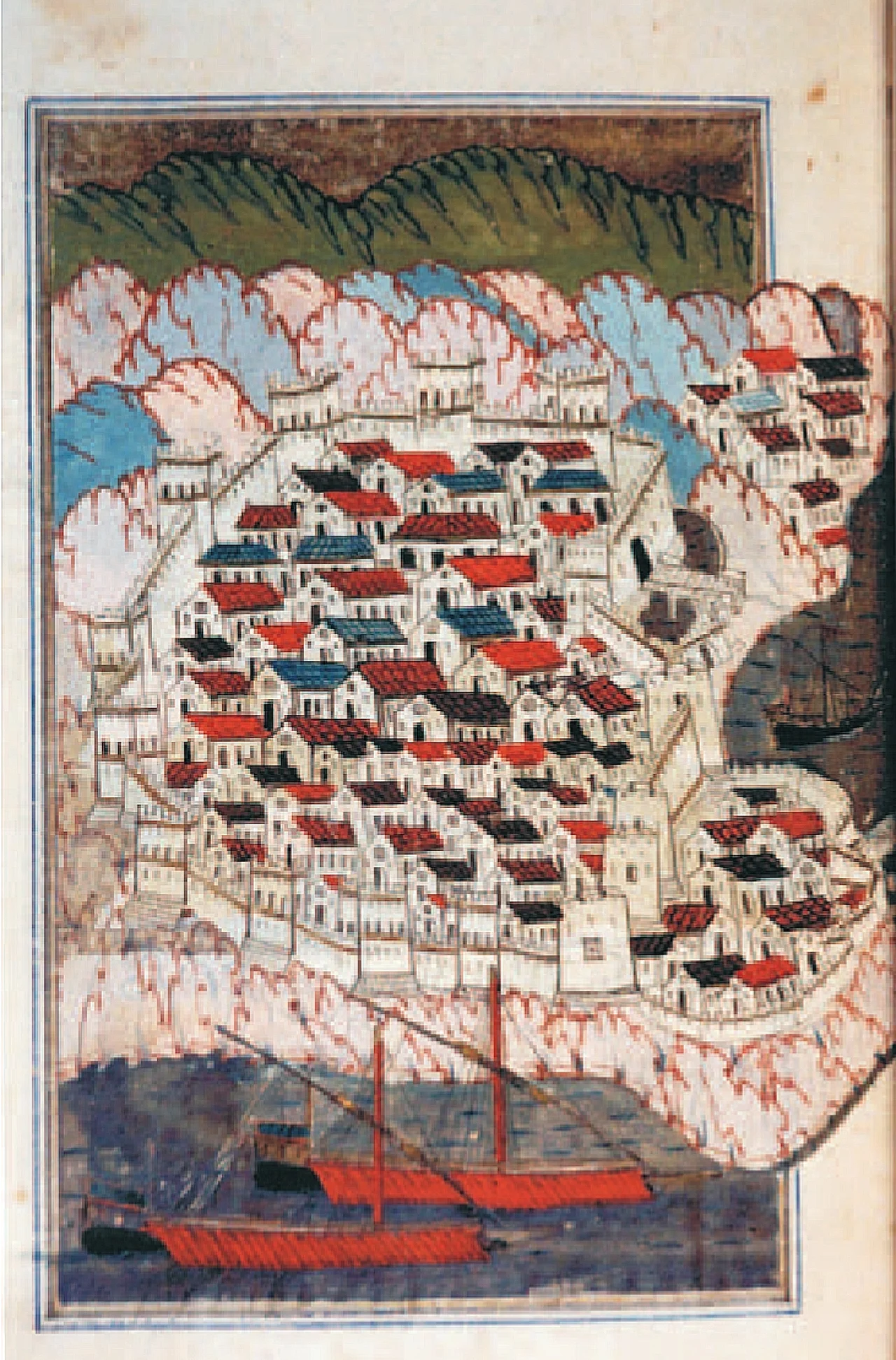

Ottoman–Venetian War (1499–1503)
The island you are flying over had a long career as a prize. Cephalonia changed hands between Byzantine emperors, Norman lords, Frankish counts, and Venetian doges across the medieval centuries, each power recognising the same thing: whoever held the Ionian islands controlled the sea lanes between the Adriatic and the eastern Mediterranean. In the summer of 1499, those lanes became the stage for a war that would redraw the boundaries of maritime power in the region — the Second Ottoman–Venetian War, fought between an empire rising and a republic stretched beyond its limits.
The Admiral from Constantinople
Kemal Reis was the Ottoman Empire's most capable admiral, and in January 1499 he set out from Constantinople with ten galleys and four supporting ships, working his way westward to take command of the main Ottoman fleet waiting in the Aegean. By July, he had absorbed that fleet — 67 galleys, 20 galliots, and around 200 smaller vessels — into a single force under his command, and turned it toward Venice's coastal holdings.
The decisive engagement came in August 1499, off the Messenian coast near Cape Zonchio (also known as the Battle of Sapienza). The Venetian fleet, commanded by Antonio Grimani, numbered 47 galleys, 17 galliots, and roughly 100 smaller craft — formidable on paper, but outfought over four days of combat on 12, 20, 22 and 25 August. The battle is notable in naval history as the first recorded use of shipboard cannons in a major sea engagement. When the smoke cleared, Kemal Reis had sunk the galley of Andrea Loredan — a member of one of Venice's most powerful patrician families — and won a victory that reverberated through European courts. Grimani was arrested on his return to Venice. (He was eventually released, and improbably became Doge of Venice in 1521.)
Cephalonia as Anchorage
After the Battle of Zonchio, Sultan Bayezid II rewarded Kemal Reis by gifting him ten of the captured Venetian galleys. The admiral wintered his fleet at Cephalonia from October to December of 1499 — the island serving as a deep-water anchorage and provisioning base while the Ottomans consolidated their position in the Ionian.
For the islanders, the presence of several hundred warships in their harbours was not abstract geopolitics. It was an immediate, physical reality: the smell of tar and salt provisions, the noise of warships being careened and repaired, soldiers and sailors moving through the towns. Cephalonia had been under Venetian protection, and the Venetian merchant network that connected the island to markets in Corfu, Venice, and the Levant had shaped its economy for generations. The Ottoman fleet's arrival signalled, at minimum, that this arrangement was no longer guaranteed.
The Ionian in Play
The war continued for four years, grinding down Venetian positions across the Aegean and Adriatic. Ottoman land forces pushed into Venetian Dalmatia starting in 1499, and in 1501 Feriz Beg captured Durazzo (modern Durrës in Albania), eliminating another piece of Venice's maritime network. By the end of 1502, the two powers agreed on an armistice, formalised in 1503.
The terms confirmed Ottoman gains. Venice retained a reduced presence in the Aegean, but the war had demonstrated something that would not be forgotten: the Ottoman navy, properly organised and aggressively led, could challenge and defeat European naval forces in open water. The age in which the eastern Mediterranean was effectively a Venetian lake was ending. These islands — Cephalonia, Ithaca, Lefkada — sat at the fulcrum of that shift, passed between powers and shaped by each.
What the War Left Behind
Cephalonia remained within Venice's sphere after the 1503 peace, but the war had made clear how precarious that position was. The island would change hands again — as it had many times before, and would continue to. Under subsequent Venetian rule, Cephalonia developed a distinctive culture that drew on both the Italian-speaking mercantile world of the Adriatic and the Greek Orthodox traditions of the eastern Mediterranean. The Venetian legacy is visible still in the island's architecture, its family names, and in the earliest surviving document that mentions the town of Lixouri by name — a letter sent in 1534 from the Paliki peninsula to the Senate of Venice.
The sea off Cephalonia remembers nothing of the battles that were fought on it. But the routes those fleets followed — through the Strait of Ithaca, along the western coast of the island, toward the open Ionian — are the same routes still visible from the air today, the blue water between green islands unchanged in its geography if not its significance.
From the Air
The Second Ottoman–Venetian War was fought across the Ionian and Aegean seas; the island of Cephalonia (38.25°N, 20.50°E) served as the Ottoman fleet's winter anchorage after the Battle of Zonchio in 1499. The Ionian Sea and the Strait of Ithaca — the narrow channel between Cephalonia and Ithaca — are clearly visible from altitude. The Messenian coast of mainland Greece, where the Battle of Zonchio was fought, lies roughly 50 km to the east. Nearest airport: Kefalonia International Airport (LGKF), on the island's southern coast.
Nearby Stories
- Glarentza 5 km away
- The Septinsular Republic 5.8 km away
- Battle of the Echinades (322 BC) 8.1 km away
- Hellenic Trench 19 km away
- Ionian Islands 22 km away
- Stratos 27 km away
- Achilleion (Corfu) 119 km away
- Corfu 153 km away