.jpg)
Oxford University Press
James Murray needed help. It was 1879, he had just signed a contract with Oxford University Press to edit something called a New English Dictionary, and his editors expected him to finish in ten years for nine thousand pounds. The work would take forty-four years and cost three hundred and seventy-five thousand. Murray would die in 1915, thirteen years before the first edition was completed. The thing that began on his contract is now the Oxford English Dictionary, twenty volumes thick, the most thorough record of any language ever assembled. It is just one of the things Oxford University Press has produced from a corner of Walton Street, in the Jericho neighbourhood north-west of Oxford city centre, since the building opened in 1830.
Older Than Most Countries
The first book printed at Oxford appeared in 1478, only twenty-two years after Gutenberg's Bible. The Press was granted the legal right to print books by royal decree in 1586 - a year before the Spanish Armada, a generation before Shakespeare's last play. Only Cambridge University Press, founded in 1534, is older. For most of its first two centuries the operation was small, irregular, and dependent on royal favour. Archbishop William Laud secured the 'Great Charter' from Charles I in 1636, giving Oxford the right to print 'all manner of books' and, crucially, the privilege of printing the King James Bible. That single privilege paid the bills for two hundred and fifty years.
Fell's Vision
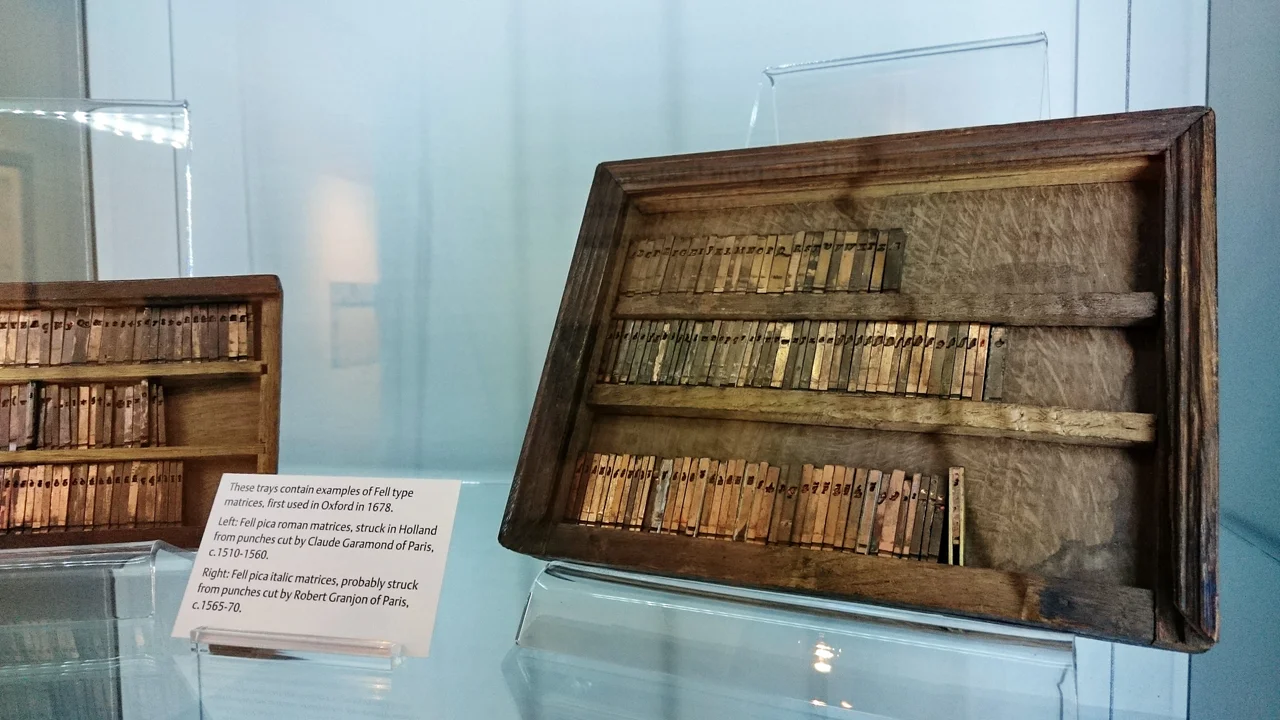
After the English Civil War, Vice-Chancellor John Fell - Dean of Christ Church, Bishop of Oxford - decided Oxford needed a proper press of its own. In 1668 he installed printing machinery and drew up the first formal publishing programme: hundreds of works, including the Bible in Greek, editions of the Coptic Gospels, texts in Arabic and Syriac, comprehensive editions of classical philosophy, mathematics, medieval scholarship, and, in a line that captures the man's appetite, 'a history of insects, more perfect than any yet Extant.' Fell also imported type matrices from the Netherlands. The metal punches he collected, now known as the Fell Types, are still on display in the OUP Museum on Great Clarendon Street. The Oxford Almanack, which he started printing as an annual broadsheet calendar in 1674, ran without interruption until 2019 - three hundred and forty-five years of unbroken publication.
The Walton Street Building
In 1825 the Delegates of the Press bought land on Walton Street, a long road that runs north from Oxford's centre into Jericho. Daniel Robertson and Edward Blore designed a building in the restrained classical manner the nineteenth century reserved for institutions of learning. The Press moved in five years later. Almost two centuries on, that same building, at the corner of Walton Street and Great Clarendon Street, is still OUP's principal office. Opposite, on the other side of the road, sits Somerville College - one of the women's colleges of Oxford, where Dorothy L. Sayers studied modern languages and Margaret Thatcher read chemistry. Walk down Walton Street on a weekday and you will see editors, typesetters, and the modern equivalents of both, going in and out of doors that have not moved in one hundred and ninety-five years.
Alice and the Flawed First Edition
In 1865 Charles Lutwidge Dodgson, an Oxford mathematics don who published under the name Lewis Carroll, paid the Press to print Alice's Adventures in Wonderland. The first edition came out flawed - the illustrations printed poorly, and Dodgson was so unhappy that he recalled and reprinted the entire run. The botched first edition was sold to America, where it survives in collections; a copy went at auction in 2016 for $2 million. The Press has handled stranger projects since. Friedrich Max Müller's Sacred Books of the East, fifty volumes of translations bringing Eastern religious texts to Western readers, was approved in 1875. James Clerk Maxwell's Treatise on Electricity and Magnetism, the foundation of modern electromagnetic theory, was published in 1873; Einstein later said his own work would have been impossible without it. The OUP Museum still keeps a nineteenth-century printing press in working condition. Visits must be booked in advance.
What a Press Is For
OUP publishes more than five hundred academic journals on behalf of learned societies around the world. It pioneered open-access scholarly publishing with Nucleic Acids Research and the Oxford Open model. It produces dictionaries - the OED, the Concise, the Shorter, the Oxford Advanced Learner's Dictionary used by English students in eighty countries. It publishes the Very Short Introductions series, with more than seven hundred titles taking on subjects from Augustine to climate change in two hundred concise pages each. The Press is owned wholly by the university - has been since 1884 - and it has been wholly tax-exempt in the United Kingdom since 1978, on grounds that its work serves the public benefit. That status has been challenged repeatedly, most fiercely by commercial publishers who compete with it for school textbook contracts. The argument runs hot. The Press keeps publishing.
From the Air
Oxford University Press sits at 51.76°N, 1.27°W, on Walton Street in the Jericho neighbourhood of Oxford, north-west of the city centre. From altitude, look for Oxford's distinctive cluster of college quadrangles and church spires - 'the city of dreaming spires' that Matthew Arnold named - with the Press buildings sitting in a low brick complex about half a mile north-west of the centre. The Radcliffe Camera dome and the spire of the University Church of St Mary the Virgin are the most prominent landmarks for orientation. Oxford lies in the upper Thames Valley, with the river curving south of the city. Nearest airports: London Heathrow (EGLL) 35 nautical miles south-east, Oxford Airport / Kidlington (EGTK) 5 nautical miles north, Booker / Wycombe Air Park (EGTB) 22 nautical miles south-east. Recommended viewing altitude is 2,500 to 4,000 feet AGL. Oxford traffic frequencies handle most local activity; expect general aviation in the area on most weekdays.
Nearby Stories
- St George's Chapel, Windsor Castle 7 km away
- RAF Honeybourne 7.8 km away
- Sulgrave Manor 8.9 km away
- Cotswolds 9 km away
- Chesham 9.4 km away
- Avebury 11 km away
- Donnington Castle 12 km away
- Ampthill Park 14 km away