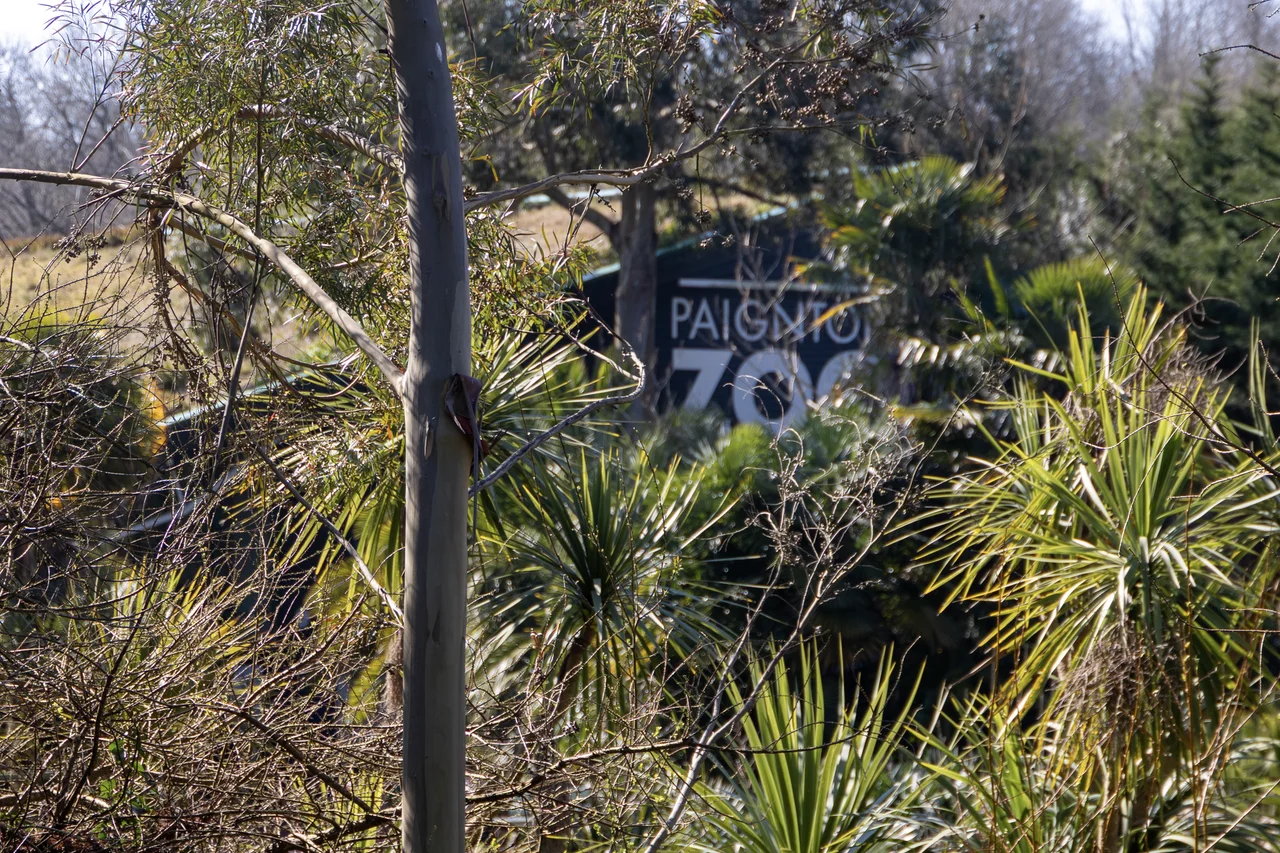

Paignton Zoo
In 1991, the wild population of the pink pigeon - a soft, peach-blushed bird endemic to a single island in the Indian Ocean - was thought to be as low as ten individuals. Just ten birds, all on Mauritius. In 2024, a bird keeper at Paignton Zoo named Tom Tooley hand-reared a pink pigeon chick using a technique he had invented himself: a catheter and a syringe instead of the conventional crop tube. The chick survived. Tooley flew to Mauritius repeatedly to teach the method to local staff. The pink pigeon is no longer about to vanish. Somewhere in this story is the answer to what a 21st-century zoo actually does. Paignton Zoo, perched on an 80-acre slope above Tor Bay in south Devon, has been doing this kind of work for a century.
Herbert Whitley's Private Menagerie
The zoo started as one man's obsession. Herbert Whitley was a wealthy English breeder living at Primley House above Paignton with the kind of fortune and stubbornness that allowed him to assemble whatever animals he liked. He had a particular love of exotic birds and rare plants. By 1923 his collection was substantial enough that he opened it to the public on 1 July of that year as Primley Zoological Gardens. Almost immediately he closed it again in protest at the Inland Revenue's amusement tax. He reopened in 1927 once he had paid up, then closed again in 1937 in another tax dispute. Whitley was an unusual founder - half horticulturist, half wildlife collector, fully eccentric - and the dual identity of the place as both zoo and botanical garden was set from the start. He cultivated his own mallow variety, Malva sylvestris Primley Blue, which still bears the estate's name.
A Wartime Zoo
When war was declared in 1939 the government ordered large entertainment venues closed, including Chessington Zoo. Chessington's manager Reginald Goddard struck a deal with Whitley to evacuate his animals down to Devon. Among the new arrivals was Peggy, daughter of the tigress Beauty who had appeared in the 1937 film Elephant Boy, along with a home-bred lioness and her four cubs. Primley reopened on 24 August 1940 as the Devon Zoo and Circus, complete with a miniature railway called the Jungle Express. Whitley had always preferred quieter exhibits, but the wartime audience wanted spectacle and Goddard provided it. The arrangement lasted until 1946, when Goddard took most of his animals back to Chessington. Whitley reorganized what remained as Paignton Zoo and Botanical Gardens. When he died in 1955 his estate - including the zoo and several Devon nature reserves like Slapton Ley - was placed in a trust that today operates as the Wild Planet Trust.
Plants for Animals, Animals for Plants
Walk around Paignton Zoo and you walk through 1,600 species of plant. The horticulture team grows magnolias and blossom trees for spring, hibiscus for the tropical houses, Japanese maples for autumn. They also grow food. Much of the planting is browse - cotoneaster, hazel, hawthorn, lacebark, sycamore - cultivated specifically to feed the gorillas, giraffes, and bongo antelope. This is more efficient than trucking branches in from elsewhere and gives the animals natural foraging variety. In 2009 the zoo installed Europe's first VertiCrop vertical hydroponic growing system to produce browse. It is no longer running, but the experiment is the kind of thing Paignton has always done. The botanical collection itself has become a serious conservation tool. The zoo grows endangered paperbark maples, which struggle to produce viable seed in the wild. It cultivates critically endangered cacti in its desert house. In 2025 it donated specimens of titan arum - the giant, stinking corpse-flower - to Kew Gardens. The gardens won Gold in Britain in Bloom in 2024 and 2025.
Born Here, Saved Here
Paignton's animal collection holds 1,876 individuals across 189 species, including eleven that are critically endangered: Sumatran tigers, western lowland gorillas, Bornean orangutans, eastern mountain bongos, brown spider monkeys, red ruffed lemurs, Sulawesi crested macaques, and the Socorro dove which is extinct in the wild. The zoo manages international studbooks for several species and participates in dozens of European breeding programmes. In 2024 a Chilean flamingo chick was raised by a same-sex pair. A Socorro dove fledged. In 2025 the zoo achieved its first successful southern cassowary breeding since 2004 - the only cassowary born in Europe that year - after the careful introduction of 16-year-old Madrid to 11-year-old Twiggy. A Diana monkey with an ovarian tumour gave birth to a healthy infant in April. A king colobus monkey arrived in October after a four-year international hunt for a suitable male. In November 2025 maned wolf pups Tolock and Lua became parents. None of this is glamour. It is patient, technical, expensive work done by people who often spend years preparing for a single birth.
Centenary, Crisis, New Owner
The zoo celebrated its centenary in 2023 with the GloWild winter light installation. But the 2020s have been hard. COVID closed the zoo in 2020. An avian influenza outbreak forced another closure during the 2022 summer holidays, costing the trust badly. A £1 million COVID loan still needed repaying. In October 2025 the Wild Planet Trust put Paignton and its sister Newquay Zoo up for sale. In December 2025 the Dutch leisure company Libéma announced its purchase of both, with plans to invest £10 million over the next two years. The trust said the new owner had committed to safeguarding the conservation work. The pink pigeon programme continues. The cassowary chick is growing. Tooley is still flying to Mauritius. The slope above Tor Bay is still full of plants and animals, and the small humans who watch over them are still doing the work.
From the Air
Coordinates 50.43 N, 3.58 W. Paignton Zoo sits about 1 nm inland from Paignton seafront, on the western slope above Clennon Gorge. Best viewed at 1,500-3,000 ft AGL - look for an 80-acre patch of mixed woodland and open paddocks just south-west of central Paignton, with the broad blue arc of Tor Bay to the east. Exeter Airport (EGTE) is 22 nm to the north-northeast. The lake and adjacent zoo trails are clearly visible from above.
Nearby Stories
- St Germans Priory 7.6 km away
- Launceston, Cornwall 9.6 km away
- Castle Drogo 12 km away
- HMS Formidable (1898) 17 km away
- Siege of Lyme Regis 19 km away
- Battle of Plymouth (1652) 40 km away
- German Submarine U-672 48 km away
- Goonhilly Satellite Earth Station 69 km away