
Palace of Aachen
For most of European history before 800, kings were itinerant. The court moved with the seasons, eating its way through the kingdom, because there was no efficient way to ship food long distances and a stationary court would have starved its own territory. Then Charlemagne, in his sixties, ageing and tired of war, simply decided to stop. After 806 he barely left Aachen at all. He picked the spot because it had hot springs his back needed, forests he could hunt in, and a location in the Carolingian heartland of Austrasia close enough to monitor the long Saxon war. He commissioned a palace from an architect named Odo of Metz, who designed a chapel so geometrically perfect, so encoded with sacred numbers from the Book of Revelation, that twelve centuries later it is still standing as the rotunda of Aachen Cathedral.
The Roman Bones Beneath
The Romans had been here first. They called the site Aquae Granni and built fifty acres of thermae over its thermal springs in the first century. The bathing complex stayed in use until the fourth century, when barbarian invasions destroyed the city. Clovis made Paris the Frankish capital, and Aachen's palace lay abandoned for centuries while a smaller restoration by the Pippinid mayors limped along. Around 765, Pepin the Short, Charlemagne's father, raised a new palace over the Roman foundations and restored the baths, stripping the pagan idols away. When Charlemagne came to power three years later, Aachen was already one of his favored residences. The geographic logic was good. It sat at a crossroads of ancient land routes, east of the Meuse, on a tributary of the Rur called the Wurm. The Roman engineers had chosen well for the same reasons the Carolingians did. Odo of Metz, when he drew his plan in the 790s, kept the Roman road grid, locked his 120-meter square to the lines that had been laid centuries before, and triangulated his new buildings to connect them to the surviving baths.
144 Cubits and the Heavenly Jerusalem
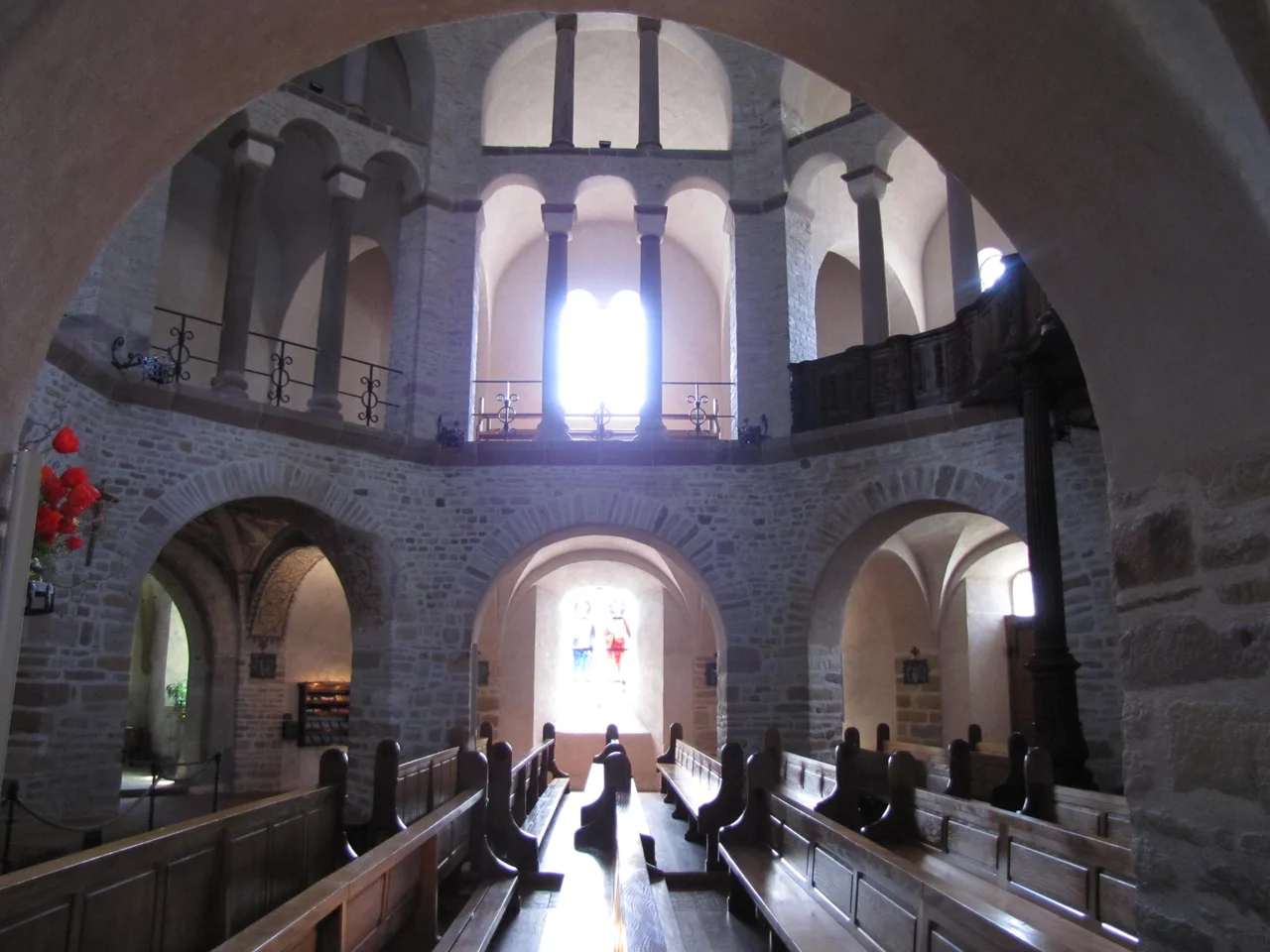
The Palatine Chapel, the part that has survived, is a sermon in stone. Odo of Metz was a cleric trained in the liberal arts, almost certainly familiar with Vitruvius, and he built Christian symbolism directly into the geometry of the dome. The octagonal cupola measures 144 Carolingian feet around its outer perimeter, which matches the 144 cubits the Book of Revelation gives as the measurement of the walls of the heavenly Jerusalem, the ideal city drawn by angels. The cupola mosaic, now hidden behind a nineteenth-century restoration, originally showed Christ in Majesty surrounded by the 24 Elders of the Apocalypse, the same Elders who stand before the throne in Revelation. Charlemagne's own throne, made of white marble plates, sat in the west of the second floor, raised on the seventh step of a platform. From there he could see three altars: the Savior directly in front of him, the Virgin Mary on the floor below, Saint Peter at the far western end. The whole chapel was conceived as a model of paradise, with the king sitting at its measured center.
Columns from Ravenna
The chapel was decorated with what would now be called architectural spoliation. Charlemagne wanted marble columns to support his arcades, and he wanted them quickly. The Pope gave him permission to take columns from buildings in Ravenna and Rome, the old imperial capitals of the West, and they were dragged across the Alps to Aachen. They are still there. Massive bronze doors were cast at a foundry near Aachen. The walls were covered with marble and polychrome stone. Eginhard, Charlemagne's biographer, wrote a description of the interior around 825 or 826 that still helps scholars understand what the chapel originally looked like. The aula regia, the council hall to the north, was 47.42 meters long, 20.76 meters wide, and 21 meters high, with a floor area of about 1,000 square meters, big enough to receive several hundred guests. It is now gone. The aula's foundations and lower walls survive inside the current Aachen Town Hall, and the first three stories of its square Granus Tower are still standing.
The City the Court Grew
When the court arrived, the city followed. Craftsmen and traders settled near the palace because that was where the money was. Charlemagne's advisors, including Eginhard and Angilbert, built houses for themselves in the new urban center. The chancellery employed scribes and notaries, mostly clergymen, who wrote the diplomas, capitularies, and royal correspondence that made the Carolingian Empire function as a state rather than a personal kingdom. The treasury accumulated gifts from foreign envoys and important visitors: precious books, weapons, clothing, the hard currency of medieval diplomacy. Charlemagne died here on 28 January 814. He was buried in the chapel he had built, where his bones still lie. The Holy Roman emperors who followed him would be crowned in the same building for the next six centuries, treating it as a relic in its own right. The palace as a whole did not survive. The chapel did, and the chapel, with its Carolingian feet and its 144 cubits and its columns from Ravenna, is enough.
From the Air
Coordinates 50.7756 N, 6.0839 E in central Aachen, North Rhine-Westphalia, Germany. Recommended viewing altitude 2,000 to 4,000 ft AGL for the cathedral complex and Town Hall. The octagonal Palatine Chapel dome at the heart of Aachen Cathedral is the dominant feature; the Town Hall sits to the north on the original aula regia site, with the surviving Granus Tower still visible. Nearest airports are Maastricht Aachen (EHBK / MST) about 25 km west and Cologne Bonn (EDDK / CGN) about 65 km northeast.
Nearby Stories
- Heinsberg-Lindern Railway 7.8 km away
- Baptismal font at St Bartholomew's Church, Liège 7.8 km away
- Federal Office for the Protection of the Constitution 16 km away
- Limburg (Belgium) 17 km away
- F.L.Y. 17 km away
- Marcinelle Mining Disaster 84 km away
- Fort Jeanne d'Arc 148 km away
- Marmoutier Abbey 202 km away