.jpg)
Palace of the Parliament
Forty thousand people lost their homes for it. Around three thousand Orthodox monks were driven from monasteries that were demolished, dynamited, or buried inside concrete bunkers to make room for it. Workers died building it, the official figure of 27 widely disbelieved by those who labored on the site, who speak of hundreds and sometimes thousands. It rises 84 meters above central Bucharest and sinks 92 meters into the earth, weighs about four million tonnes, contains 365,000 square meters of floor space and a thousand rooms. It is the heaviest building in the world, the largest civilian administrative building in the world, and the second-largest administrative building of any kind after the Pentagon. Romanians have spent thirty-five years figuring out how to feel about it.
The Earthquake That Gave Him a Pretext
On 4 March 1977, the Vrancea earthquake struck Bucharest with a magnitude of 7.4, killing more than 1,500 people and damaging much of the old city center. Nicolae Ceausescu, who six years earlier had returned from a state visit to North Korea deeply impressed by Pyongyang's monumental architecture and Kim Il Sung's mass adulation, used the earthquake as the justification for a systematization program he had already been planning. He wanted Bucharest remade in the socialist realist style, organized around a vast new civic axis terminating in the largest building anyone had ever seen. The architect competition was won by Anca Petrescu, who was 28 years old. She would lead a team of 700 architects across more than a decade of construction, beginning on 25 June 1984, with the dictator himself attending the inauguration of the work and frequently inspecting the site.
What Was Demolished
Approximately seven square kilometers of historic Bucharest were demolished to clear the site and the boulevard leading to it. This was about a fifth of the old city. The Uranus-Izvor neighborhood, with its 19th-century apartments and shops, was razed beginning in 1982. The 16th-century Mihai Voda Monastery was reduced and shifted on rollers nearly 300 meters; other monasteries were destroyed outright. Brancovenesc Hospital, built in the 1830s and one of the city's oldest, was demolished. The National Archives moved. Some 37 factories and workshops disappeared. About 40,000 people, the populations of entire urban districts, were forcibly relocated, mostly to standard concrete apartment blocks on the edges of the city. Old neighbors lost touch with each other. Family churches stopped existing. Some of the displaced never settled into their new lives. None of them, in any meaningful sense, were ever compensated for what they had lost.
The Workers and the Cost
Between 20,000 and 100,000 people worked on the building at any given time, in three shifts that included 5,000 Romanian Army soldiers and large numbers of so-called volunteers, many of them ordered to the site by their workplaces or their party cells. Some were prisoners. Some were political prisoners. Forced labor was an open feature of the project. The site was famously dangerous, with poor safety practices, demanding deadlines, and Ceausescu's personal pressure for speed. The official death toll given by the Communist government was 27. Workers and survivors who have spoken since the 1989 revolution put the number much higher, with some estimates running into the thousands. The truth is unrecoverable now. While the palace went up, Romania was suffering through one of the harshest austerity programs in modern Europe. Ceausescu had decided to pay off the country's foreign debt at any cost. Bread, meat, and electricity were rationed. Apartments went unheated through winters. Hospitals lacked basic supplies. The palace consumed materials and capital that the country could not spare.
The Materials of Romania
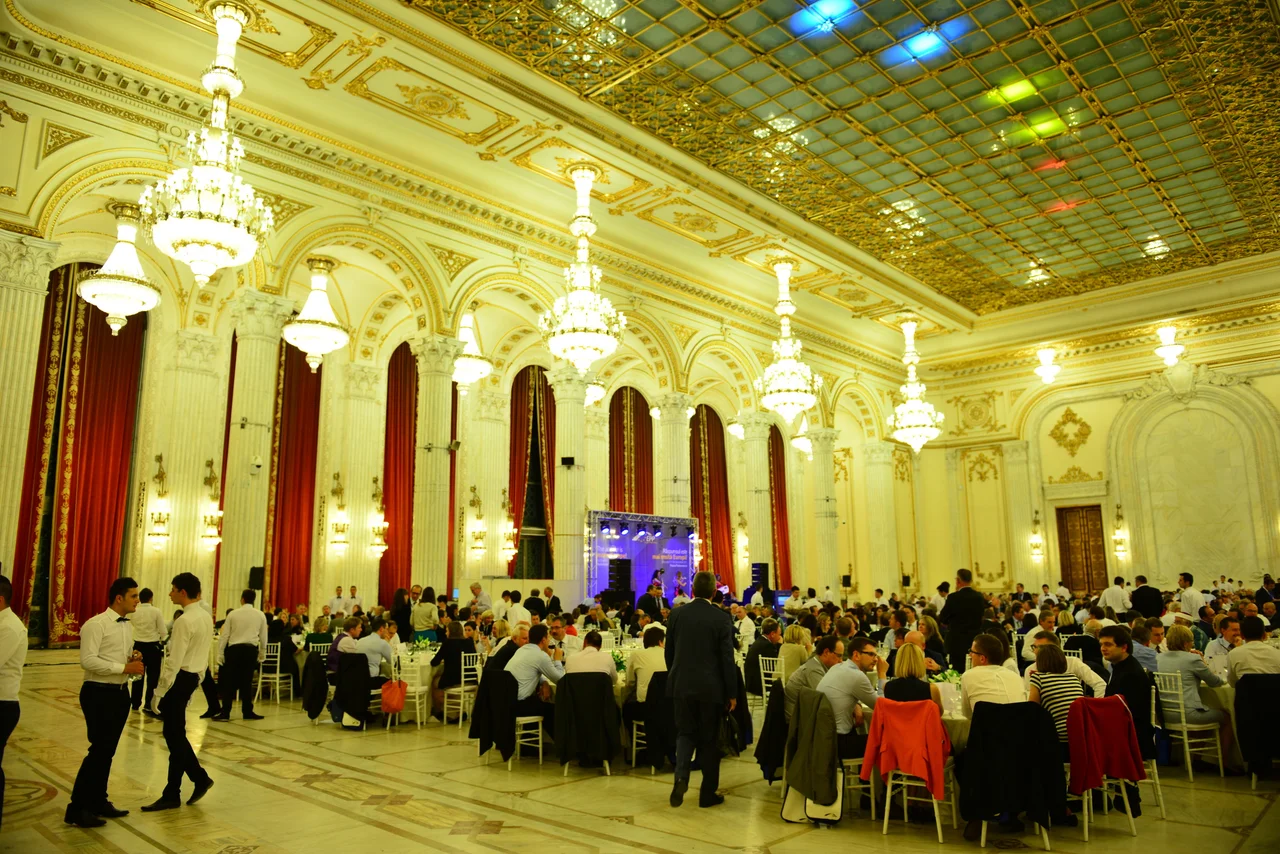
Almost everything in the palace is Romanian. The building used 1,000,000 cubic meters of marble, more than 95 percent of it domestic. There are 480 chandeliers using 3,500 tonnes of crystal, plus 1,409 ceiling lights and countless mirrors. Manufacturing the chandeliers alone took two years at the Vitrometan glass factory in Medias. There are 700,000 tonnes of steel and bronze in the doors, windows, capitals, and decorative ironwork. The parquet and wainscoting use Romanian walnut, oak, sweet cherry, elm, and sycamore maple. The 200,000 square meters of woolen carpets included some so large that the looms had to be reassembled inside the building because the finished pieces could not have been carried through the doors. The few exceptions to Romanian materials include the doors of Nicolae Balcescu Hall, a personal gift from Mobutu Sese Seko, the dictator of Zaire and one of Ceausescu's closer foreign friends.
What Romania Did With It
Ceausescu was executed on Christmas Day 1989, ten days after the revolution began. The palace was about 70 percent finished. Romania had to decide what to do with it. In 1990, Rupert Murdoch reportedly offered a billion dollars to buy it. The offer was rejected. Since 1994, the lower house of the Romanian Parliament, the Chamber of Deputies, has met inside; since 2004, the Senate as well. The west wing houses the National Museum of Contemporary Art, opened in 2004. The cost of just heating and electricity exceeds six million dollars a year. Tourists visit by the thousands; films like The Nun and War Dogs have used the interiors as the Vatican, as a corrupt official's mansion. The building keeps sinking, six millimeters every year, the ground compressing under its weight. Some Romanians point at it with wary pride: the largest, the heaviest, ours. Others can never look at it without seeing the demolished neighborhoods, the displaced families, the workers who never came home. Both feelings are legitimate. The palace makes room for both.
From the Air
The Palace of the Parliament rises at 44.4275 N, 26.0875 E atop Dealul Spirii in central Bucharest's Sector 5. From above, look for the unmistakable enormous white-marble mass at the western terminus of the 3.5 km Bulevardul Unirii axis, which runs east toward Piata Unirii; the Dambovita River curves north of the building. Bucharest Henri Coanda International (LROP) is 18 km north-northwest; Bucharest Baneasa (LRBS) is 11 km north. Recommended viewing altitude 1,000 to 2,500 ft AGL; controlled airspace is dense over central Bucharest with restrictions over government buildings.
Nearby Stories
- National Transport Museum, Bulgaria 34 km away
- Slanic Mine 68 km away
- Sinaia 79 km away
- Great Basilica, Pliska 87 km away
- Sinaia Monastery 108 km away
- Holy Forty Martyrs Church, Veliko Tarnovo 115 km away
- Shumen Fortress 126 km away
- Danube Delta 227 km away