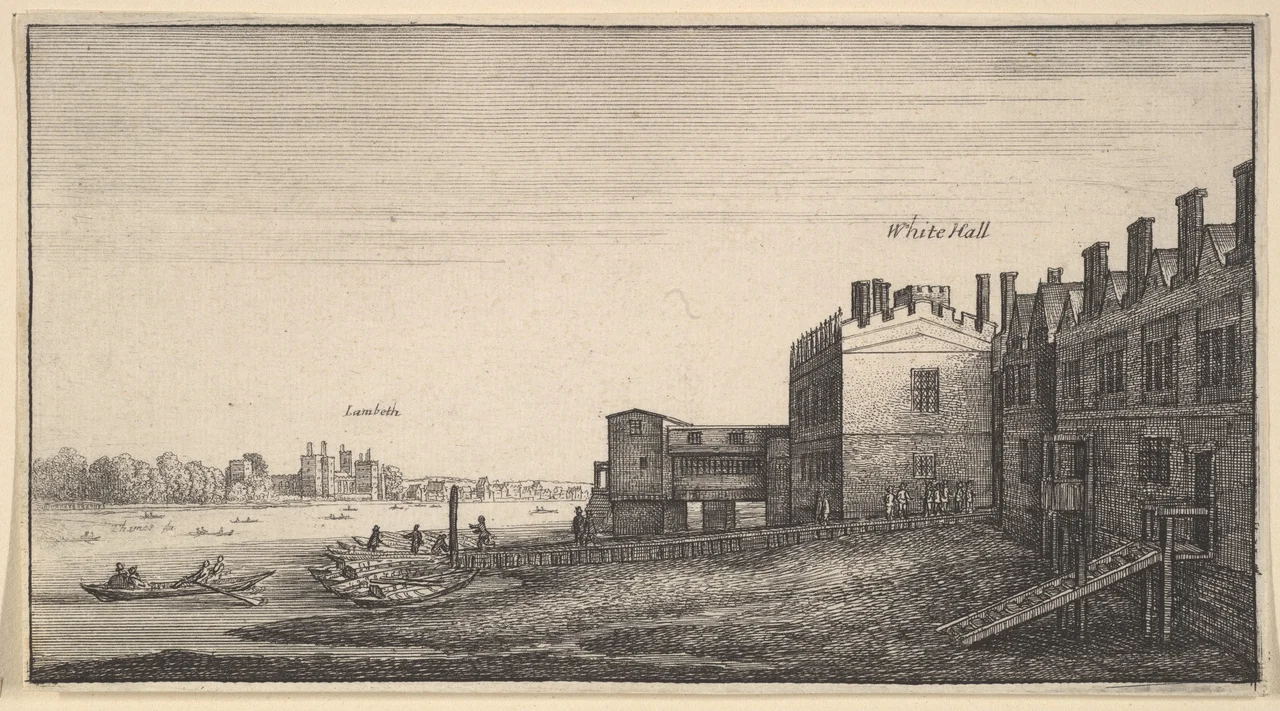

Palace of Whitehall
On 4 January 1698, a servant in an upper room of the Palace of Whitehall hung wet linen around a burning charcoal brazier to help it dry. The linen caught fire. The flames spread through the largest palace in Europe - more than 1,500 rooms, sprawling across 23 acres along the Thames - and raged for fifteen hours before they could be stopped. The next day the wind picked up and reignited the fire farther north. John Evelyn wrote in his diary on 5 January: "Whitehall burnt! nothing but walls and ruins left." Christopher Wren, ordered by William III to save what he could, focused his efforts on the architectural jewel of the complex - Inigo Jones's Banqueting House of 1622. The Banqueting House survived. Almost nothing else did.
From York Place to Royal Residence
The palace had begun centuries earlier as York Place, the London residence of the Archbishops of York. Walter de Grey bought the property soon after 1240 and expanded it. Edward I stayed there while work continued at Westminster. By the time Cardinal Wolsey took it over in the early sixteenth century, he had built it up to rival Lambeth Palace as the greatest house in the capital. In 1530 Henry VIII removed Wolsey from power and took York Place as his own - inspecting his new possession, the chroniclers note, in the company of Anne Boleyn. The old royal apartments at the Palace of Westminster had been gutted by fire in 1512, and Henry now needed a new principal residence. He gave the building a Tudor king's full attention. The Flemish artist Anton van den Wyngaerde was hired to redesign it. Henry added a bowling green, an indoor real tennis court, a cockfighting pit, and a tiltyard for jousting - now the site of Horse Guards Parade. More than £30,000 was spent during the 1540s alone, half as much again as the entire cost of Bridewell Palace.
Where Tudors Married, Lived, Died
Henry VIII married two of his wives here: Anne Boleyn in 1533 and Jane Seymour in 1536. He died in the palace in January 1547. The body of Elizabeth I was brought up the Thames by barge from Richmond in March 1603 to lie in state. The hall hosted, in 1611, the first known performance of Shakespeare's The Tempest. In February 1613 Princess Elizabeth married Frederick V of the Palatinate here. James I's secretary William Fowler composed Latin verses for a sundial in the garden. John de Critz painted the king's withdrawing chamber with a scheme of the four winds, the four corners of the earth, and the four elements - linked to a wind dial on the wall that responded to a weather vane on the roof. The forty-room lodgings James gave to his favourite Robert Carr included a picture gallery converted from a bowling alley. In 1622 James commissioned Inigo Jones to build a new Banqueting House. Peter Paul Rubens painted its ceiling in 1634. Fifteen years later, on 30 January 1649, Charles I was executed on a scaffold built in front of that same building - walking out through a window of the room his father had commissioned, beneath a ceiling celebrating the divine right of kings.
The Largest Palace in Europe
By 1650 Whitehall was the largest complex of secular buildings in England. The 1,500 rooms had been built piecemeal over more than a century, in many styles and many sizes, so that the palace looked, contemporaries said, more like a small town than a single building. Courtiers were allowed to build onto their assigned lodgings. Stephen Fox, Charles II's Clerk of the Green Cloth, started with three rooms in the 1660s and ended up with a grand mansion - coach house, stables, river views - all inside the palace network. Charles II, like his father, died at Whitehall. James II ordered changes by Christopher Wren, including a Roman Catholic chapel completed in December 1686 during a period of intense anti-Catholic feeling. The chapel's ceiling was adorned with 8,132 pieces of gold leaf. Grinling Gibbons carved the enormous marble altarpiece. The chapel attracted both criticism and awe in equal measure. It would not last.
Two Fires and an Empty Skyline
The first fire came on 10 April 1691. It started in the apartment once used by the Duchess of Portsmouth and damaged the older palace structures, though the state apartments survived. Some historians have noted, perhaps darkly, that the burned-out sections gave the rest of the complex a greater cohesiveness. William and Mary, who never warmed to Whitehall, preferred Kensington Palace. When Mary II died of smallpox there at the end of 1694, her body was brought to Whitehall to lie in state on 24 January. The second fire came on 4 January 1698 - the wet linen, the charcoal brazier, the servant who left for fifteen minutes. The palace was gone by morning. The Banqueting House survived, ringed by smoking ruins. Some buildings in Scotland Yard and along the park escaped. The Holbein Gate stood until 1769, when it too was demolished. Among the works of art destroyed that night were Michelangelo's Cupid, Hans Holbein the Younger's iconic Whitehall Mural with its Portrait of Henry VIII, and Bernini's marble bust of Charles I. Christopher Wren drew up plans for a replacement palace. It was never built.
What Survived
Today the Banqueting House is the only complete building of the old palace still standing on Whitehall, restored but recognisable. Other fragments are buried in the modern buildings around it. A tower from the covered tennis courts Henry VIII built is incorporated into the Old Treasury and Cabinet Office at 70 Whitehall. Most remarkable is Henry VIII's Wine Cellar, a Tudor brick-vaulted undercroft from Wolsey's Great Chamber, some 70 feet long and 30 feet wide. When the new Ministry of Defence building was constructed beginning in 1938, the cellar was directly in the way of both the new building and the planned route of Horse Guards Avenue. Following a request from Queen Mary in 1938 and a promise made in Parliament, the cellar was encased in steel and concrete and physically moved - nine feet to the west and nearly nineteen feet deeper - in 1949, when post-war construction resumed. It now sits in the basement of the Ministry of Defence, intact, the foundation of a vanished palace held inside the foundation of a working ministry. The street outside is still called Whitehall. The British government still gathers here. The palace is gone. The address remains.
From the Air
The site of the Palace of Whitehall is at 51.5044N, 0.1256W, along the modern street called Whitehall between Trafalgar Square and the Palace of Westminster. The Banqueting House - the only surviving building of the original palace - is the chief landmark. Recommended viewing altitude is 1,500-2,500 feet AGL to take in the full extent of the old palace footprint, from Northumberland Avenue south to Derby Gate and from Horse Guards Road east to Victoria Embankment. The Ministry of Defence Main Building, which contains Henry VIII's Wine Cellar, occupies the eastern portion. Central London Class A airspace covers the entire area. Nearest airport is London City (EGLC) approximately 6 nm east; Heathrow (EGLL) lies about 14 nm west.
Nearby Stories
- Stevenage 5.7 km away
- Malling Abbey 5.7 km away
- 1952 Farnborough Airshow Crash 7.7 km away
- Ingatestone Hall 8.2 km away
- Hellfire Caves 9.1 km away
- The Carrington Event: The Solar Storm That Could Happen Again 9.8 km away
- Bletchley Park 16 km away
- Castle Hedingham 23 km away