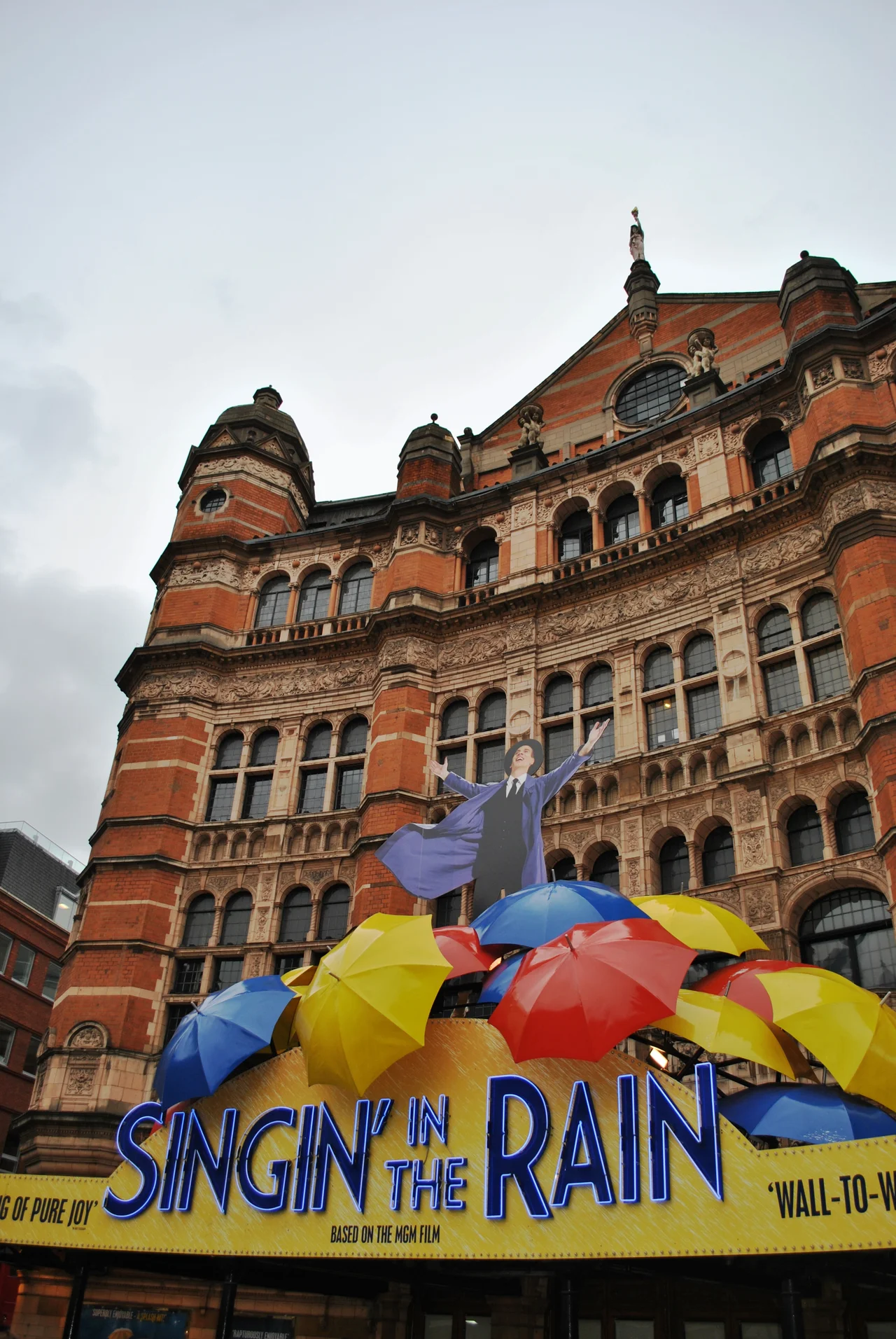

Palace Theatre, London
When Andrew Lloyd Webber bought the Palace Theatre in 1983 for £1.3 million, the first thing he did was take down the huge neon sign that had defaced the terracotta facade for decades. "Much to the chagrin of West End producers," he later remembered, "who told me I had removed the greatest theatre advertising sight in London." The producers had a point. By then the Palace had been a London landmark for almost a century - a vast red-brick mass at Cambridge Circus whose corner site, opposite the Shaftesbury Theatre, made it visible from half of Theatreland. But Lloyd Webber had a longer view. Underneath the neon was a Grade II* listed Victorian theatre that had hosted Anna Pavlova, premiered the first British wildlife film, presented Britain's first Royal Variety Performance, and would, eventually, become home to a global theatrical phenomenon about a boy wizard.
Tableaux Vivants and the First Wildlife Film
The Palace's first decades were defined by a peculiar Victorian compromise. When the London County Council denied the theatre permission to build a promenade - then a popular feature at the Empire and Alhambra, where adult entertainment thrived - the Palace responded with tableaux vivants. These featured women in flesh-coloured body stockings, posing in classical scenes and reassuring nervous Victorian audiences that what looked like nude bodies actually were not. In March 1897 the theatre began screening films from the American Biograph Company, pioneering the 70mm format that filled the proscenium arch with a sharp, large image. The screenings included early newsreels from around the world - some shot by film pioneer William Kennedy Laurie Dickson, including footage of the Boer War in 1900. In 1907 Oliver G. Pike premiered In Birdland here, the first British wildlife film ever shown to a paying audience. On 26 February 1909, the public saw Kinemacolor for the first time in a programme of twenty-one short colour films. The Palace was, briefly, the most technologically adventurous theatre in London.
Pavlova, Chevalier, and Royal Variety
When Alfred Butt took over as manager in 1904, he reshaped the theatre as a destination for star turns. The dancer Maud Allan created a sensation with her Vision of Salome. Anna Pavlova performed here. Margaret Cooper, an elegant pianist-singer, drew sophisticated crowds. The musical director Herman Finck composed dances for the resident company of Palace Girls and made many recordings with the theatre's orchestra. In 1911 the Palace Girls performed a song-and-dance number called Tonight that broke out as a popular romantic instrumental piece called In The Shadows. The name of the building was finally formalised as The Palace Theatre that same year. In 1912 the theatre hosted the first Royal Variety Performance in Britain, commanded by King George V and produced by Butt. During the First World War the Palace presented revues, and Maurice Chevalier became known to British audiences from this stage. The building had a knack for catching new talent at the moment audiences were ready for it.
Marx Brothers, Astaire, and the Threat of Demolition
On 11 March 1925 the musical comedy No, No, Nanette opened at the Palace starring Binnie Hale and George Grossmith Jr. Its 665-performance run made it the third longest-running West End musical of the decade. The Marx Brothers appeared in 1931, performing selections from their Broadway shows. Fred Astaire took his final stage musical bow here in Gay Divorce in 1933. Twice in the early 1930s the building was threatened with demolition - offers of £400,000 and £450,000 came in for the site, one from an American chain that wanted to build a department store. C. B. Cochran, who led the board, refused to sell. After the war the Palace settled into a long career as a musical house. Song of Norway ran 525 performances in 1946. Where's Charley? followed in 1958, then Flower Drum Song. Laurence Olivier transferred to the Palace in The Entertainer in 1957. Cabaret ran in 1968. The Danny La Rue revue Danny at the Palace ran for 811 performances starting in 1970.
Two Records: Superstar and Les Mis
Two extraordinary runs defined the Palace in the final third of the twentieth century. Jesus Christ Superstar opened in 1972 and ran for 3,358 performances, finally closing in 1980. Five years later, on 4 December 1985, Les Misérables moved into the theatre from the Barbican Centre. It would play the Palace for nineteen years, only leaving in April 2004 to continue its record-setting run at the Queen's Theatre (now the Sondheim) so that the Palace could be refurbished. Andrew Lloyd Webber bought the building in 1983 and began restoring it. He took down the neon. He restored the terracotta. When Les Misérables left in 2004, Lloyd Webber set about refurbishing the auditorium and front of house - removing the paint that had been brushed over the original onyx and Italian marble in earlier decades. The building was Grade II* listed: a working theatre that also had to be treated, increasingly, as a heritage site. In April 2012 the Really Useful Group sold the Palace to Nimax Theatres, who had bought four other theatres from Lloyd Webber back in 2005.
The Boy Who Came Back
On 7 June 2016 Harry Potter and the Cursed Child began previews at the Palace - a two-part play written by Jack Thorne from an original story by Thorne, J. K. Rowling, and John Tiffany. It opened officially on 30 July. The production was suspended in March 2020 because of the COVID-19 pandemic and reopened on 14 October 2021 after a nineteen-month break - one of the longest dark periods in the Palace's history. In August 2024 a double-decker bus crashed into the canopy on the side of the building; there were no injuries, and performances continued. The Palace today is the London anchor of one of the most successful theatrical franchises in the world, a stage that has hosted Pavlova and the Marx Brothers and Olivier and now does eight shows a week for audiences of children who arrived in this theatre as their first West End experience. Outside, the terracotta is clean. The neon is long gone. The corner of Cambridge Circus is still one of the busiest pedestrian intersections in central London, and the building still does what theatres on busy corners are supposed to do: it pulls people in.
From the Air
The Palace Theatre stands at 51.5132N, 0.1295W on Cambridge Circus, the intersection of Shaftesbury Avenue and Charing Cross Road in the West End. Recommended viewing altitude is 1,500-2,000 feet AGL for a clear view of the distinctive red-brick and terracotta facade. The Theatreland district is densely packed - the Shaftesbury, Noël Coward, and Phoenix theatres are within a few hundred yards. Central London Class A airspace covers the area, heavily restricted. Nearest airport is London City (EGLC) approximately 7 nm east; Heathrow (EGLL) lies about 13 nm west. Tottenham Court Road and Leicester Square tube stations are the nearest landmarks.
Nearby Stories
- Stevenage 5.7 km away
- Malling Abbey 5.7 km away
- 1952 Farnborough Airshow Crash 7.7 km away
- Ingatestone Hall 8.2 km away
- Hellfire Caves 9.1 km away
- The Carrington Event: The Solar Storm That Could Happen Again 9.8 km away
- Bletchley Park 16 km away
- Castle Hedingham 23 km away