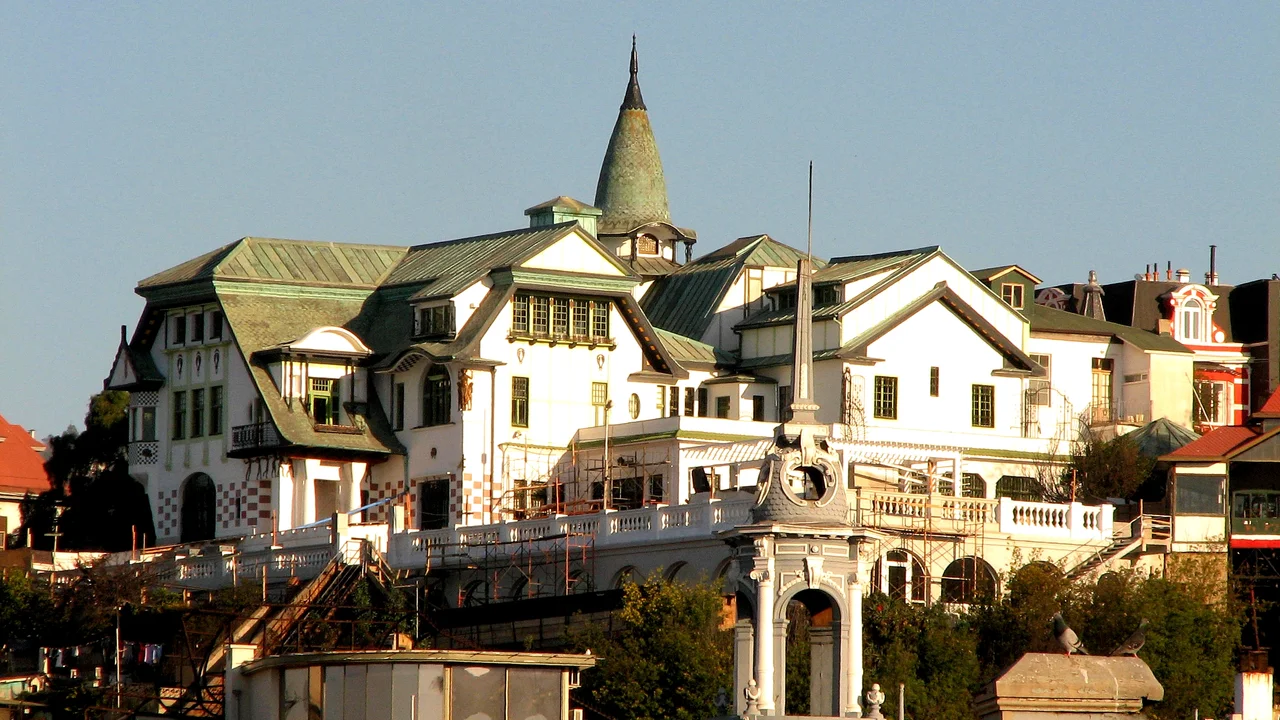

Palacio Baburizza
Pasko Baburica left a speck of an island in the Adriatic when he was seventeen and crossed the world to a desert. Born on Koločep, off the Dalmatian coast, in 1875, he sailed for Chile in 1892 and went to work in the nitrate fields around Iquique, where saltpeter mined from the driest desert on Earth was fertilizing the farms of Europe. He made a fortune in that white dust. In 1925 he bought a lavish Art Nouveau chalet perched on Cerro Alegre, one of Valparaíso's painted hills, and the building has carried his Hispanicized name ever since: the Palacio Baburizza.
A House Built for Another Man
Baburizza did not commission the palace; he inherited it by purchase. The mansion was built in 1916 for Ottorino Zanelli, an Italian immigrant who had grown rich in the food trade and belonged to one of Valparaíso's leading merchant families. He hired the Italian architects Arnaldo Barison and Renato Schiavon, who set the house into the steep slope of Cerro Alegre and crowned it with a turret. The result is an eclectic confection: balconies and bow windows, terraces and attics, a facade alive with curves and ornament. The hill itself was the kind of place a wealthy immigrant chose in this era, high above the working port, reached by funicular, with the whole bay spread out below.
The Saltpeter Magnate
The fortune that filled this house came from one of the strangest economies in history. For decades Chile held a near-monopoly on natural sodium nitrate, scraped from the Atacama and shipped through ports like Iquique and Valparaíso to fertilize distant fields and feed the munitions industries of a warring world. Baburizza built his wealth buying and selling that nitrate, expanding his holdings until the saltpeter crisis of 1928 shook the entire trade. He was, by all accounts, a man who remembered where his good fortune had come from, and he turned much of it toward philanthropy in the country that had taken him in as a poor young immigrant.
A Gift of Paintings
Baburizza spent his money on canvases as well as causes. Traveling through Europe, he assembled a substantial collection of paintings, and on his death in 1941 he bequeathed it to Valparaíso, the adopted city that had made him rich. In 1971 the municipality bought the palace itself and turned it into the Museo Municipal de Bellas Artes, the city's fine arts museum and a school of art. Its walls now hold works by painters bound up with Chile's own story, among them the German-born traveler Mauricio Rugendas, who painted the young republic, alongside Alfredo Valenzuela Puelma, Alfredo Helsby, and Carlos Hermosilla Álvarez. In 1979 the building was declared a historic monument.
Inside the Turreted Chalet
The interior matches the drama of the exterior. A carved wooden door sheathed in copper greets visitors, and the dining room centers on a Renaissance-style fireplace cut from marble and worked with embossed medallions and braided ornament, hung above with a fine linen tapestry from the eighteenth century. The museum closed for a long restoration in 1997 and reopened in 2011, its woodwork and wrought iron carefully revived. The palace has even had its share of fleeting fame, appearing as a backdrop on international television including The Amazing Race, a small modern footnote for a house that has watched over the bay for more than a century.
Crown of Cerro Alegre
The palace's setting is half its charm. Cerro Alegre, the Cheerful Hill, was historically home to the city's British and German merchant families, who built fine houses high above the noise and risk of the docks. Today the hill is one of Valparaíso's most beloved corners, its steep, narrow alleys famous for their murals and mosaic stairways, its slopes reached by the antique funiculars that the city has run since the 1880s. Standing on the terrace of the Palacio Baburizza, you look out over a tumble of brightly painted rooftops to the harbor below, exactly the view a homesick immigrant from a small Adriatic island chose to spend his fortune on. The house and its hill remain inseparable.
From the Air
The Palacio Baburizza stands at 33.040°S, 71.629°W, on Cerro Alegre, one of the hills that climb steeply behind Valparaíso's historic quarter. From the air, look for it among the dense, brightly colored rooftops on the slope just inland and uphill from Plaza Sotomayor and the working port; the building's turret and its position on the hillside terrace help distinguish it. Nearest is Viña del Mar Airport (SCVM), a Chilean Navy base about 16 km north with infrequent civilian use, and the small Rodelillo field (SCRD) above the city to the southeast. Santiago's Comodoro Arturo Merino Benítez International (SCEL) lies roughly 110 km east beyond the coastal range and is the main gateway. A viewing altitude of 1,500 to 3,000 feet AGL best reveals the tiered hillside neighborhoods; mornings often bring a coastal marine layer that clears toward midday.
Nearby Stories
- Battle of Papudo 24 km away
- Casa de Isla Negra 28 km away
- Battle of Chacabuco 31 km away
- Battle of Maipú 38 km away
- Aconcagua 94 km away
- Constitución, Chile 237 km away
- Santa Olga 278 km away
- 1687 Peru Earthquake 1982 km away