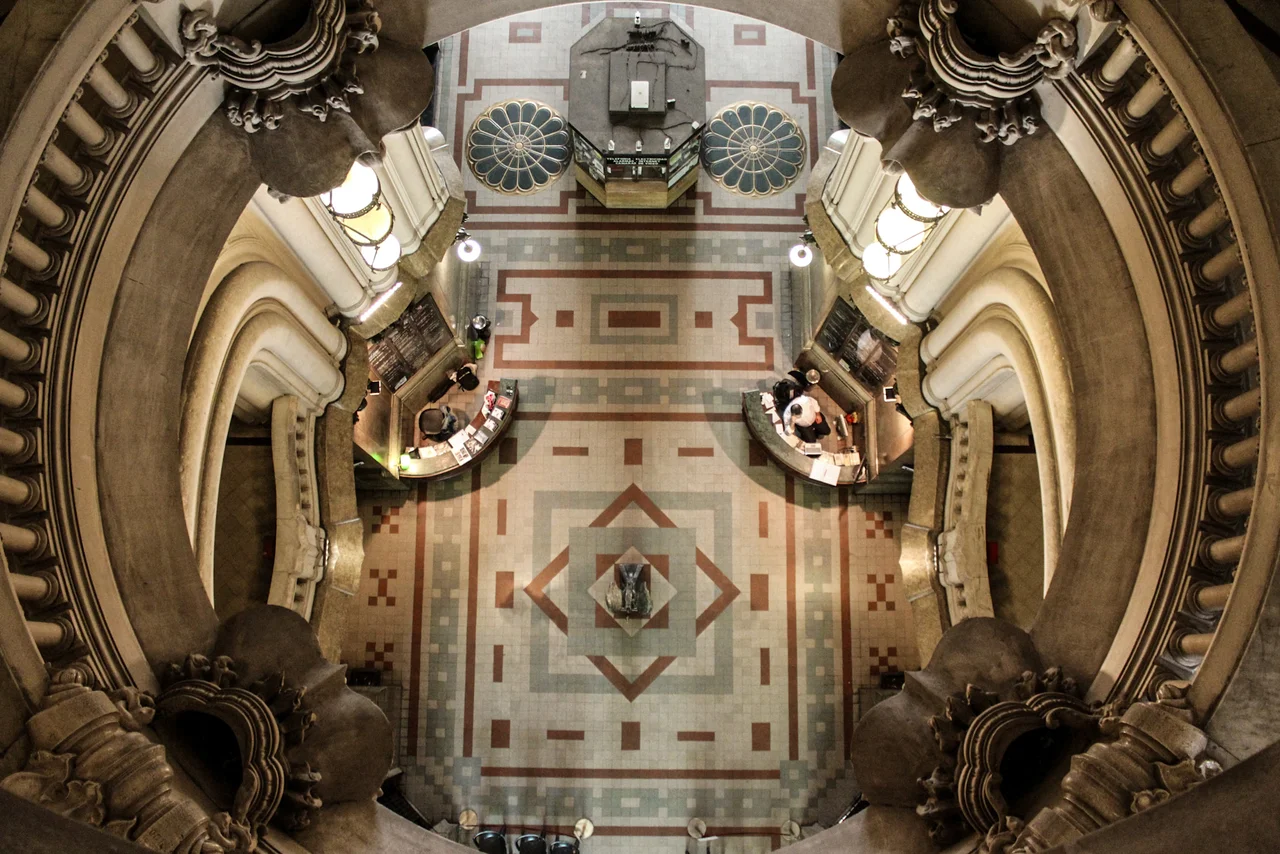

Palacio Barolo
An Italian textile magnate, convinced that Europe was sliding toward ruin, decided to build a refuge for the bones of Dante on the far side of the world. That is the legend behind the Palacio Barolo, and whether or not the poet's ashes were ever truly meant to arrive, the building that resulted is one of the strangest skyscrapers ever raised. Standing on Avenida de Mayo in the Monserrat barrio, it is not merely decorated with references to the Divine Comedy. It is the Divine Comedy, rendered in stone and steel: a tower you can read like a poem, from the inferno of its lobby to the paradise of its beacon.
A Poem You Can Climb
The architect was Mario Palanti, an Italian who shared his client's devotion to Dante Alighieri, and he built the structure to the exact proportions of the text. The Palacio Barolo rises 100 meters, one meter for each of the hundred cantos of the Divine Comedy. Its 22 floors divide into three realms: the basement and ground floor are hell, floors one through fourteen are purgatory, and fifteen through twenty-two are heaven. The lobby radiates from a central dome through nine vaulted archways, the nine circles of the Inferno, lined with Latin inscriptions and monstrous carved figures. On the lower floors, geometric reliefs nod to alchemical fire, the green-white-red of the Italian flag, and Masonic symbolism. Even the foundations were laid out to the golden ratio. Few buildings have ever been so completely an idea made physical.
The Refuge for Dante's Ashes
Luis Barolo was an immigrant who reached Argentina in 1890 and grew rich in knitted fabrics, and he carried with him a particular dread about the Old World. He believed Europe was beginning to drift toward collapse, and he wanted Dante's remains carried as far from the continent as possible, safe in a tower at the bottom of the Americas. The poet's ashes never made the journey, but the conviction shaped everything. Palanti was designing a near-identical sibling at the same time across the river in Montevideo, the Palacio Salvo, the two towers conceived as a matched pair. When the Barolo opened in 1923 it was the tallest building not only in Buenos Aires but in all of South America, and it held that title until the Kavanagh Building overtook it in 1935.
A Lighthouse Across the River
Crown the building and you reach its most ambitious flourish. At the summit sits a powerful rotating beacon, bright enough to be seen across the Río de la Plata in Montevideo, more than two hundred kilometers away. In Dante's scheme it represents the nine choirs of angels and the divine light at the end of the pilgrim's ascent. But Palanti intended something grander still. The beam from the Barolo and the beam from its twin, the Salvo, were meant to arc toward each other across the estuary, a pair of welcoming pillars greeting travelers arriving from the Atlantic, an echo of the Pillars of Hercules. Through some miscalculation, the two beams never quite met over the water. The gesture failed, but the ambition behind it tells you everything about the men who dreamed this place.
Aligned With the Southern Sky
The tower keeps one final secret for a single night each year. A small ornamental spire at the very top is shaped to evoke the Southern Cross, the constellation that wheels over the southern hemisphere, and it is set so that it aligns with the actual stars of the Cross on the ninth of July, Argentine Independence Day. Today the building has shed its mythic ambitions and filled with ordinary working life: lawyers' offices, a Spanish-language school for foreigners, a shop selling tango clothes, the studios of architects and designers. Declared a national historic monument in 1997, it still runs its original, gloriously antiquated elevators. Visitors climb through hell and purgatory to reach the beacon, and the city of Buenos Aires unfolds below them, exactly as Palanti meant it to.
From the Air
Palacio Barolo stands at 34.610 degrees south, 58.386 degrees west, on Avenida de Mayo in the Monserrat barrio, roughly midway between the Plaza de Mayo and the National Congress. From the air, look for its slender lighthouse-topped tower along the broad straight axis of Avenida de Mayo; the matching Palacio Salvo lies across the Río de la Plata in Montevideo, Uruguay. The nearest airport is Aeroparque Jorge Newbery (SABE), about 4 km north along the waterfront, with Ministro Pistarini International (SAEZ, Ezeiza) about 28 km southwest. The beacon historically projected toward the river estuary; best appreciated at low altitude in clear evening conditions when the tower's verticality stands out against the low colonial-era avenue around it.
Nearby Stories
- Ezeiza Massacre 1.9 km away
- Luján, Buenos Aires 5.1 km away
- Curutchet House 13 km away
- Colonia del Sacramento 17 km away
- Martín García Island 28 km away
- Atucha Nuclear Power Plant 37 km away
- Lobos 43 km away
- Cry of Asencio 87 km away