
Palacio de Aguas Corrientes
Look at it from the street and you would swear it housed royalty: a full city block of glittering glazed tile, a steep mansard roof, escutcheons and ornament crowding every surface in the manner of a French Renaissance chateau. Then you learn the truth, and the building becomes wonderful in an entirely different way. The Palacio de Aguas Corrientes is one of the most opulent structures in Buenos Aires, and behind its dazzling skin it was built to do something utterly unglamorous: hold the city's drinking water. This is a giant tank in a ballgown, the most beautiful piece of plumbing infrastructure you are ever likely to see.
A Palace That Was Really a Tank
Inaugurated in 1894 to occupy a whole block of the Balvanera district along Córdoba Avenue, the building was designed around twelve enormous water tanks stacked across three floors, with a combined capacity of 72,000 tons. Everything decorative was, in a sense, a disguise for that purpose. It replaced an earlier and frankly ugly water tower on Lorea Plaza, near where Congress now stands, and the planners decided that if a reservoir had to sit in the middle of the growing capital, it might as well be magnificent. The water tanks are long gone, dismantled in 1978, but the iron skeleton that once held all that weight remains, and the palace still functions in part as a working pumping station for the city it has served for well over a century.
Three Hundred Thousand Tiles From England
The skin is the spectacle. More than 300,000 glazed, multicolored terracotta tiles cover the exterior, every one of them manufactured by Royal Doulton in Britain and shipped across the Atlantic to be fitted into place. The supporting iron structure came from Belgium, and the whole composition rests on 180 columns, an international collaboration assembled into a single ornate whole. Set into the facade are escutcheons representing the fourteen Argentine provinces that existed at the time, so the building wears the map of its own country across its walls. The effect at street level is overwhelming, a riot of pattern and color that stops pedestrians mid-stride, most of whom never guess that all this finery was wrapped around millions of liters of water. The building belonged to a British-owned water company until Argentina nationalized that company in 1892 and the palace passed to the city, a small monument to the era when British capital and British craftsmanship built much of modern Buenos Aires.
The Memory of a City in Paper
The palace guards something less visible but just as remarkable: the archives of how Buenos Aires was built and watered. Established in 1873, these are the only records that hold complete information on the city's water and sanitation planning. One collection contains plumbing and fire-hydrant plans for some 320,000 lots, the oldest dating to 1889, an archive so vast it numbers in the millions of documents. Among them are the plans of buildings that no longer exist, demolished to carve out the great avenues, including the colossal 9 de Julio. There are records of nearly every structure ever connected to the water network, building by building, owner by owner. It is, in effect, the paper memory of an entire metropolis.
From Engineering to Legend
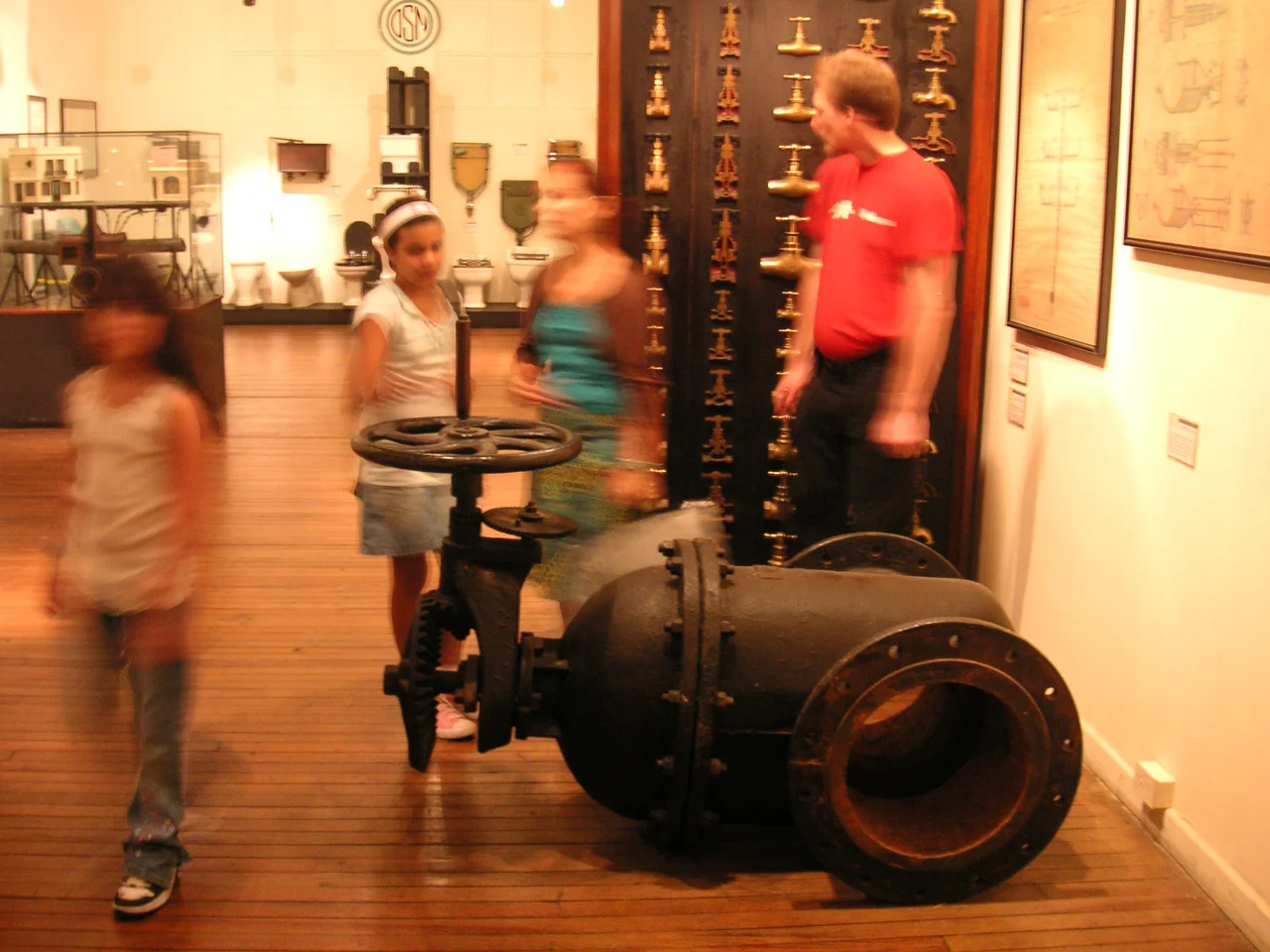
Today the building has settled into a quieter life. It houses offices of Agua y Saneamientos Argentinos, the company that now runs the city's water, alongside the historic archives and a small museum dedicated to the waterworks. Inside, visitors can see surviving pipes and the original ceramics, the inner workings of a system that once defined modern, sanitary Buenos Aires when clean water was still a hard-won achievement. The palace even reached into literature: it figures prominently in Tomás Eloy Martínez's celebrated novel Santa Evita, woven into one of Argentina's most haunting fictions about the wandering corpse of Eva Perón. A water tank that became a palace, and then became a legend.
From the Air
The Palacio de Aguas Corrientes occupies a full block at 34.601 degrees south, 58.395 degrees west, in the Balvanera barrio, fronting Córdoba Avenue between Riobamba and Ayacucho streets. From the air, look for a large rectangular building topped by a steep dark mansard roof, set within the dense grid of central Buenos Aires a short distance northwest of the National Congress. The nearest field is Aeroparque Jorge Newbery (SABE), roughly 4 km northeast on the Río de la Plata waterfront; Ministro Pistarini International (SAEZ, Ezeiza) lies about 28 km southwest. Best viewed at low altitude in clear light, when the ornate roofline and full-block footprint distinguish it from the surrounding apartment blocks.
Nearby Stories
- Ezeiza Massacre 1.9 km away
- Luján, Buenos Aires 5.1 km away
- Curutchet House 13 km away
- Colonia del Sacramento 17 km away
- Martín García Island 28 km away
- Atucha Nuclear Power Plant 37 km away
- Lobos 43 km away
- Cry of Asencio 87 km away