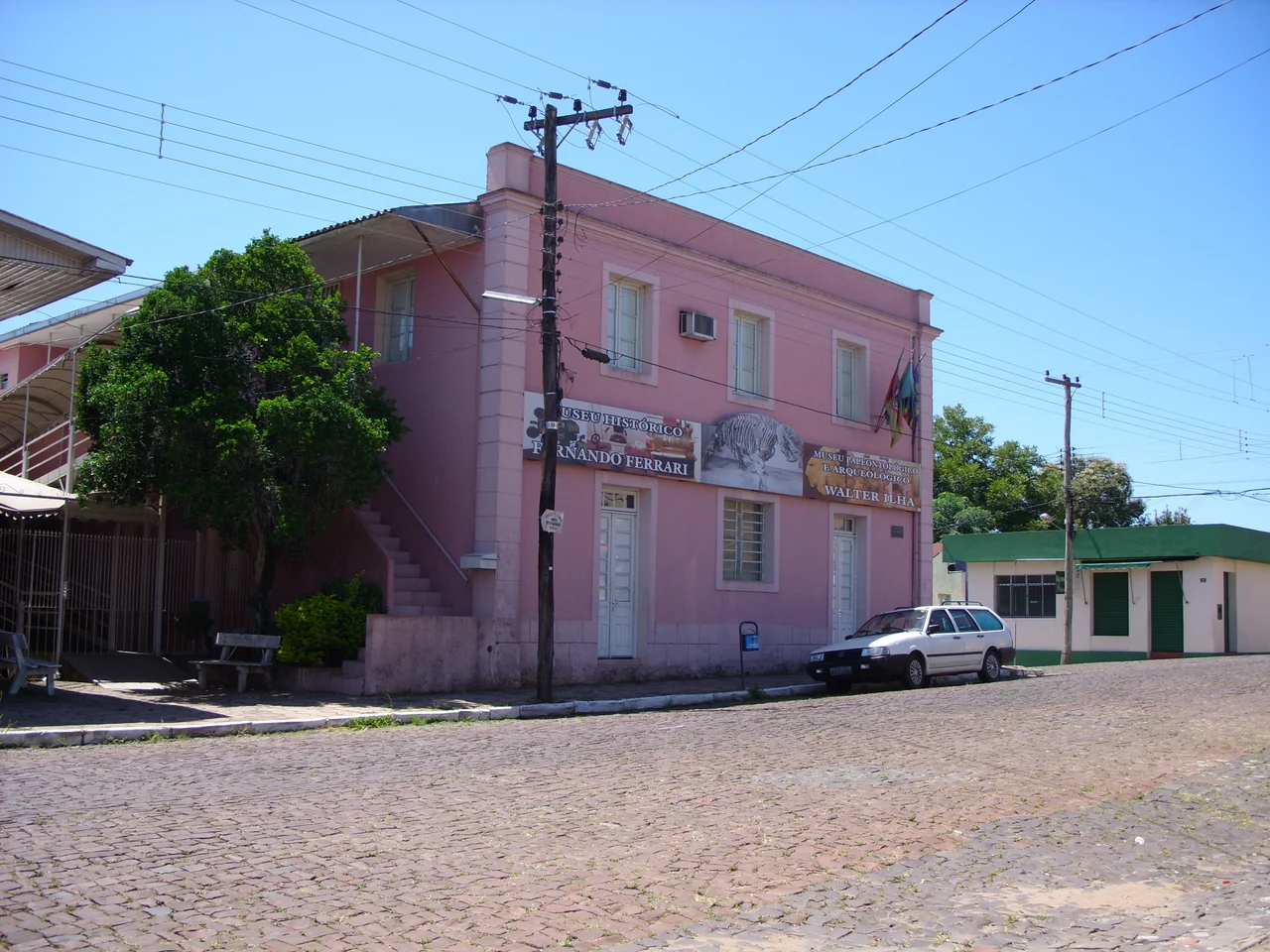

Paleontological and Archaeological Museum Walter Ilha
A printer with no formal scientific training spent his evenings chasing a question that most people never think to ask: what walked here before us? Walter Ilha lived in Sao Pedro do Sul, a quiet town in central Rio Grande do Sul, and the ground beneath it happens to hold the remains of a vanished world some 230 million years old. He read everything he could find, wrote to authorities, and began gathering fossils one specimen at a time. The museum that now bears his name grew out of that single-minded devotion, and it preserves creatures from a moment in deep time when the very first dinosaurs were beginning to stir.
When This Land Was Pangaea
The fossils in Sao Pedro do Sul date to the Triassic period, around 230 million years ago, when South America was not yet South America at all but part of the supercontinent Pangaea. This region sits within the Paleorrota, one of the richest fossil areas in Brazil, where ancient rock layers preserve the dawn of the age of reptiles. Among the bones recovered nearby are those of Prestosuchus, a fearsome deep-skulled predator that stalked these floodplains before true dinosaurs ruled, and the deposits have yielded some of the oldest dinosaur relatives known to science. The museum's collection spans plants and animals from that lost ecosystem, arranged to trace the long, branching story of life itself.
The Amateur Who Would Not Quit
Walter Ilha was a printer by trade and a scientist by passion, the kind of self-taught enthusiast who reshapes a field by sheer persistence. He consulted bibliographies and journals, contacted anyone who might help, and used every means he could find to raise public awareness of the fossil record around his town. His effort earned genuine respect: though an amateur, he was regularly invited to speak at scientific events and was accepted as a member of the Brazilian Paleontology Society. Working alongside the city's officials, he pushed for a place to house and protect what he was finding, convinced that these remains were a heritage worth saving rather than scattering.
A Dream That Outlived Its Dreamer
Ilha's persistence bore fruit on 28 September 1980, when the Paleontological Museum of Sao Pedro do Sul opened in a room beside the City Radio building, stocked with his own donated collection of fossils, minerals, and archaeological pieces. He did not live to see it grow. Walter Ilha died in September 1987, but his work had momentum of its own. That November, the museum was formally established by municipal law and renamed in his honor, a tribute to a man who had spent years insisting that the past mattered. The institution he started carried his name forward, ensuring his quiet labor would not be forgotten.
Where the First Dinosaurs Walked
Why does this quiet town matter to science at all? Because the rocks of the Paleorrota record one of the great turning points in life's history. In the Triassic, this floodplain teemed with strange beasts: mammal relatives, armored reptiles, and the predatory Prestosuchus that ruled before dinosaurs did. Crucially, the region also preserves some of the earliest dinosaurs and their close kin known anywhere, creatures like Staurikosaurus, among the oldest of their lineage. The town of Sao Pedro do Sul even rests on petrified forest deposits, conifer trunks turned to stone. The bones gathered here are not curiosities on a shelf; they are pages from the opening chapter of the dinosaur story, when the giants that would dominate the next 150 million years were just beginning.
From One Collection to Many
What began as a single person's gathering became a shared scientific resource. The museum's holdings, seeded by Ilha's own specimens of mineralogy, paleontology, and archaeology, have since been enriched by contributions from major Brazilian universities, including UFRGS, UFSM, and UNISINOS. Today it stands as an important repository for Triassic material from the surrounding Paleorrota and a destination for anyone curious about the deep history written into this corner of Rio Grande do Sul. It is a reminder that great collections do not always begin in great institutions. Sometimes they begin with one determined person, a stack of borrowed books, and the conviction that what lies beneath our feet is worth knowing.
From the Air
The Walter Ilha museum sits in Sao Pedro do Sul at roughly 29.64 degrees south, 54.28 degrees west, in the fossil-rich Paleorrota region of central Rio Grande do Sul, Brazil, along highway BR-287. From the air the surrounding country is gently rolling farmland and pasture cut by river valleys; the town itself is the main visual landmark. The nearest major airport is Santa Maria Airport (ICAO: SBSM) to the east. Farther afield, Rivera's binational airport (ICAO: SURV) lies to the southwest near the Uruguayan border, and Montevideo's Carrasco International (ICAO: SUMU) well to the south. Expect humid subtropical weather with generally good visibility over open terrain.
Nearby Stories
- Battle of Ituzaingó 40 km away
- Ruins of São Miguel das Missões 93 km away
- Santa Cruz do Sul 132 km away
- São Borja 137 km away
- João Goulart's House 155 km away
- Santana do Livramento 162 km away
- Passo Fundo 181 km away
- 2009 Brasil de Pelotas Bus Disaster 198 km away