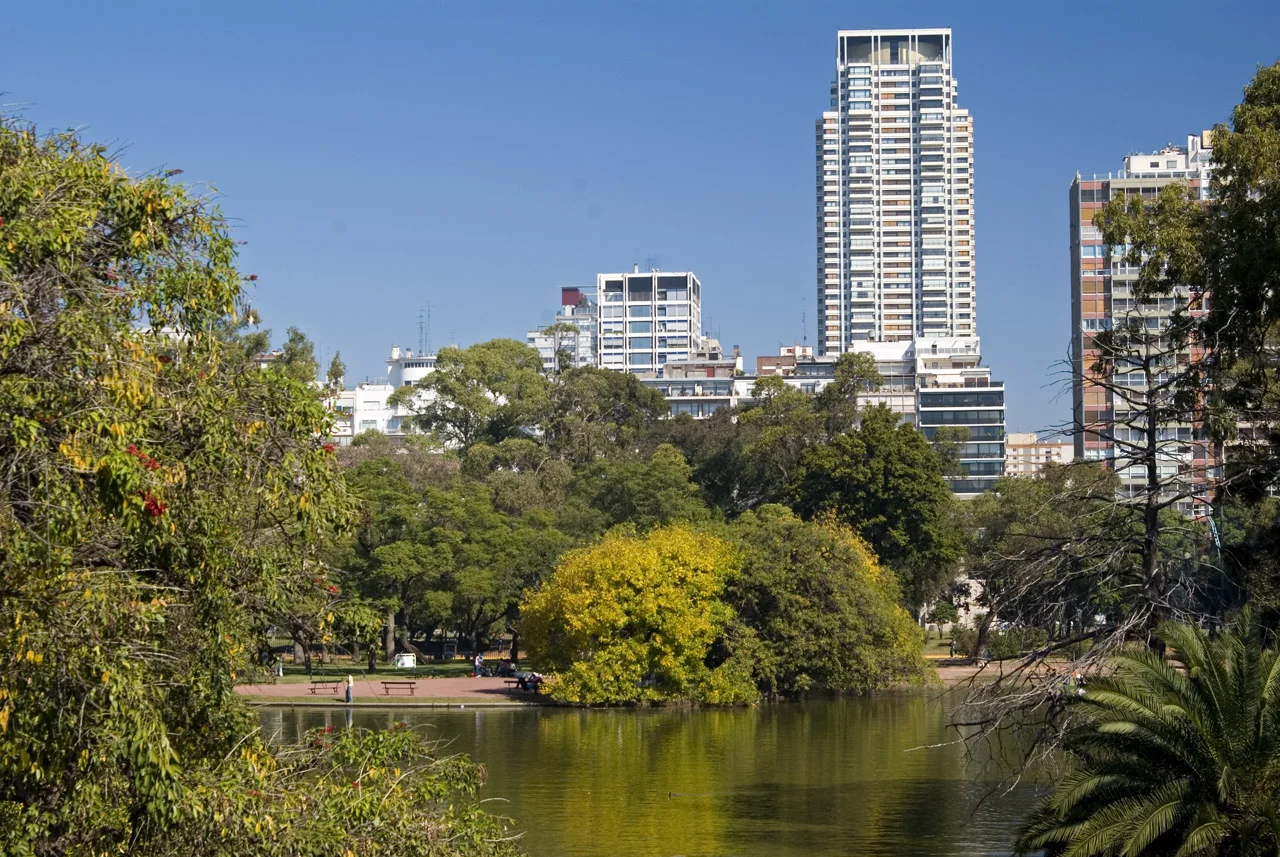

Palermo, Buenos Aires
Ask a porteño where Palermo is and you may get a different answer depending on who is asking. Palermo Soho means boutiques and crowded bar tables; Palermo Hollywood means film studios and late dinners; Palermo Chico means embassies behind high hedges; Villa Freud means, only half-jokingly, the highest concentration of psychoanalysts in the Americas. All of it is technically one neighborhood, the largest in Buenos Aires, and all of it is also gloriously, stubbornly distinct. This is less a barrio than a confederation of them, stitched together across 17 square kilometers of parkland, racetracks, and tree-lined streets where roughly a quarter of a million people live.
A Saint, a Dictator, and a Park
The name reaches back to a Franciscan abbey honoring Saint Benedict the Moor, who lived from 1526 to 1589 and serves as a patron of the Sicilian city of Palermo. A competing folk tale credits an Italian immigrant, Juan Domingo Palermo, said to have bought the land not long after Buenos Aires was founded in 1580. What is certain is that the strongman Juan Manuel de Rosas built a country estate here, confiscated after his fall in 1852. Two decades later President Domingo Faustino Sarmiento turned those grounds into something public and lasting, beginning work on the great Parque Tres de Febrero in 1874, then Plaza Italia and the Palermo racetrack in 1876, with the Buenos Aires Zoological Gardens formally opened in 1888. A tyrant's pleasure villa became the people's park.
The Lungs of the City
Palermo holds the largest green space in Buenos Aires, and it was designed to rival the grand parks of Europe. The Bosques de Palermo, the Palermo Woods, drew inspiration from the Bois de Boulogne in Paris and the Prater in Vienna, and within them you find a Rose Garden, the Eduardo Sívori art museum, and the geometric dome of the Galileo Galilei planetarium, opened in 1966. A year later came the serene Buenos Aires Japanese Gardens, among the largest outside Japan. The Botanical Gardens had arrived back in 1902. On weekends the lakes fill with rowboats and the paths with runners, cyclists, and the horse-drawn buggies called mateos, a slow Sunday rhythm wrapped inside one of South America's busiest cities.
Borges Wrote Here First
Palermo Viejo, the oldest pocket of the district, keeps a literary ghost. Jorge Luis Borges spent part of his childhood in this then-quiet barrio of low Spanish colonial houses, and it was here that he first wrote poetry. His poem on the mythical founding of Buenos Aires names a specific square near his boyhood home, today a small pilgrimage site for readers. Che Guevara, too, once lived in this ward before history claimed him. The neighborhood drew waves of immigrants from Poland, Armenia, Ukraine, and Lebanon, alongside old Spanish and Italian families, and their churches, schools, and kitchens still flavor the streets. The cobblestones and recycled old houses now shelter a newer, more self-conscious bohemia, but the bones of the place are genuinely old.
Soho, Hollywood, and the Night
In the 1990s, television and radio producers settled into the blocks bounded by Córdoba, Santa Fe, Dorrego, and Juan B. Justo avenues, and the area earned the half-ironic nickname Palermo Hollywood, now defined by restaurants, sports clubs, and an all-hours nightlife. Just beside it, Palermo Soho gathered around Plaza Serrano, properly named Plazoleta Cortázar, and filled the old low houses with design studios, boutiques, and bars chasing an alternative edge. Northwest along Libertador Avenue, the upmarket Las Cañitas borders the Palermo racetrack and the Campo Argentino de Polo, the storied ground where Argentina, the spiritual home of the sport, crowns its champions. From the polished mansions of Palermo Chico to the late-night clamor of Soho, the barrio refuses to be just one thing.
From the Air
Palermo spreads across the north of Buenos Aires near the Río de la Plata, centered around 34.589 degrees south, 58.431 degrees west. From the air it is the city's great green quarter: the broad parklands of the Bosques de Palermo, the oval of the Hipódromo Argentino racetrack, the polo grounds, and the botanical and Japanese gardens stand out clearly against the surrounding urban grid. Aeroparque Jorge Newbery (SABE) sits on the waterfront at the barrio's northeastern edge, only 2 to 3 km from its parks, making Palermo one of the first districts visible on approach; Ministro Pistarini International (SAEZ, Ezeiza) lies about 30 km southwest. Best viewed in clear daytime conditions, when the contrast between dense city blocks and the expansive green lungs of the park is most striking.
Nearby Stories
- Ezeiza Massacre 1.9 km away
- Luján, Buenos Aires 5.1 km away
- Curutchet House 13 km away
- Colonia del Sacramento 17 km away
- Martín García Island 28 km away
- Atucha Nuclear Power Plant 37 km away
- Lobos 43 km away
- Cry of Asencio 87 km away