
Paliki
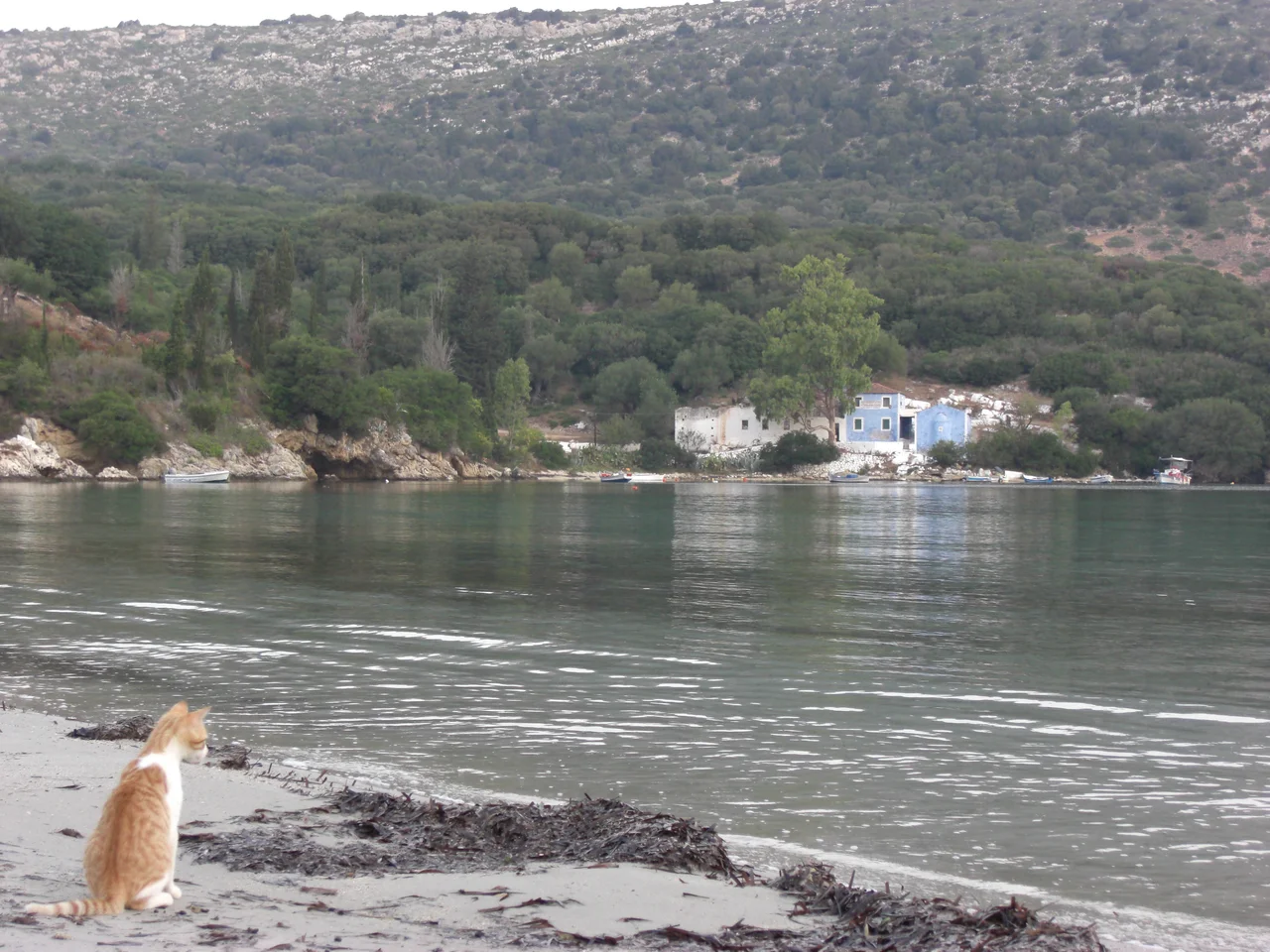
Separated from the rest of Cephalonia by the long arm of the Gulf of Argostoli, the Paliki peninsula feels like an island within an island. Its capital, Lixouri, is a short ferry ride from Argostoli, but the two cities have different temperaments — Lixouri quieter, more sardonic, with a reputation for producing satirical poets and thinkers who took a dim view of pretension in all its forms. The mountains of Paliki's western and northern flanks reach 500 metres, dropping steeply to some of the island's least-visited coastline. On a peninsula shaped like a hand reaching into the Ionian Sea, the beaches on the southern shore glow with an unusual reddish clay. And somewhere under the olive groves and the earthquake-rebuilt villages, according to one provocative theory, lies the lost homeland of Odysseus.
A Land of Earthquakes and Rebuildings
Paliki sits on one of the most seismically active landscapes in Europe. The 1953 Ionian earthquake — one of the strongest to strike Greece in the twentieth century — destroyed the majority of Lixouri's older buildings, as did an earlier earthquake in January 1867. The town that visitors see today is largely a post-1953 reconstruction, which gives it a different character from the more architecturally layered towns of other Greek islands.
Yet things survived. The Iakovatios Library preserves a collection of books and documents in a classic Ionian building that reflects the island's long intellectual and literary tradition. Near the harbour stands a former primary school built in 1933 — an avant-garde modernist building that looks startlingly contemporary even now. A few ruins of the ancient city of Pale, from which Paliki takes its name, remain in the north of the peninsula, identifiable to those who know where to look. The oldest written mention of Lixouri comes from a letter sent in 1534 by local officials to the Senate of Venice — a reminder that the town's administrative life was shaped for centuries by its relationship with the Venetian Republic.
The Ithaca Question
In 2005, the British businessman and classical scholar Robert Bittlestone published a book called "Odysseus Unbound" that made a case many classicists found startling: Paliki, he argued, was Homer's Ithaca. Not the island currently named Ithaca, lying just across the strait, but this western peninsula of Cephalonia — separated from the main island in ancient times, Bittlestone proposed, by a navigable marine channel that has since been filled with rockfall and sediment from successive earthquakes.
Homer describes Ithaca as lying low, westernmost of the islands, with Samos and Dulichium to its east — a description that fits the geography of Paliki more comfortably than it fits modern Ithaca, which sits to the north and east of Cephalonia rather than to the west. Bittlestone's hypothesis attracted serious academic attention and generated geological surveys of the isthmus between Paliki and the rest of Cephalonia. The question remains genuinely open. The academic consensus has not shifted decisively in either direction, and geologists continue to study the site. What the theory does, whatever its ultimate validity, is restore Paliki to the map of the ancient Ionian world — not as a footnote to the larger island, but as a place that may have carried one of the oldest and most resonant addresses in Western literature.
Poets and Thinkers
Paliki has a habit of producing people who look at the world sideways. Andreas Laskaratos, born in Lixouri in 1811, was a satirical poet and essayist whose biting critiques of local clergy and social hypocrisy made him enemies in roughly equal measure to admirers. He was excommunicated by the Greek Orthodox Church — a distinction he wore with evident satisfaction — and spent part of his career in London. His willingness to puncture authority and pretension made him a figure of local pride long after his critics were forgotten.
Spyridon Marinatos, born in Lixouri in 1901, became one of the twentieth century's most important archaeologists. He excavated across Greece, but his most celebrated work was the discovery and excavation of Akrotiri on the island of Thera (Santorini) — the Bronze Age settlement buried by a volcanic eruption roughly 3,600 years ago, sometimes called the "Greek Pompeii." Marinatos died on site at Akrotiri in 1974. The peninsula that produced him is not inclined to name-drop, but his connection to Paliki is a genuine source of pride.
Red Beaches and Cliff Monasteries
The landscape of Paliki rewards those who make the ferry crossing. Xi Beach, on the southern coast, is unusual: its sand has a reddish-orange tint from the clay deposits in the surrounding cliffs, and the shallow water warming over it turns a peculiar clear green. Mania Beach, on the western side, is wilder — emptier, faced toward the open sea, the kind of place that feels genuinely untouched.
Up on the western cliffs, the Kipouria monastery clings to the edge of the headland above the sea. It is small, not heavily visited, but the setting — the Ionian stretching away to the west, the cliff falling sharply below — gives it an intensity that larger, more celebrated monasteries sometimes lack. The monastery of Vatsa Bay sits in similar landscape. These are places that feel earned rather than touristic, which is perhaps the essential quality of the peninsula as a whole.
From the Air
The Paliki peninsula occupies the western lobe of Cephalonia, with its tip at approximately 38.18°N, 20.35°E and its main town Lixouri at 38.20°N, 20.44°E. The Gulf of Argostoli, which separates Paliki from the rest of the island, is clearly visible from altitude — a long, sheltered inlet running north-south. Xi Beach's distinctive reddish sand is visible from low altitude on the southern coast. The island of Ithaca lies to the northeast across the Strait of Ithaca. Nearest airport: Kefalonia International Airport (LGKF), on the southern coast of the main island, approximately 20 km from Lixouri by air.
Nearby Stories
- Glarentza 5 km away
- The Septinsular Republic 5.8 km away
- Battle of the Echinades (322 BC) 8.1 km away
- Hellenic Trench 19 km away
- Ionian Islands 22 km away
- Stratos 27 km away
- Achilleion (Corfu) 119 km away
- Corfu 153 km away