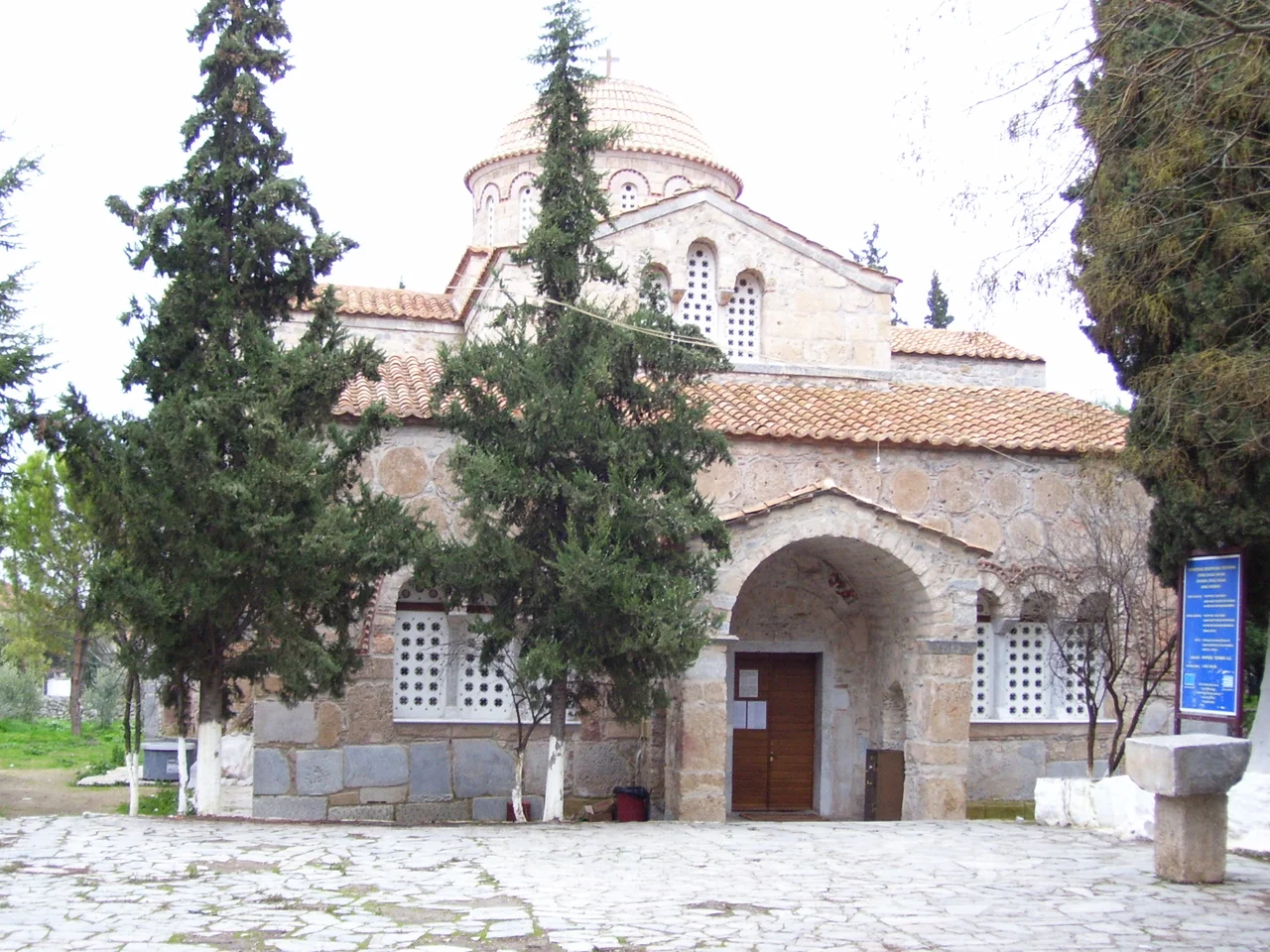

Panagia Skripou Monastery
When Leo, commander of the palace guard in Constantinople, decided to raise a church on his Boeotian estate in the ninth century, he did not quarry fresh stone. He dismantled a city instead. Column drums, carved corbels, and even tombstones from the ruins of ancient Orchomenus were pried apart and reset into new walls, so that a monument to Byzantine faith rose from the bones of a Mycenaean and Greek city that had stood for two thousand years before it. The result — the Church of the Dormition of the Theotokos, completed in 873/874 — is not just beautiful. Because a stone inscription on the exterior of its sanctuary arch records the exact year of construction and the name of its founder, it is one of the very few Byzantine buildings whose date is certain beyond dispute.
A General Builds a Church
Leo held the rank of Protospatharios — leader of the spatharioi, the palace guards of the Byzantine emperor in Constantinople. He was also lord of the territory around ancient Orchomenus in Boeotia, and sometime around 873 he resolved to mark his ownership with something permanent. Four inscriptions carved into the church walls record his identity and intentions. He wanted the building to have, in the words of one epigram, a "resplendent, polished surround everywhere." Scholars believe the church may have been designed partly as a funerary monument — an unusual ambition in Byzantine Greece — which could explain its exceptional scale and the personal urgency that breathes through those stone proclamations. Why Leo chose this particular hilltop above Orchomenus is another question. The traveler Pausanias, writing in the second century CE, had already noted sanctuaries of the Graces and Dionysus in the area; they have never been found, but the ground had clearly been sacred long before Christianity arrived.
Ancient Stone, New Walls
Walking around the exterior of the Dormition church today, you read it like a palimpsest. The ashlar courses are interrupted by column vertebrae turned sideways, by carved architectural fragments repurposed as decorative panels, by tombstone slabs pressed flat into the masonry. This technique — reusing ancient material, known as spolia — was common in early medieval church-building throughout the former Roman world. At Panagia Skripou it is more visible than almost anywhere else in Greece. The stones came from the ruins of Orchomenus, which had been an important Boeotian city and, long before that, a major Mycenaean power. Beneath the church's west precinct, excavators found Mycenaean-period foundations; inside the nave, traces of an early Christian mosaic were uncovered. The site had been layered with occupation for three thousand years before Leo set his workmen to build.
The Shape of a New Architecture
The Church of the Dormition measures 22.30 by 18.60 metres — without the narthex — making it the largest and most luxuriously finished known church of its type and era outside Constantinople. Its plan is an inscribed cruciform with a dome, protruding cross-arms, and a narrow western narthex. Scholars classify it as the most important example of the transitional cruciform type in Greece: the form in which the early Christian basilica was evolving toward the mature Middle Byzantine cross-in-square plan. The eastern end has three apses; the two side apses function not as the usual pastophoria but as chapels of Saints Peter and Paul, as an inscribed epigram explains — an unusual dedication that also hints at Leo's connections to Rome. The church name, Skripou, is thought to derive from the Latin word scriptus, meaning inscription, a reflection of its unusually text-rich walls.
Frescoes, Fire, and Continuing Life
The oldest surviving frescoes inside the church date to the twelfth century, painted long after Leo's death. Restoration work has continued since 1930, and in 1939 the bell tower to the northwest was constructed to plans from the Greek Ministry of Culture. Then, during a modern restoration campaign — while frescoes were being uncovered and sculptures cleaned — fire broke out and caused serious damage. Sandblasting cleared smoke from the interior in a first phase of repair; the restoration of window shutters and narthex frescoes awaited a second. Panagia Skripou functioned as a monastery for centuries; today it serves as a parish church for the town of Orchomenus. The community celebrates its patronal feast on August 15, the Dormition of the Theotokos, and again on September 10 — the day in 1943 when, according to local tradition, the Panagia protected the town and its people from German occupying forces who intended to destroy it.
What the Date Means
Most medieval buildings have uncertain dates. Dendrochronology, documentary guesswork, stylistic analysis — historians piece together approximations. The church at Panagia Skripou is different. The inscription on the exterior of the sanctuary arch states the year of construction and the name of the man who paid for it, giving scholars an anchor to date the transitional cruciform church form with unusual precision. That single dated monument has allowed art historians to sequence other, undated Byzantine churches against it, making the Dormition of Orchomenus a kind of calibration point for an entire chapter of medieval architectural history. Leo's need to inscribe his name in stone four times over has turned out to be a gift to every scholar who came after him.
From the Air
Panagia Skripou Monastery sits at approximately 38.494°N, 22.976°E on the outskirts of Orchomenus in Boeotia, about 130 kilometres northwest of Athens. Flying from Athens International (LGAV), head northwest over the Boeotian plain; the ruins of ancient Orchomenus and its Mycenaean treasury mound are visible just north of the modern town. The church itself is small but its domed silhouette stands out against the flat agricultural land. The ancient Lake Copais, now drained, once spread across the valley below — the patchwork of drainage channels and fields still carries the ghost of that great former lake. Approach from the south at low altitude for the clearest view of the monastery precinct.
Nearby Stories
- Aulis (ancient Greece) 4.3 km away
- Pleistos 4.6 km away
- Doris (Greece) 5.9 km away
- Corinth Rail Disaster 6.9 km away
- Daphni Monastery 16 km away
- Loutraki 19 km away
- Saint George Monastery, Aidipsos 23 km away
- Skopelos 51 km away