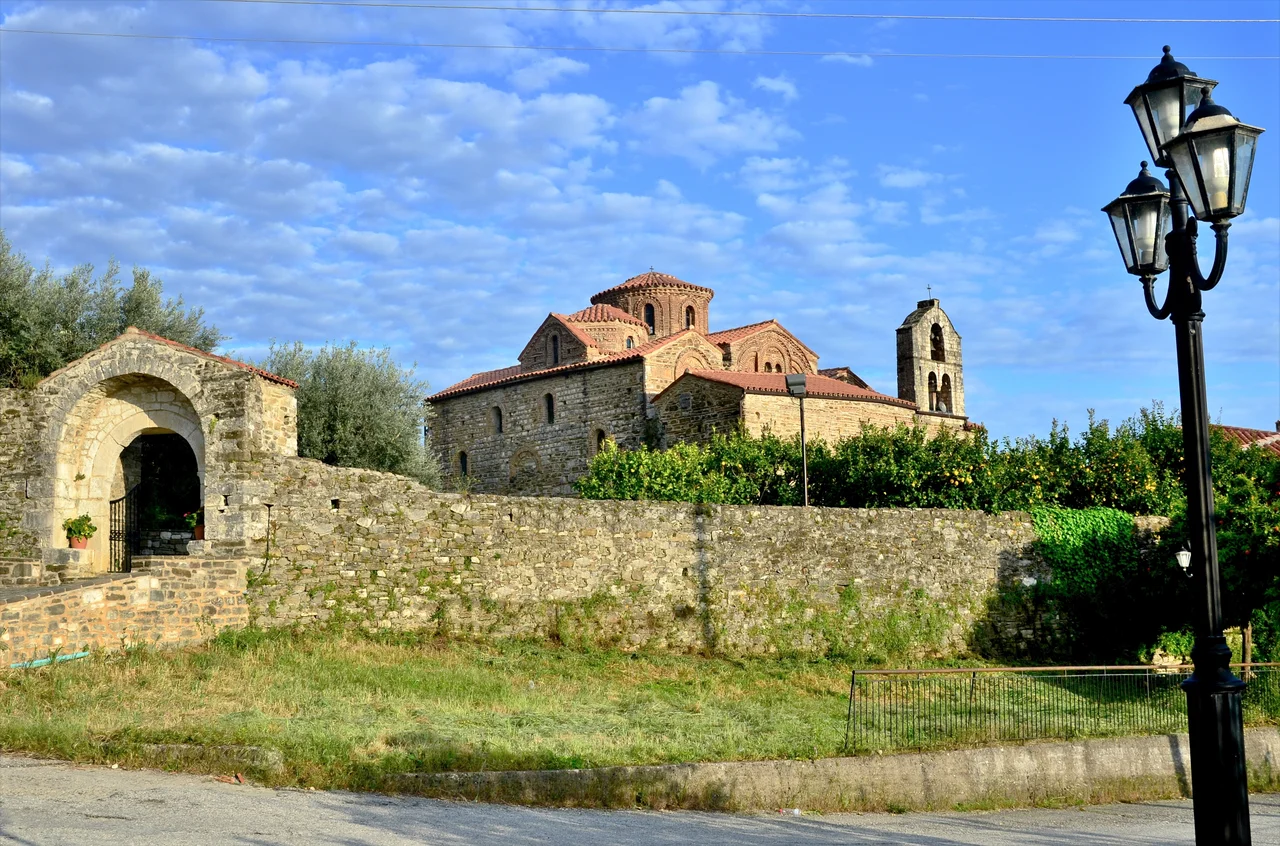

Panagia Vlacherna, Arta
The rulers of a medieval state needed a place to be buried, and the Komnenos Doukas family, who governed the Despotate of Epirus in the thirteenth and early fourteenth centuries, chose the Panagia Vlacherna. The church stands in the village of Vlacherna, just outside Arta, and its walls contain more than a thousand years of Greek Christian architecture compressed into a single building. The oldest layers date to the end of the ninth or the beginning of the tenth century. Beneath the vaulted roofs and three surviving domes, the accumulated decisions of Byzantine builders across four hundred years of construction and reconstruction are legible to anyone who knows where to look.
A Dynasty's Burial Church
The Despotate of Epirus was one of the successor states that emerged after the Fourth Crusade of 1204 fractured the Byzantine Empire. Its rulers, the Komnenos Doukas family, built Arta into a formidable regional capital, and they adorned it with churches. Panagia Vlacherna was the most politically significant of these: a burial place for the dynasty, a statement in stone about the continuity and legitimacy of Byzantine rule in this corner of Greece. It was decorated with frescoes, sculptures, marble inlays, and mosaics — the full vocabulary of Byzantine sacred art brought to bear on a church whose political importance equaled its religious one.
The dedication to the Panagia — the Virgin Mary — connected the Epirote church to one of the most venerated shrines in the Byzantine world: the Church of the Blachernae in Constantinople, which housed a sacred icon of the Virgin and where the emperors prayed before battle. The naming was deliberate, carrying the prestige of the imperial capital into the provinces.
Layers of Stone
The church that visitors see today is not the church that was first built here. The original structure, probably of the late ninth or early tenth century, was a three-aisled basilica with a wooden roof and a semicircular apse protruding from the eastern wall. Fragments of that first building survive in the later masonry — architectural members incorporated into walls built centuries afterward. The difference in the masonry is still visible on the east face of the church.
In the early thirteenth century the church was substantially rebuilt as a three-aisled vaulted basilica. In the middle of that same century, a dome was added above each aisle, along with a furnace in the north aisle, creating an unusual triple-domed basilica. At the end of the thirteenth century, a narthex was added on the western end. Other additions and chapels followed, though most have not survived. The result is a building that developed organically over four centuries, each generation of builders working with what existed and making it serve their needs.
What the Architecture Holds
The interior geometry rewards close attention. The three aisles are of unequal width, separated by colonnades. The transepts in the sanctuary are divided by walls with arched openings, rather than the open colonnades found elsewhere in Byzantine architecture. The narthex is subdivided by projecting pilasters into three sections corresponding to the three aisles. Each nave carries a semi-cylindrical arch internally and a pitched tiled roof outside, the continuous horizontal broken by the rising domes.
Of the five original entrances — one on each long side of the building, three in the western wall — only the central western entrance remains open today. The others have been walled up over the centuries, reducing the church's permeability to the outside world and concentrating access to a single threshold. Standing at that entrance and looking east along the unequal widths of the three aisles, the accumulated decisions of a millennium of builders are present all at once.
A Thousand Years on Site
The Panagia Vlacherna was built by Komnenos Doukas rulers as one of three monasteries associated with the penance of Despot Michael II — the other two being Kato Panagia, beside the Arachthos River west of Arta, and the site where the Church of Saint Theodora now stands in the city. Michael's wife Theodora, who was canonized as a saint of the Orthodox Church, was closely associated with these foundations.
Today the church stands in the village of Vlacherna, a short distance from the center of Arta, accessible and still in religious use. The frescoes that cover the interior walls — painted across multiple periods from the thirteenth century onward — are among the primary surviving documents of Byzantine art in the Epirus region. The tombs of the Komnenos Doukas family are no longer visible, but the building they chose as their resting place endures: plastered, painted, vaulted, and still standing after more than eleven hundred years of Greek history.
From the Air
Panagia Vlacherna is located at approximately 39.172°N, 21.000°E, in the village of Vlacherna just north of Arta. The nearest airport is LGPZ (Aktion National Airport) near Preveza, approximately 50 km to the southwest at 38.952°N, 20.765°E. Approaching from the Ionian coast at 3,000–5,000 feet heading northeast, the Arachthos River and the compact urban center of Arta are clear navigation landmarks. The village of Vlacherna is a short distance north of Arta's center; the church's triple domes and pitched roofs are visible from low altitude in clear conditions.
Nearby Stories
- Battle of Karpenisi 13 km away
- Castle of Santa Maura 17 km away
- Prousou Monastery 21 km away
- Paxos 22 km away
- Dodona 22 km away
- Meteora: The Monasteries Built on Impossible Pillars 42 km away
- Achilleion (Corfu) 47 km away
- SM UC-38 67 km away