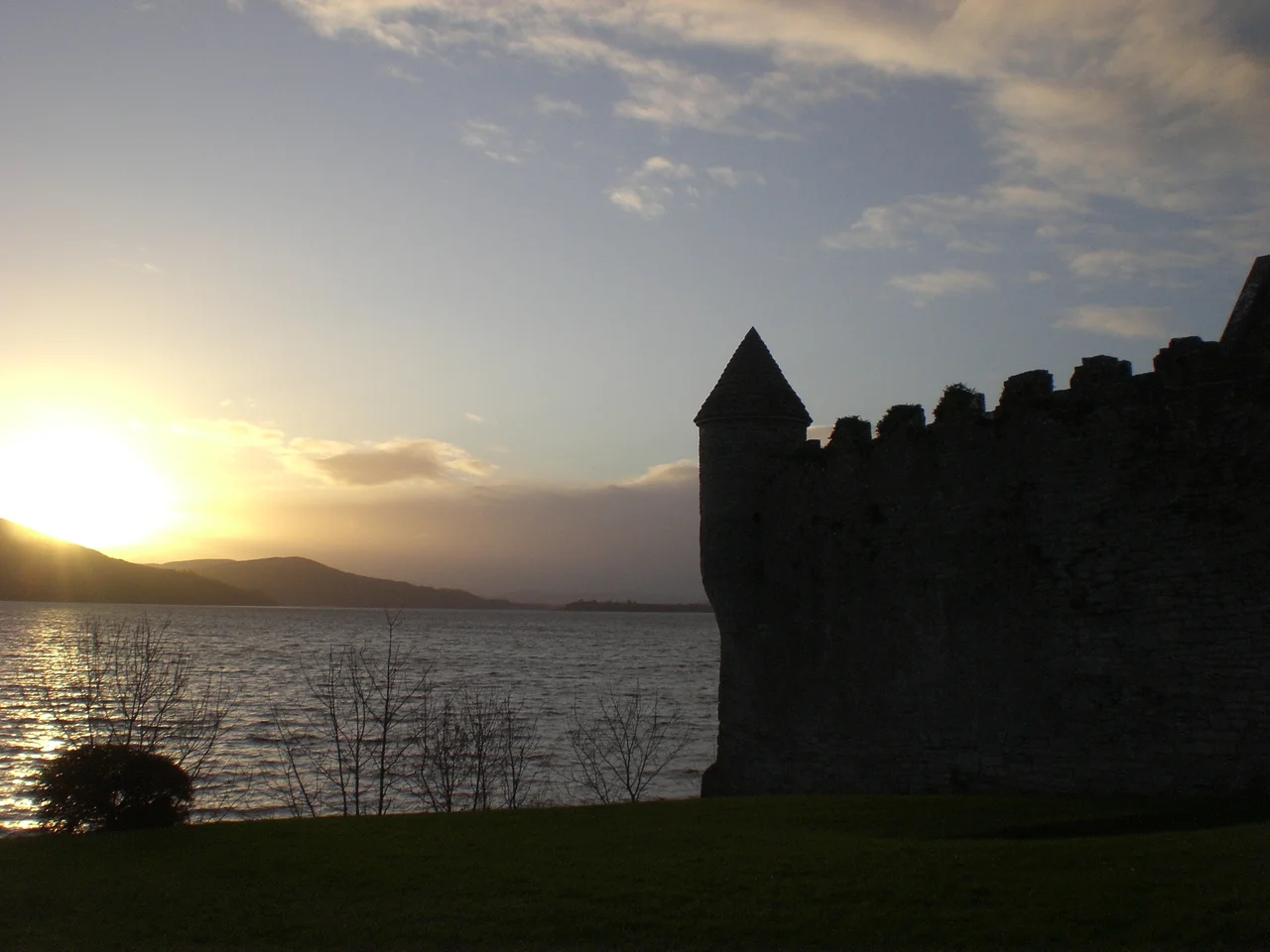

Parke's Castle
On 3 November 1591, Brian O'Rourke, Lord of West Breifne, was brought from the Tower of London to Tyburn and hanged, drawn and quartered. He had been denied a lawyer at his trial. He had not been allowed to examine the charges against him. His real offence was helping shipwrecked sailors of the Spanish Armada. His ancillary distinction was being the first person ever extradited from Scotland to England, taken in chains from King James VI's court after Elizabeth I leaned on her royal relative. The castle Brian O'Rourke had defended at Newtowne on the shore of Lough Gill passed eventually to an English settler named Robert Parke. Parke's Castle, which still stands today, is built on the foundations of the Gaelic tower house Brian O'Rourke once called home.
The Tower House on the Lough
The first mention of an O'Rourke tower house at Baile Nua, or Newtowne, appears in the Annals of Lough Ce for the year 1546. The entry records that 'great treachery was practiced by the sons of Alexander MacCabe against O'Ruairc in his own town, his castle in the Barony of Drumahaire.' The tower house probably dated to the early sixteenth century, when the O'Rourkes were one of the strongest Gaelic dynasties in Connacht. They were never alone on this landscape. A short walk from Parke's Castle, along the lakeshore, is Castle Duroy, also originally a tower house, of which just one wall now stands. In Dromahair village, a 13th-century O'Rourke hall house survives covered in ivy beside the River Bonet. The Franciscan friary of Creevelea was founded by the O'Rourkes in 1508. And a small mountain called O'Rourke's Table overlooks Lough Gill, traditionally the meeting place of the family in medieval times.
Brian's Choice
Brian O'Rourke became chieftain in 1566, after his father's death and a series of disputes with his brothers. He ruled during the most aggressive phase of the Tudor conquest of Ireland, when Henry VIII's policy of 'surrender and regrant' had given way to outright military expansion in the northwest. Brian fought, made peace, fought again. The English seized his castle at Leitrim in 1578, but he came to terms and was knighted that October. When the Anglo-Spanish War began in 1585, the calculus changed. The Spanish Armada of 1588 was scattered by storms, and survivors washed up on the Irish coast. Brian sheltered them. To the English Governor of Connacht, Sir Richard Bingham, this was treason. Bingham attacked O'Rourke's castle at Newtowne. Brian escaped first to Doe Castle in County Donegal, then sailed to Scotland to try to raise an army of gallowglass mercenaries.
The First Extradition
King James VI of Scotland was Elizabeth I's distant relative, and Elizabeth wanted O'Rourke in custody. James obliged. Brian O'Rourke was arrested almost as soon as he stepped onto Scottish soil and extradited to London, the first such case between Scotland and England, and indeed between Ireland and Britain in any modern sense. He was imprisoned in the Tower of London for months, denied a lawyer, denied the right to examine the charges against him, and tried for high treason. The verdict was inevitable. On 3 November 1591, he was hanged, drawn and quartered at Tyburn. Back at Newtowne Castle, his absence created a power vacuum. Records from the next two decades are sparse, and what happened at the tower house during the troubled years of the Nine Years' War is largely unknown.
Parke's Plantation
The Plantation of Leitrim began in 1620, with forty-eight English and Scottish 'undertakers' tasked with founding new towns on confiscated Gaelic lands. Large grants flowed to favoured courtiers of James VI and I. Newtowne was first granted to Sir William Irving of the Privy Council, who passed it to Sir John Spottiswood. A well-connected businessman named Roger Jones had already brought his young nephews Robert and William Parke to Sligo in 1606. By 1628, Robert Parke had a licence to hold a weekly market and two annual fairs at Newtowne. He had also mortgaged 1,000 acres from Con O'Rourke. The manor house Robert Parke built reused the foundations of the O'Rourke tower house, and the courtyard was paved over with cobblestone, erasing the visible traces of the earlier Gaelic castle. His brother William took over the O'Rourke castle at Dromahair.
The Lough Today
Parke's Castle was restored by the Office of Public Works in the late twentieth century and now operates as a visitor attraction managed by Heritage Ireland. The whitewashed walls and pitched roofs are not strictly authentic to either the Gaelic tower house or the Plantation manor, but the layout follows the original footprint, and excavations beneath the courtyard uncovered traces of the medieval castle the Parkes had so carefully buried. A 'Local Link' bus from Sligo to Dromahair stops at the castle gate. Lough Gill stretches out in front, the same lough W.B. Yeats made famous a few generations later with 'The Lake Isle of Innisfree'. The island itself, also visible from the castle, is according to Yeats's own description scrubby and disappointing in the flesh. But the castle survives, and so does the memory of the man who tried to defend it: the Gaelic lord who sheltered Spanish sailors and paid for that mercy with his life.
From the Air
Parke's Castle sits at 54.26°N, 8.33°W on the north shore of Lough Gill in County Leitrim, just east of the county boundary with Sligo, on the R286 road about 12 km east of Sligo town. Nearest commercial airport is Sligo Airport (EISG) about 15 km west, with Knock (EIKN) about 75 km southwest. The castle's whitewashed walls are clearly visible from low altitude on the lakeshore. Yeats's Lake Isle of Innisfree sits in the lough less than 2 km to the south. The wooded shoreline and small islands of Lough Gill create a distinctive landscape pattern that stands out from the agricultural land beyond. Best viewing altitude 1,000-2,500 ft for the lake and castle together.
Nearby Stories
- Kesh Ambush 3.4 km away
- Florence Court 3.6 km away
- Ballyshannon 4 km away
- Ireland West Airport 6.4 km away
- Carrick-on-Shannon 11 km away
- Easky 13 km away
- Border Region 25 km away
- RMS Empress of Britain (1930) 109 km away