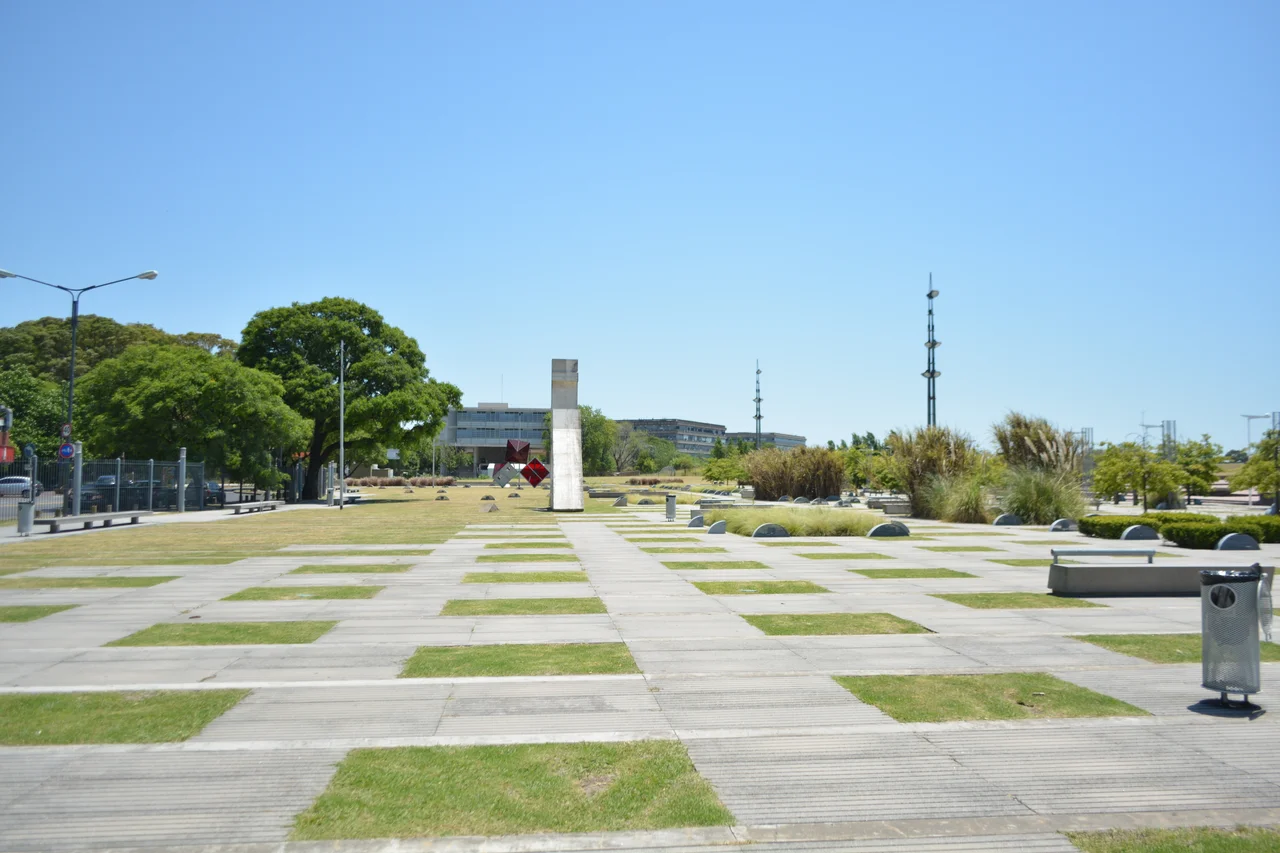

Parque de la Memoria
The park was built here for a terrible reason: this is roughly where they fell. During Argentina's military dictatorship of 1976 to 1983, the regime loaded drugged prisoners onto aircraft, flew them out over the Río de la Plata, and pushed them, still alive, into the brown water below. These were the vuelos de la muerte, the death flights. The military airport from which many of those planes took off lies just a few hundred metres up the coast. So when Argentines chose where to build a memorial to the roughly 30,000 people their own state made vanish, they did not choose a quiet plaza downtown. They chose the riverbank itself.
The Wound in the Grass
The central monument is a long ramped path of grey concrete, cut into the lawn so that it reads, from above, as a gash opening toward the river. Argentine architect Alberto Varas won the 1998 international competition with this idea: not a triumphal arch, not a heroic statue, but a wound that will not close. Walking down it, you descend gradually below the level of the surrounding park, the city falling away behind you until there is only the water ahead. The path holds the names. They are inscribed on plaques of dark Patagonian porphyry stone, listed by year and then alphabetically, each one a person taken between 1969 and 1983. Where a victim was pregnant when she disappeared, the stone says so. Many of the panels are left blank, deliberately, waiting for the names not yet recovered.
The People, Not the Number
Thirty thousand is the figure Argentines repeat, and the number matters because the regime worked so hard to make these people disappear without trace. But the park resists letting them dissolve back into a statistic. Each name on the wall was a student, a union organizer, a teacher, a doctor, a teenager, a parent. People were seized for expressing left-wing ideas, or simply for knowing someone who had. They were held in secret detention centres, tortured, and murdered, their bodies hidden so completely that for decades their families had no grave to visit. That absence is the cruelty the monument answers. By carving every recoverable name into stone and setting it beside the river, the park gives the disappeared the one thing their killers denied them: a place where they are named, and where they can be mourned in the open.
Art Against Forgetting
Eighteen sculptures stand among the lawns, twelve chosen by competition and six commissioned from artists known for their human-rights work. Roberto Aizenberg, Clorindo Testa, and the American conceptual artist Jenny Holzer all contributed works here. The park's most quietly devastating piece stands not on the grass but out in the water itself: Claudia Fontes' figure of a boy in mirror-polished steel, set some forty metres offshore, his back turned to the shore so no visitor can ever meet his eyes. He is a reconstructed portrait of Pablo Míguez, disappeared at the age of fourteen, one of the children the river took. His reflective surface dissolves into the estuary behind him. Poland's Magdalena Abakanowicz contributed her hollow, headless Walking Figures nearby. The art does not shout. It asks the visitor to slow down, to stand at the water's edge, and to carry the weight of what the smooth surface of the Río de la Plata still hides.
Memory as a Verb
The fight for this ground was itself part of the story. In 1997, students from the National School of Buenos Aires first proposed a riverside park to honour the disappeared, and the city approved construction in 1998. The Monument to the Victims of State Terrorism was inaugurated on 7 November 2007. It rose only because mothers, grandmothers, and survivors refused for thirty years to let the country move on quietly, demanding investigations, trials, and truth. The park is run by a public commission, and its meeting hall hosts exhibitions and education programs so that nueva memoria, new memory, keeps being made. Argentina chose not to bury this chapter. It built it a monument by the river and made remembering an act of citizenship.
From the Air
Parque de la Memoria sits at 34.541 degrees south, 58.437 degrees west, on the Costanera Norte where the Río de la Plata meets the northern edge of Buenos Aires. The nearest airport is Aeroparque Jorge Newbery (ICAO: SABE), barely a kilometre to the south along the same riverbank, the airfield historically linked to the dictatorship's death flights. The larger Ministro Pistarini International Airport at Ezeiza (ICAO: SAEZ) lies about 30 km to the southwest. From the air the park reads as a green wedge on the waterfront beside the Ciudad Universitaria campus, the long pale line of the memorial wall angling toward the immense, silt-brown expanse of the estuary. Low-altitude approaches to SABE pass directly over the site; clear, calm days give the best view of the river that is inseparable from this memorial's meaning.
Nearby Stories
- Ezeiza Massacre 1.9 km away
- Luján, Buenos Aires 5.1 km away
- Curutchet House 13 km away
- Colonia del Sacramento 17 km away
- Martín García Island 28 km away
- Atucha Nuclear Power Plant 37 km away
- Lobos 43 km away
- Cry of Asencio 87 km away