
Parque Tres de Febrero
This green expanse was once one man's private estate, and the city took it from him at gunpoint. The land belonged to Juan Manuel de Rosas, the strongman who ruled Buenos Aires with an iron grip until rival forces defeated him at the Battle of Caseros on 3 February 1852. When Rosas fled into exile, his sprawling properties on the city's northern edge passed to the public, and Argentines gave the park his enemies' date as its name: Parque Tres de Febrero, the Third of February. There is a fittingness to it. The estate of a man who hoarded power became the city's most democratic ground, open to everyone, every day.
A Park to Civilize a Nation
The vision belonged to Domingo Faustino Sarmiento, the writer-president who believed parks and schools could turn a young, turbulent republic into a modern nation. He had personally opposed Rosas, and he pushed the project forward alongside congressman Vicente Fidel López. Work began in 1874, and the park was inaugurated on 11 November 1875, designed by the urbanist Jordán Wysocki and architect Julio Dormal. It was meant to rival the great public grounds of Paris and London, a place where a clerk, a laundress, and a senator might stroll the same paths. The Porteños, as the people of Buenos Aires call themselves, adopted it completely. On weekends the lawns still fill with families, runners, rowers, and cyclists, exactly as Sarmiento hoped.
The Frenchman Who Drew the Gardens
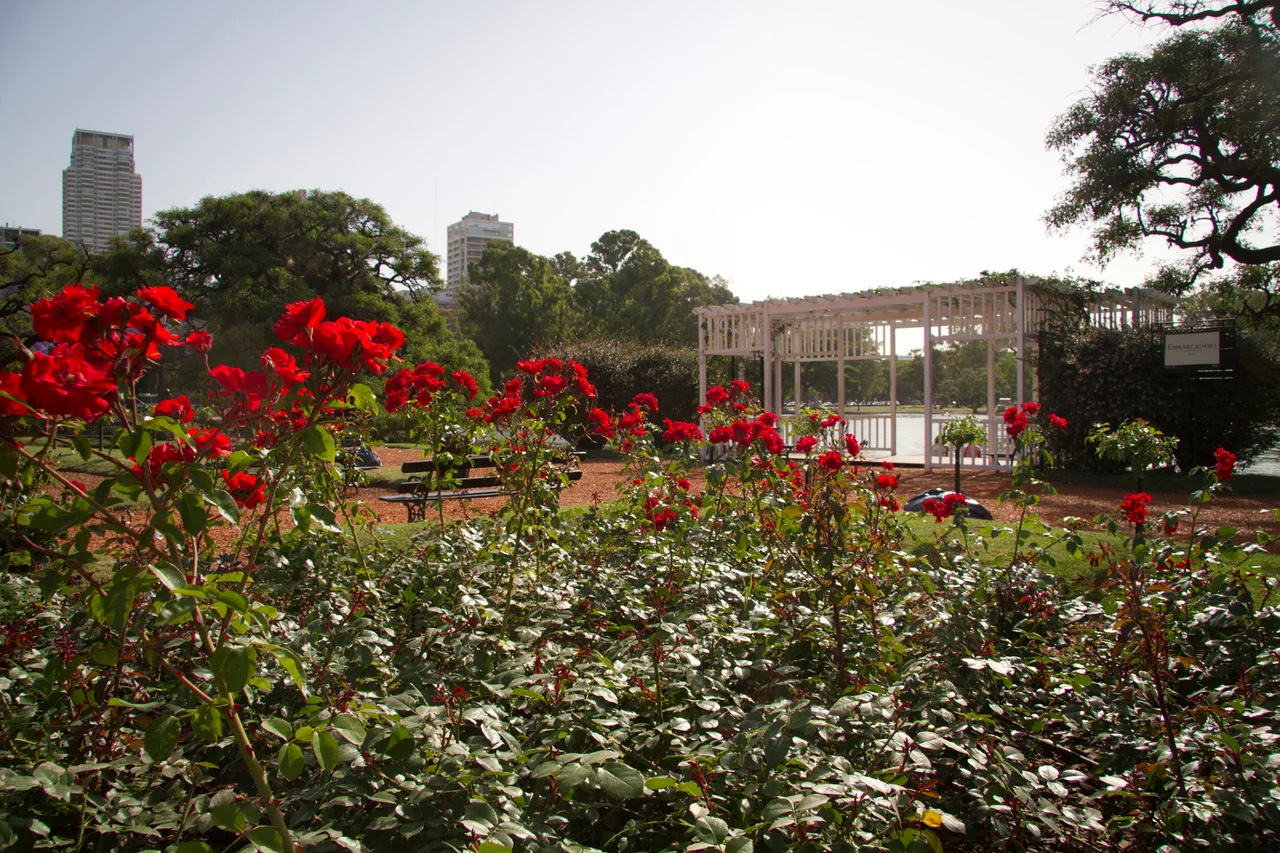
The park took its enduring shape from Carlos Thays, a French-Argentine landscape architect commissioned in 1892 to expand and beautify it. Over the next two decades Thays designed much of green Buenos Aires: the Zoological Gardens, the Botanical Gardens, the adjoining Plaza Italia, and the jewel at the park's heart, El Rosedal, the Rose Garden. Begun by Thays and completed by his disciple Benito Carrasco in 1914, the Rosedal holds some twelve thousand rose bushes laid out in formal beds, threaded by a pergola heavy with climbing roses and crossed by a graceful white wooden bridge over its lake. The garden was honoured in 2012 with the Garden Excellence Award from the World Federation of Rose Societies. In spring, when the beds erupt, it draws crowds the way a cathedral draws pilgrims.
Poets, Planets, and a Garden from Japan
The park accumulated wonders. Near the boating lake lies the Poets' Garden, where stone and bronze busts honour writers from Jorge Luis Borges to William Shakespeare and Italy's Luigi Pirandello. The Andalusian Patio, a 1929 gift from the city of Seville, brings a tiled fountain and a shaded glorieta. In 1966 the Galileo Galilei planetarium opened, its modernist dome floating on three concrete arches, projecting the southern sky for generations of schoolchildren. And in 1967 the Buenos Aires Japanese Garden opened here, said to be the largest Japanese garden outside Japan, inaugurated during a state visit by Japan's then-Crown Prince Akihito and Princess Michiko. Between 1948 and 1950 a temporary circuit through the park even hosted Grand Prix motor racing, engines snarling past the rose beds.
The Living City Park
Three artificial lakes ripple at the park's centre, dotted on warm days with rented rowboats and pedal boats. Joggers trace loops beneath the groves; couples claim benches; vendors sell mate and choripán along the paths. The old Edwardian café on the grounds became the Eduardo Sívori fine-arts museum in 1996. The historic zoo beside Plaza Italia, founded in 1888, closed to the public in 2016 and is being reborn as an ecological park. Through all the changes, the essential thing endures. What was seized from a dictator a century and a half ago remains what its founders intended: a vast, breathing common ground at the heart of one of Latin America's great cities, where the whole of Buenos Aires comes to walk.
From the Air
Parque Tres de Febrero spreads across the Palermo district at 34.573 degrees south, 58.415 degrees west, framed by Avenida del Libertador and Avenida Figueroa Alcorta. The nearest airport is Aeroparque Jorge Newbery (ICAO: SABE), only about two kilometres east along the Río de la Plata, so close that aircraft on approach pass over the park's lakes and groves. Ministro Pistarini International at Ezeiza (ICAO: SAEZ) lies roughly 25 km southwest. From the air the park is unmistakable: a deep green block punctuated by the bright geometry of the Rosedal, the silver glint of its three lakes, and the white dome of the planetarium near Avenida Sarmiento. Clear summer days reveal the rose beds in full colour; the park is loveliest from above in the southern-hemisphere spring, roughly October and November.
Nearby Stories
- Ezeiza Massacre 1.9 km away
- Luján, Buenos Aires 5.1 km away
- Curutchet House 13 km away
- Colonia del Sacramento 17 km away
- Martín García Island 28 km away
- Atucha Nuclear Power Plant 37 km away
- Lobos 43 km away
- Cry of Asencio 87 km away