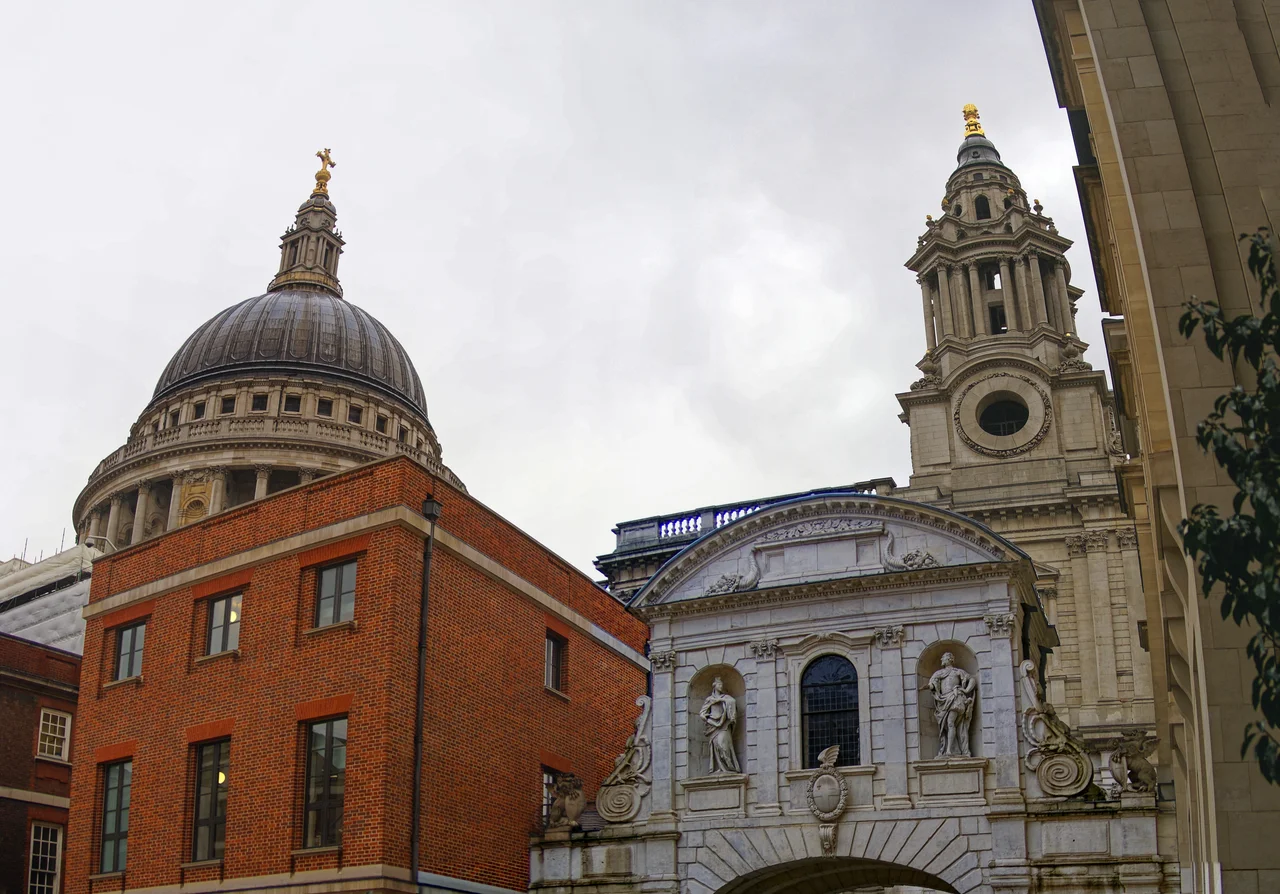

Paternoster Square
The Lord Mayor of London described the 1960s redevelopment of Paternoster Square as "ghastly, monolithic constructions without definition or character." He was not exaggerating. For three decades, one of the most symbolically charged sites in London — immediately north of St Paul's Cathedral, on ground that had been devastated by the Blitz — was occupied by some of the bleakest postwar architecture in the city. It took until 2003 to fix it.
A Square With Many Names
The name Paternoster comes from the street that once occupied this ground — Paternoster Row, historically the centre of London's publishing and bookselling trade, lined with printers, bookshops, and stationers. The Row was renamed Newgate Market around 1872, reflecting an older use: before the publishing trade, the area had long been a meat market serving much of the city. That market's memory is preserved in the name Paternoster Square, which the site took on much later. The publishing trade on Paternoster Row was effectively destroyed on the night of 29 December 1940, when German bombing during the Blitz ignited a firestorm that consumed much of the area. Millions of books were lost along with the buildings. The ground sat largely empty for years afterward, cleared but not rebuilt.
The Holford Disaster
In 1956, the Corporation of London published architect Sir William Holford's proposals for redeveloping the precinct north of St Paul's. The plan attempted to solve traffic problems while protecting the cathedral's presence on Ludgate Hill — one of the historic high points of the City. The report was controversial from the start because it placed modern architecture directly beside Christopher Wren's masterpiece. The rebuilding carried out between 1961 and 1967 delivered something worse than controversy: it realised only part of Holford's concept, involved other architects whose work had little of Holford's vision, and produced the kind of undistinguished concrete blocks that the Lord Mayor later condemned. For those who cared about St Paul's setting, the development was an open wound. By the late 1980s, most tenants had left and the precinct was largely vacant.
A Third Attempt
In 1990, architect John Simpson proposed a classically inspired scheme championed by the Prince of Wales, which would have blended more sympathetically with the cathedral. It was not built. Instead, in 1996, permission was granted for a master plan by Sir William Whitfield, which was constructed through the late 1990s and early 2000s. By October 2003, the redeveloped square was complete — pedestrianised, colonnaded, and lined with buildings by Whitfield's firm and others. Among the first new tenants was the London Stock Exchange, which relocated from Threadneedle Street in 2004. Goldman Sachs, Merrill, Nomura Securities, and Fidelity Investments followed. The square became a finance hub, privately owned but publicly accessible — a distinction that mattered in October 2011, when Occupy London protesters attempted to occupy the space and were blocked by police acting on a High Court injunction.
The Column and the Gate
The main monument in the redeveloped square is a 75-foot Corinthian column of Portland stone, topped by a gold-leaf-covered flaming copper urn lit by fibre optics at night. Designed by Whitfield Partners, it also serves as a ventilation shaft for a service road beneath the square — a pragmatic dual purpose that the column's classical grandeur does not immediately suggest. Near the entrance to the plaza stands Christopher Wren's 1669 Temple Bar Gate, which had stood on Fleet Street until 1878 before spending over a century in exile at Theobalds Park. Contractors were paid £3 million to restore it and install it here in 2004. The gate's return completed a kind of symbolic restoration — Wren, who designed St Paul's Cathedral visible from every corner of the square, now also frames its entrance.
From the Air
Located at 51.5147°N, 0.0994°W, immediately north of St Paul's Cathedral in the City of London. From altitude, the dome of St Paul's is the primary landmark; Paternoster Square lies directly to its north. The 75-foot column in the square's centre is visible on clear days. Nearest airports: London City (EGLC) approximately 6 miles east; Heathrow (EGLL) approximately 15 miles west.
Nearby Stories
- Stevenage 5.7 km away
- Malling Abbey 5.7 km away
- 1952 Farnborough Airshow Crash 7.7 km away
- Ingatestone Hall 8.2 km away
- Hellfire Caves 9.1 km away
- The Carrington Event: The Solar Storm That Could Happen Again 9.8 km away
- Bletchley Park 16 km away
- Castle Hedingham 23 km away