
Paz Palace
José Camilo Paz commissioned the grandest house Buenos Aires had ever seen and never spent a single night in it. The founder of the newspaper La Prensa wanted a palace to match a Parisian dream, so he hired the French architect Louis Sortais and ordered the building raised with materials shipped from France, stone by stone, across the Atlantic. Construction dragged on from 1902, and Paz died in Monte Carlo in 1912, two years before the work was done. Sortais, his architect, died too without ever crossing the ocean to see his masterpiece. The Palacio Paz was finished in 1914 for a master who would never climb its marble stairs.
A House Built for a Ghost
By any measure the building is staggering. Behind its long French facade facing Plaza San Martín lie roughly 12,000 square metres of construction spread across four storeys and some 140 rooms, halls, and galleries, making it the largest single-family residence ever built in the city. Paz's widow, Celmira Díaz, and their children moved in and lived here, but the house served as a family home for barely twenty-four years. There is something poignant in the scale of it, a fortune in imported marble and gilt and parquet assembled by a man's ambition, then inherited by a family who could only rattle around inside a dream that was never quite theirs. The story of the palace is, at heart, the story of vaulting ambition outrunning the span of a single life.
The Grand Salon and the Great Round Hall
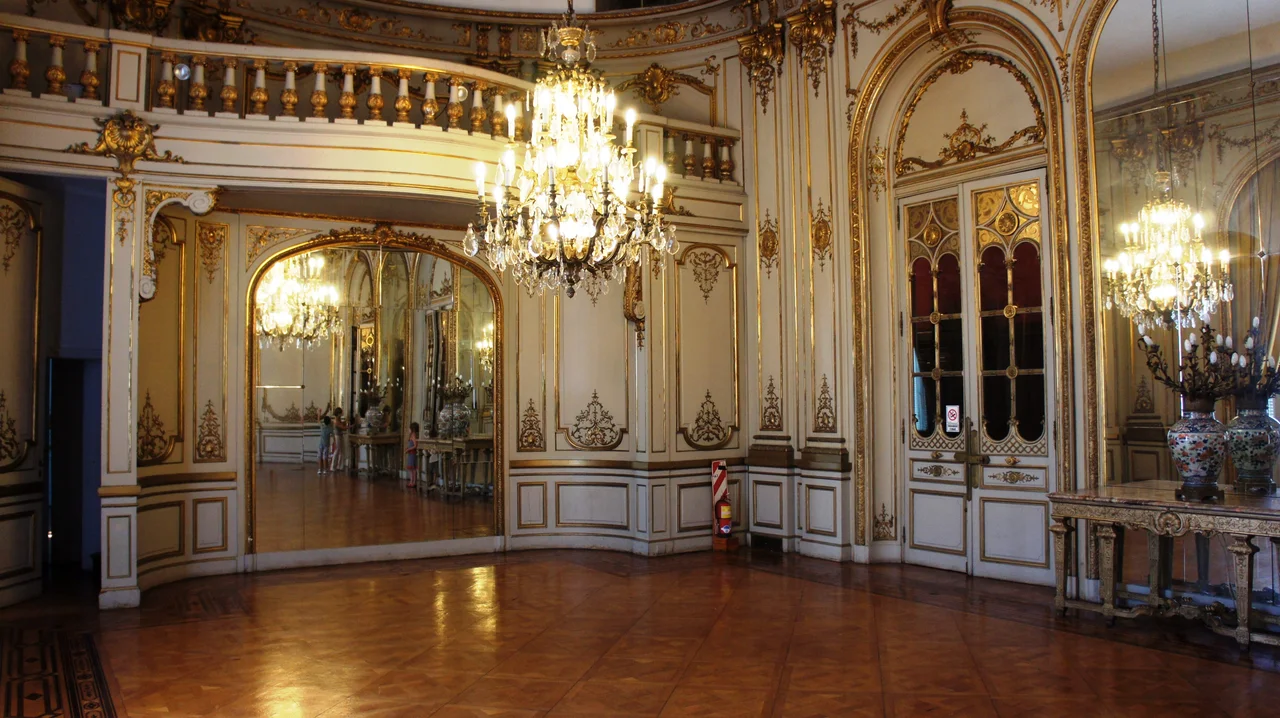
Inside, the rooms compete with the great houses of Europe. The Salón de Honor, a vast hall of marble and bronze, is crowned by a circular gallery and a dome lined with gold leaf, lit by a ring of windows. There are Louis XV and Louis XVI salons, a Renaissance dining room, smoking rooms panelled in dark wood, and an armory hall. The decoration is not Argentine but a deliberate transplant of French aristocratic taste, the aspiration of a turn-of-the-century Buenos Aires so rich on beef and grain that it called itself the Paris of South America. Walk these rooms today and you understand the boast: the city's elite genuinely believed they were building a new European capital on the banks of the River Plate.
From Mansion to Military Circle
In 1938 the family sold the palace, and it was bought by the Círculo Militar, the Military Officers' Association, which has occupied it ever since. The club itself was older than the building, founded in 1880 by Nicolás Levalle, a decorated army officer who hoped a shared social institution might ease the rivalries among officers drawn from Argentina's then-fractious provinces. The association turned the mansion into its headquarters, library, and a cultural foundation that runs the palace as a museum and hosts lectures and concerts. Its specialist military library holds more than 120,000 volumes, the foremost collection for military-history research in the country.
Crusader Mail and a Camera Crew
One wing houses the Museo de Armas de la Nación, the National Arms Museum, opened in 1941 and considered Argentina's most important military museum. Across fifteen rooms its collection runs from chain-mail armour attributed to a Byzantine emperor around the year 1100, through crusader-era crossbows, maces, and two-handed swords, to banners and weapons from the Argentine War of Independence and early machine guns. The palace's cinematic grandeur has not gone unnoticed: it stood in for high-society settings in the 2015 film Focus, Ricky Martin shot a music video in its halls in 2011, and the 2024 series Senna filmed scenes here. The museum is open to the public, and guided tours let visitors walk the rooms their builder never saw.
From the Air
The Paz Palace stands in the Retiro district at 34.595 degrees south, 58.378 degrees west, facing Plaza San Martín near the eastern end of Avenida Santa Fe. The nearest airport is Aeroparque Jorge Newbery (ICAO: SABE), about four kilometres north along the Río de la Plata waterfront; Ministro Pistarini International at Ezeiza (ICAO: SAEZ) lies roughly 28 km southwest. From the air the palace reads as a broad, pale, French-roofed block on the green margin of Plaza San Martín, just inland from the Retiro rail terminals and port. The dense towers of the microcentro rise immediately to the south. Clear days over central Buenos Aires give the cleanest line on the plaza and the mansard roofline that marks the building out from its modern neighbours.
Nearby Stories
- Ezeiza Massacre 1.9 km away
- Luján, Buenos Aires 5.1 km away
- Curutchet House 13 km away
- Colonia del Sacramento 17 km away
- Martín García Island 28 km away
- Atucha Nuclear Power Plant 37 km away
- Lobos 43 km away
- Cry of Asencio 87 km away