
Peasholm Park
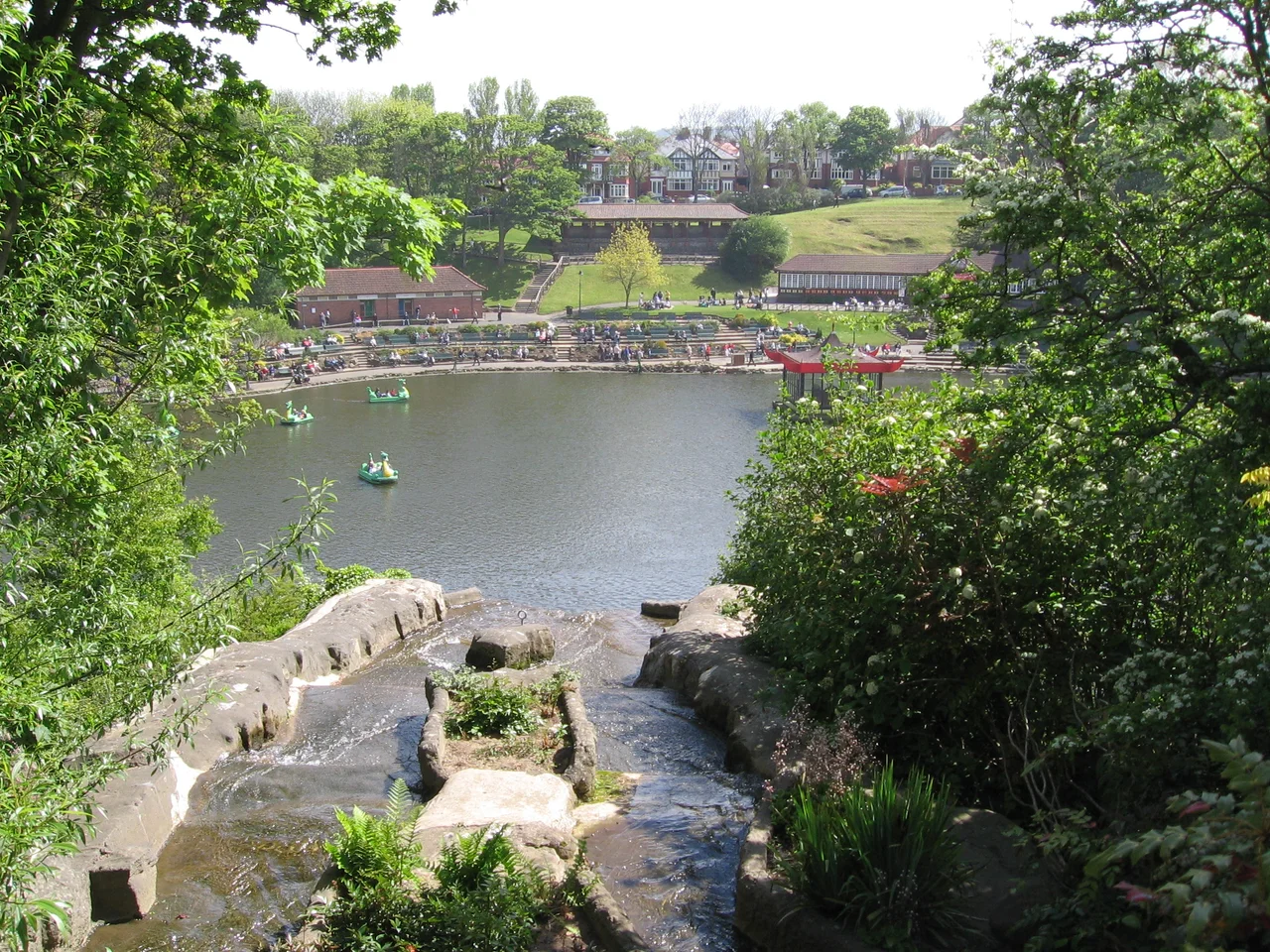
Three times a week during summer in Scarborough, men in waterproofs climb inside scale models of First World War battleships and pedal them around an artificial lake in front of a few hundred spectators. The fleet has been called the world's smallest manned navy. They fire real pyrotechnics. Smoke drifts across the water. A scale Bismarck or Graf Spee is hunted by a scale destroyer flotilla in a re-enactment of, depending on the year, the Battle of the River Plate or some looser amalgamation of twentieth-century naval combat. It has been happening since 1927, in a Japanese-themed Edwardian park dropped into a wooded ravine on the north side of Scarborough. The park is real. The pagoda is real. The navy is, in its tiny way, also real.
Tuckers Field, 1911
Peasholm Park sits on land that was once a medieval manor called Northstead - part of the Crown Estate since the fourteenth century. By the early twentieth century the field was farmland and allotments, and it was called Tuckers Field. In 1911, Scarborough Corporation bought it from the Duchy of Lancaster. The borough engineer, Harry W. Smith, had the unusual idea of laying out the new park in Japanese style. The orientalist fashion was at its high tide in Edwardian England, and Smith collected Japanese-style statues from Killerby Hall and imported exotic shrubs and flowers from the French Riviera home of a retired Scarborough banker. The park opened to the public in 1912. In 1924 it was extended south-west into Peasholm Glen, a narrow steep-sided ravine that runs back toward the moors, doubling the size to fourteen hectares.
The Pagoda and the Willow Pattern
At the centre of the lake stands an island. On the island stands a pagoda, said to be based on the design of the Willow Pattern - the blue-and-white china pattern that became fashionable in England in the late eighteenth century, supposedly depicting a Chinese love story (the story was actually invented to sell the china). The pagoda is reached by an arched Japanese-style bridge, the Half-Moon Bridge, which is opened to the public during the tourist season. Waterfalls feed the lake from the wooded glen above. In 1999 vandals set fire to the pagoda; the park was closed. Heritage Lottery Fund money, more than £300,000, paid for the restoration - the pagoda rebuilt in its original form using fire-retardant wood, the Half-Moon Bridge replaced, the lake drained and de-silted, the cascade upgraded.
Naval Warfare on the Lake
The Battle of Peasholm started in 1927. The first fleet was scale models of First World War battleships and a German U-boat. After the Second World War the models were replaced - the fleet was rebuilt to recreate the 1939 Battle of the River Plate, the Royal Navy versus the Graf Spee in the South Atlantic. The boats were originally entirely man-powered, with council employees inside pedalling and steering. In 1929 electricity was introduced for the larger vessels, but the smaller ones remained pedal-powered. The world's smallest manned navy, in other words, has been operating for nearly a century. The half-hour performances take place three times a week through the summer, with real pyrotechnic effects, real smoke, real announcer dramatising the action over the loudspeaker. Crowds gather around the lake edge. Adult admission is £5.50, child £2.50.
The Tree That Wasn't Extinct
Peasholm Glen, the upper extension of the park added in 1924, is now home to the Peasholm Glen Tree Trail. A leafleted route identifies the rare and unusual specimens collected here over a century of cultivation. During the restoration work after the 1999 pagoda fire, the most remarkable discovery was the Dicksonian Elm, a species that had been believed extinct - found alive and well in the glen, apparently overlooked by the wider botanical community for decades. The discovery was a reminder that municipal parks, which look quiet and ordinary from outside the gate, sometimes contain things that the official record has lost track of. The park received Grade II listed status from English Heritage in 1999.
Why It Still Works
Peasholm Park is, in its way, a perfectly preserved Edwardian fantasy: the orientalism, the pagoda, the boating lake, the pedal-powered model boats firing fake cannons in mock sea battles for the entertainment of tourists. None of it should still be running. The original holiday-maker boom that filled the park in the 1920s and 1930s faded after the 1970s as British seaside resorts declined. The park itself decayed. But the same conservatism that made the Naval Warfare event seem dated also made it precious - a thing that nowhere else does, a thing that was nearly lost and was rescued by Lottery money, a thing that local volunteers and the Friends of Peasholm Park have decided is worth keeping. Three times a week, the smoke rises from the lake. The fleet sails. The Edwardians, somewhere, are quietly satisfied.
From the Air
Peasholm Park sits at 54.2912 degrees N, 0.4101 degrees W, on the north side of Scarborough behind North Bay. Nearest aviation reference is Humberside (EGNJ) about 60 km southeast. From 2,000 ft AGL the park reads as a wooded ravine opening northeast toward North Bay, with the boating lake forming a distinct dark oval at the seaward end. The pagoda on its island is sometimes visible as a small bright point at the lake centre. Scarborough Castle's headland is 1 km southeast. Best viewing on a clear summer afternoon - the lake and pagoda are most photogenic from the north.
Nearby Stories
- York Minster fire 1.8 km away
- Helmsley Castle 1.9 km away
- SM UC-75 10 km away
- Middlesbrough Cathedral 11 km away
- RAF Leconfield 11 km away
- Mulgrave Castle 12 km away
- Arctic Viking (H452) 24 km away
- Breagh Gas Field 37 km away