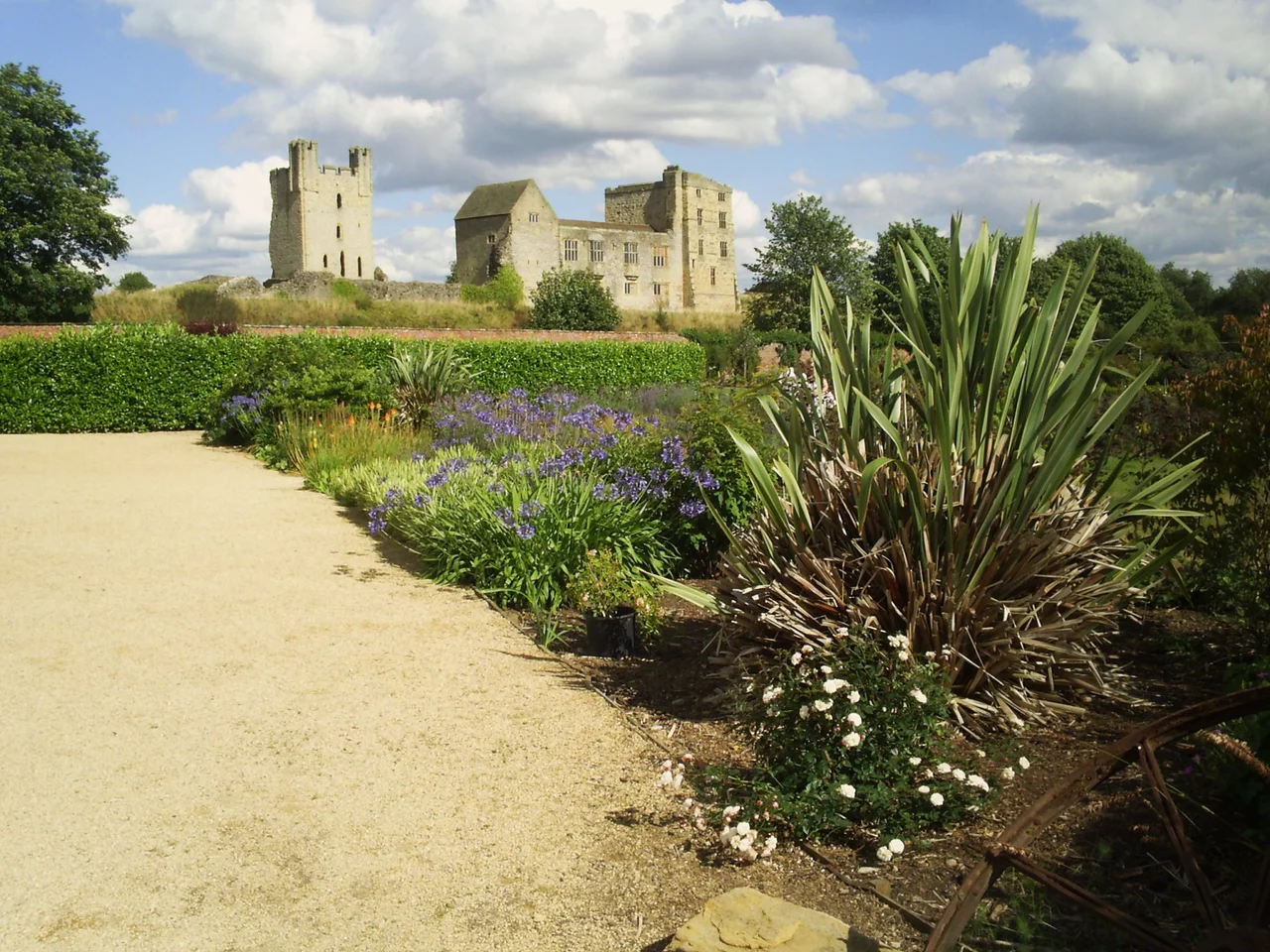

Helmsley Castle
There is a moment, walking up to Helmsley Castle from the market square, when the East Tower comes into view and one half of it is missing. The remaining half stands as tall and square as it did when Edward III slept inside it in 1334; the other half lies in the ditch below, sheared away in a single deliberate explosion. Both halves are deliberate. The standing half is what English kings and Yorkshire barons built over five centuries. The fallen half is what Parliament took down in 1644 - and what an 18th-century landowner happily left lying there, because his new mansion looked better with a ruin in the view.
A Castle on a Rock Above the Rye
Walter l'Espec built the first timber castle here around 1120, on a rocky outcrop above the River Rye. He was a Norman baron with no children and a habit of giving land away to monks - it was Walter who granted the meadow three kilometres west where Rievaulx Abbey rose, and Aelred of Rievaulx, the famous novice master, was close enough to Walter that the castle served as a refuge during unsettled years. Walter's only son had died young, falling from a horse, and on his death in 1153 the estate passed to his sister Adelina and her husband Peter de Roos. It was their descendants who turned the wooden fortress into stone. Robert de Ros began the conversion in 1186, building the round corner towers and the south gateway. By the time his great-grandson Robert married Isabel d'Aubigny in the 1260s, Helmsley had the massive south barbican that still squats over the outer ditch, daring you to imagine attacking it.
The King Who Slept Here and the King Who Did Not
Edward III stayed for five days in 1334, probably while the East Tower was being heightened for the royal occasion. A century and a half later, Edmund de Roos sold the castle to Richard, Duke of Gloucester - the future Richard III - in 1478. Richard never bothered with Helmsley; he preferred Middleham, further west in the Dales. After Bosworth in 1485, Henry VII returned the castle to Edmund. The de Roos line ended in 1508, and the castle passed by cousinship to the Manners family, who held it through five generations of earls of Rutland. It was Edward Manners, the 3rd Earl, who finally softened the medieval fortress. He turned the old hall into a Tudor mansion, converted the chapel into a kitchen, and tucked a covered gallery between them. A letter of 1578 mentions the masons being slow and ten pounds being paid out for the work - a glimpse of a Tudor renovation invoice in mid-flight.
Three Months Under the Guns
In September 1644, with Parliament's army flooding north after Marston Moor, Sir Thomas Fairfax brought a force to Helmsley to take the last Royalist stronghold in the area. Sir Jordan Crosland held the castle for the King with about 200 men. Fairfax could not bring up siege guns heavy enough to crack the walls, so he settled in to starve them out. The garrison sallied, fought, and shot at his lines, and somewhere during those three months Fairfax himself was struck in the shoulder by a musket ball that smashed his shoulder blade and broke his arm. He came close to dying. Crosland surrendered on 22 November with all the honours of war, marching out with arms loaded, matches lit, colours flying, and drums beating. Parliament then slighted the castle - sections of curtain wall pulled down, the east wall of the keep blown out - and left it as the half-ruin you see today.
A Ruin by Design
The castle changed hands twice more - to George Villiers, the second Duke of Buckingham, and in 1695 to Charles Duncombe, a London banker who paid ninety thousand pounds for the forty-thousand-acre estate (roughly eleven million in 2018 money). Duncombe's heir, who took the family name, hired William Wakefield - a protege of Sir John Vanbrugh - to build a new country house up the hill at Duncombe Park, and quite deliberately let the medieval castle decay below it. The ruin was the view. J. M. W. Turner came to sketch it; the Victorian vicar of All Saints' Church held fetes and pageants among the broken walls; in the Second World War somebody actually planned to fold the castle's earthworks into an anti-tank defence. English Heritage now runs the site, though the Feversham family still owns it. The mansion that survived the slighting - the soft Tudor lodging tucked behind the keep - is still there, painted plaster intact, while the half-tower looms above it like a piece of theatre.
From the Air
Located at 54.24 N, 1.06 W in the market town of Helmsley at the southern edge of the North York Moors National Park. The castle sits on a rocky outcrop above the River Rye, with Duncombe Park's grounds spreading to the southwest. Rievaulx Abbey ruins lie 3 km west in the next valley. Nearest civil airport is Teesside International (EGNV), 50 km north-northwest. Best viewed at 1,500 to 2,500 feet AGL; the castle's distinctive half-tower silhouette is visible from several kilometres out.
Nearby Stories
- Battle of Marston Moor 1.6 km away
- Middlesbrough Cathedral 3.6 km away
- Ilkley 6.1 km away
- Middleham Castle 6.9 km away
- Scampston Hall 6.9 km away
- Raby Castle 11 km away
- RAF Leconfield 20 km away
- German submarine U-2367 72 km away