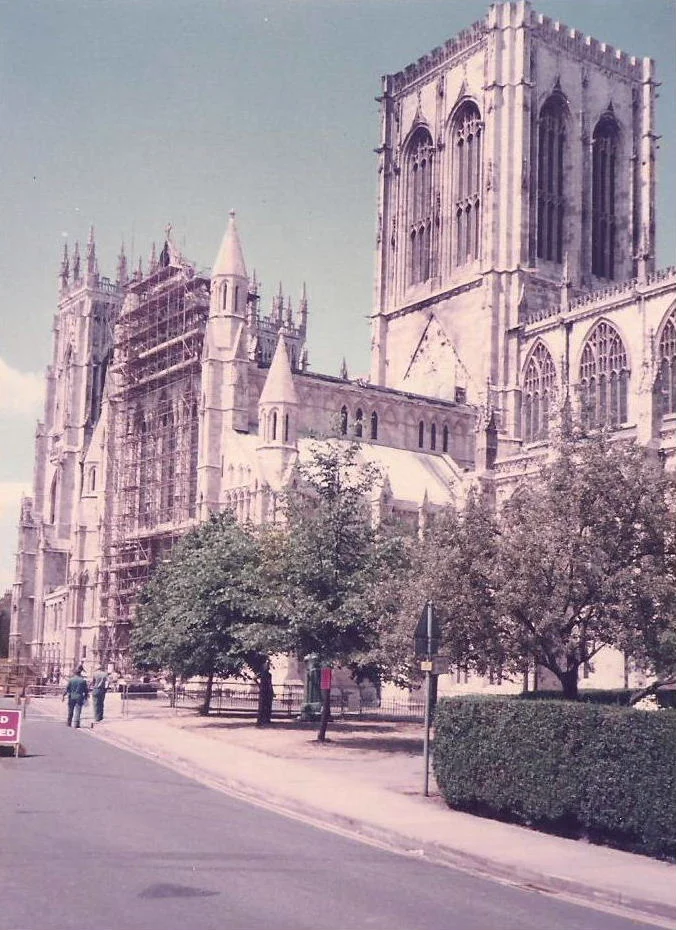

York Minster fire
On the morning of 9 July 1984, the fire brigade arrived at York Minster and found cathedral staff running into a burning building with wet handkerchiefs over their faces. They were rescuing books of remembrance, candlesticks, altar cloths - anything they could carry from beneath a 200-foot column of flame. Three days earlier, in the same cathedral, the Most Reverend John Habgood had consecrated David Jenkins as Bishop of Durham despite public controversy over Jenkins's theological views. By that afternoon, parts of the British press were asking whether God had a message for the Church of England. The Archbishop of York called the notion 'ridiculous.' The investigators called it a lightning strike.
The Fifth Fire
York Minster has burned five times. A fire in the south transept in 1753 was blamed on workmen burning coals. In 1829, a man named Jonathan Martin set fire to the choir using torn hymnbooks and wood from the pews. In 1840, an unattended candle started a fire in the south nave roof. In 1971, a tarpaulin caught fire in the north-west tower. And in 1984, the south transept roof was destroyed by what investigators concluded was an 80-percent-probable lightning strike during the storm that crossed the Minster between the late evening of 8 July and the early hours of 9 July. The fire is thought to have started around 1:00 a.m. and burned undetected for 90 minutes before the 2:30 a.m. phone call to the fire control room at Northallerton.
Climbing Toward the Roof
When the fire brigade arrived, they could not reach the burning roof. Firefighters wearing breathing apparatus climbed the spiral staircase carrying ropes - meant to haul hoses up to the roof level - but the heat and locked doors stopped them. They had to work from external ladders, dousing a fire 100 feet above the ground. The intense heat reached the famous Rose Window. The glass - installed in the 15th century after the Wars of the Roses ended and recently renovated - cracked into 40,000 pieces. Crucially, the lead edges held the pieces in place. None of the glass was lost. Firefighters used a 100-foot ladder to spray water on the window directly, cooling it gradually rather than letting it shatter from differential temperature shock. Flames reached almost 200 feet into the night air. Sparks rained on the neighbourhood, and residents in nearby streets were evacuated.
The Decision to Pull It Down
Over 120 firefighters worked the blaze, with 20 pumps and three turntable ladders. Crews came from as far as Scarborough, Harrogate and Selby. Hose lines ran all the way to the River Ouse for water supply. The prevailing wind was blowing the fire toward the rest of the cathedral, threatening the central tower. With the south transept roof structure already compromised, the senior fire officers made the call: bring the burning roof down deliberately to create a firebreak. Jets of water were used to collapse the remaining roof timbers - logged at 4:00 a.m. The firefighters in the roof space reported a strange sensation of the floor moving as the timbers slipped beneath their feet, lubricated by molten lead from the roof covering. The fire was declared under control at 5:54 a.m. Crews stayed on damping down for 24 hours. The cathedral still stood.
Lightning or Judgment
Three days before the fire, John Habgood, Archbishop of York, had consecrated David Jenkins as Bishop of Durham. Jenkins had recently questioned literal interpretations of the Virgin Birth and the bodily Resurrection in a television interview, and there had been protests against his consecration. When lightning - or something - then set the same cathedral on fire, parts of the press jumped on the symbolism. Letters to The Times argued whether it was divine displeasure. Habgood publicly dismissed the suggestion as ridiculous. Investigators considered three theories: lightning, arson by a protester, and electrical fault. They concluded lightning was 80% likely - based on the storm that night, the inaccessibility of the roof space where the fire started, and the absence of any public visitor in that area for five and a half hours before the predicted start time. Arson and electrical fault were given 10% chance each. The cause of the fire was atmospheric, not theological.
The Ferrands Oak
By the morning after, debris lay 5 feet deep on the south transept floor. The collapse of the roof actually allowed the first detailed archaeological study of the area in centuries - each charred timber was measured, catalogued, and kept. Within three weeks the masonry and timber were cleared and a temporary aluminium and plastic roof installed to keep the rain out. A later movable roof on rails let cranes manoeuvre new material in and out. A request went out for tall oaks. Among the trees felled was the Ferrands Oak from the St Ives estate in West Yorkshire - over 80 feet tall and 250 years old, taller than the roof it would replace. Of the medieval carved roof bosses, only six could be saved. Six new bosses were designed by children through a campaign by the BBC television programme Blue Peter. Insurance from the Ecclesiastical Insurance Fund covered most of the £2.25 million reconstruction. Public donations of up to £500,000 paid for an upgraded lightning conductor system. The rededication ceremony took place in October 1988 in the presence of Queen Elizabeth II. The Rose Window is still there, and the bosses designed by 1980s schoolchildren are now part of the medieval cathedral's ceiling.
From the Air
York Minster stands at 53.962°N, 1.081°W, dominating the centre of historic York. From the air, the cathedral's two western towers and central lantern tower are the city's most recognizable feature - visible for many miles in clear weather. The south transept is the central wing facing south, away from the river. Leeds Bradford (EGNM) is about 22 nm southwest. From cruising altitude on clear days, York Minster is one of the easiest landmarks to identify in northern England.
Nearby Stories
- Scampston Hall 3.5 km away
- Salts Mill 4.7 km away
- Newburgh Priory 6 km away
- Brodsworth Hall 6.2 km away
- Coverham Abbey 16 km away
- RAF Leconfield 17 km away
- Macclesfield Canal 27 km away
- RAF Scampton 35 km away