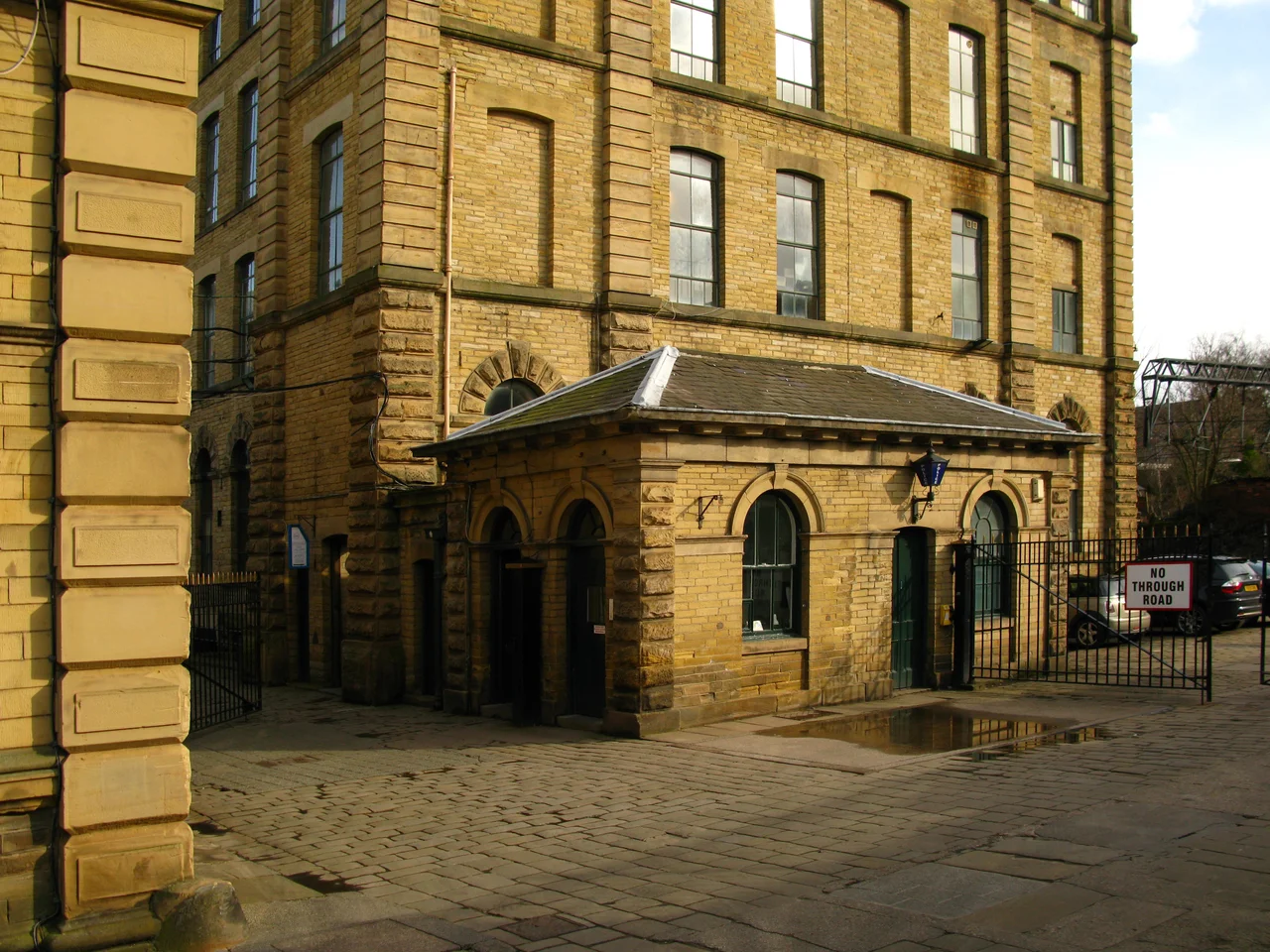

Salts Mill
Titus Salt did not believe a textile mill had to grind workers into dust. He had walked through the dye houses of nearby Bradford in the 1840s, where children worked sixteen-hour shifts among dangerous machinery, where disease moved through tenements like weather. So in 1853, on a green stretch of the River Aire three miles north of the city, he opened a mill so large it broke records and a village so orderly it had no pubs. Salts Mill was the biggest industrial building on Earth when its doors swung open. The 1853 Gallery, today's main exhibition space, still carries the date as its name.
A Mill Against the Grain
Bradford had grown rich on wool and cruel in the doing. Salt commissioned Salts Mill and the surrounding village of Saltaire as a deliberate rebuke to that cruelty. He hired the respected Bradford building firm J and W Beanland, picked stone that would carry six storeys without flinching, and surrounded the works with stone cottages, a hospital, schools, a church, almshouses and washhouses. Workers had ventilation and daylight; their children had teachers. The Italianate campanile of the mill chimney was meant to be admired, not endured. Whether Salt's paternalism was generous or controlling depended on whose side of the loom you stood, but conditions at Saltaire were undeniably better than the alternative. UNESCO inscribed the village as a World Heritage site for exactly that reason: a complete surviving example of a Victorian model industrial settlement.
The Long Silence
Spinning continued for a century and a third. Then in 1986, the last shift walked out and the great floors went dark. Saltaire's reason for existing had vanished. Within a year the empty mill was bought by Jonathan Silver, a Bradford-born entrepreneur in his late thirties who had already sold a clothing chain and travelled the world. Silver saw something else in the cavernous space. He cleaned the soot from the walls, opened the 1853 Gallery, and persuaded a local artist named David Hockney to lend works. Hockney had grown up in Bradford. The two men became close friends, and Hockney kept on lending. Today the mill houses one of the largest public collections of his paintings, drawings and stage designs anywhere in the world.
Hockney's Yorkshire
The pictures hang where weavers once stood. A wall of swimming-pool blues from Los Angeles, a wall of Yorkshire moors painted in colours that no photograph can carry, prints made on iPads in the last decade beside lithographs from the 1960s. Hockney's relationship with the mill outlasted Silver, who died in 1997. The artist continued sending work, including the great landscape series he made after returning to Yorkshire in the 2000s. In August 2024 Bradford's Peace Museum moved into the mill's third floor, funded by the city's stint as 2025 UK City of Culture and the National Lottery. A textile mill that once helped clothe an empire now holds paintings, books, restaurants and a small museum dedicated to peace. Titus Salt, who hated waste, would probably approve.
Walking the Village
Saltaire repays slow looking. The stone cottages on the gridded streets still house residents, though property prices have crept upward. The United Reformed Church Salt built in 1859 holds his tomb. The Leeds and Liverpool Canal runs alongside the mill, towpath busy with cyclists and walkers heading toward Bingley's famous Five-Rise Locks a few miles upstream. The village is one stop from central Bradford on the Airedale line. Visitors come for Hockney and stay for an afternoon of Victorian streetscape that never had a chance to grow ugly because Salt would not let it.
From the Air
Salts Mill sits at 53.84 N, 1.79 W in the Aire Valley three miles north of central Bradford and four miles south of Keighley. The closest airport is Leeds Bradford (EGNM), six miles east-northeast across the moor. Manchester (EGCC) lies thirty-five miles south-southwest. From altitude, look for the distinctive long rectangular roof and Italianate chimney rising beside the silver curve of the River Aire and the parallel line of the Leeds and Liverpool Canal. Best viewed from 3,000 to 5,000 feet on a clear day; the mill is unmistakable against the green of Shipley Glen and Baildon Moor to the north.
Nearby Stories
- Battle of Seacroft Moor 3 km away
- RAF Topcliffe 7.4 km away
- Pretoria Pit Disaster 8.7 km away
- Lundhill Colliery Explosion 11 km away
- Forest of Bowland 12 km away
- Coverham Abbey 16 km away
- Macclesfield Canal 18 km away
- Leighton Hall, Lancashire 21 km away