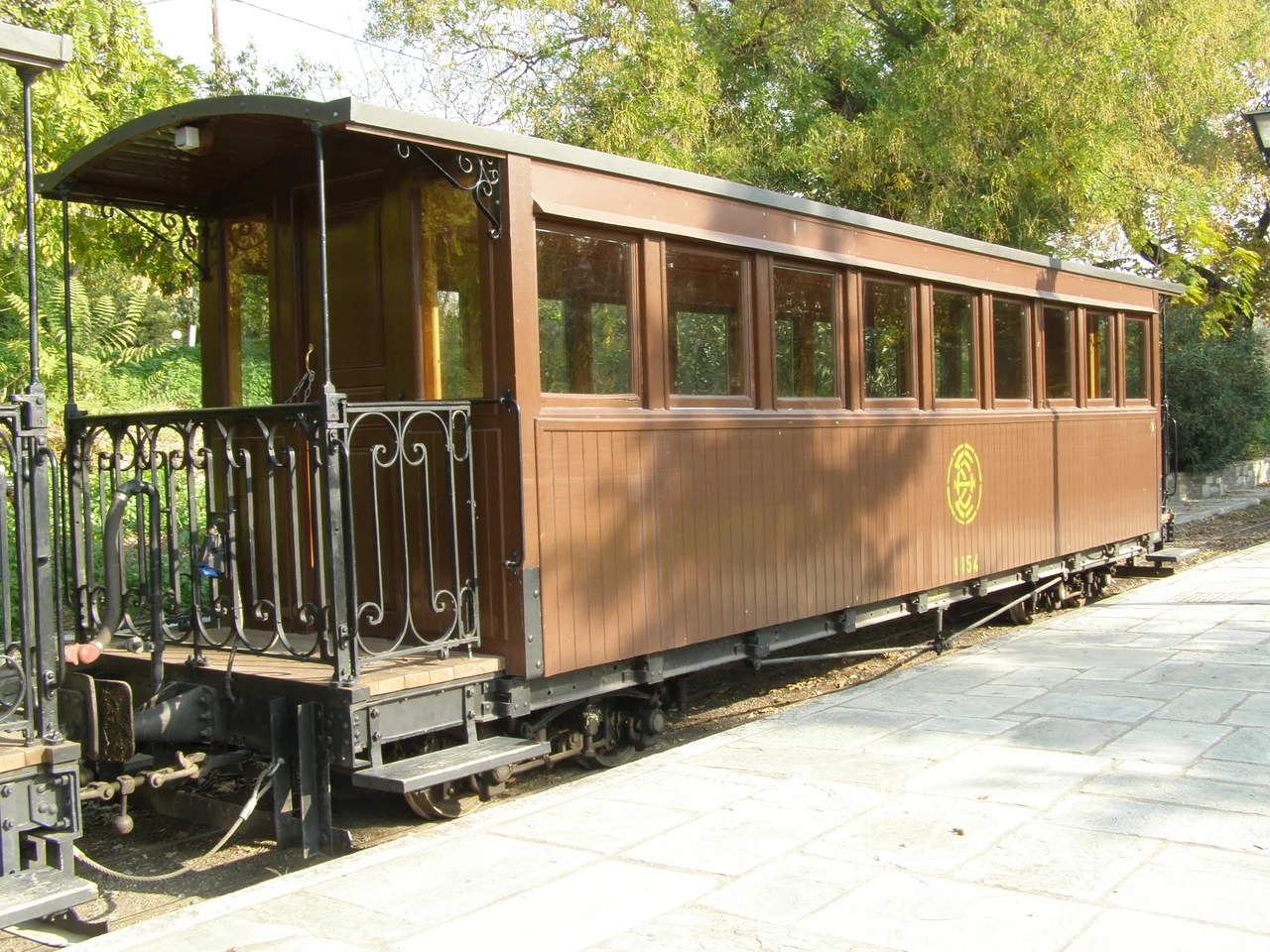

Pelion railway
A small boy once watched his father lay this railway through the mountains, and never forgot it. The father was Evaristo de Chirico, an Italian-Greek engineer who threaded a narrow-gauge line up the flank of Mount Pelion at the turn of the twentieth century. The son was Giorgio de Chirico, who grew up to become one of the most influential painters of the modern era. For the rest of his life, Giorgio slipped tiny trains into his haunting, dreamlike canvases, half-hidden behind arches and walls, the trains of a Pelion childhood surfacing again and again in the work of a master.
An Engineer and His Watching Son
The Pelion railway is sometimes called the De Chirico train, and the nickname carries a whole family story. Evaristo de Chirico designed the line, supervising its construction in stages between 1894 and 1903. Working alongside the project was his young son Giorgio, born in Volos, who absorbed the sight of locomotives moving through the mountain landscape. Decades later, having helped invent Metaphysical painting and inspired the Surrealists, Giorgio de Chirico kept returning to the image of a small train, often tucked into the background of an otherwise still and dreamlike scene. Few railways anywhere can claim to have shaped the visual imagination of a great artist. This one runs straight through it.
Narrow Gauge, by Necessity
The line began as an ambition of the Thessaly Railways company. Having completed its metre-gauge routes from Volos to Larissa in 1884 and onward to Kalampaka in 1886, the company looked east toward the communities of the Pelion peninsula. But the terrain was unforgiving and the space tight, so engineers chose a narrow gauge that could thread the mountainside. The railway crept outward from Volos, reaching Agria in 1892, Ano Lechonia in 1896, and finally Mileai, or Milies, in 1903. The lower stretch near Volos ran essentially as a tramway through the city. It was only above Ano Lechonia that the line revealed its real character, climbing into terrain where ordinary railway building gave way to something closer to mountaineering in iron and stone.
Bridges, Tunnels, and a River of Stone
The mountain section from Ano Lechonia to Mileai is the engineering heart of the railway. Across this stretch the builders threw seven stone bridges, bored two tunnels, and carried five stone road bridges over the line, finishing at Milies with a graceful iron bridge. Engine sheds rose at Volos, Agria, and Mileai, and water towers stood ready to slake the steam locomotives along the climb. To ride it is to feel the engineering in your body: the slow grade, the curves hugging the contours, the lush Pelion greenery sliding past the windows. This was never a railway built for speed. It was built to reach places that a faster line never could.
Suspended, and Saved
The railway's fortunes followed Greece's. Thessaly Railways ran it as a private line until 1955, then the state took over, and in 1971 it passed to the Hellenic Railways Organisation, which promptly suspended service to save money. For a time the train seemed finished. But affection for it ran deep. The Friends of Pelion Railway revived a lower stretch as a heritage line from 1987 to 1994, and in 1996 the upper section from Ano Lechonia to Mileai reopened, first with steam, then with diesel from 1999. Stations at Ano Lechonia and Agria, battered by earthquakes, were rebuilt to their original designs. Today the little train runs on weekends and holidays from spring into autumn, daily through July and August, carrying passengers up the same slopes a boy once watched his father conquer.
From the Air
The Pelion railway climbs from Volos (near 39.33 degrees N, 23.05 degrees E) eastward and upward toward Milies on Mount Pelion, with the operating heritage section running between Ano Lechonia and Mileai. A viewing altitude of 4,000 to 7,000 feet reveals the line tracing the lower wooded slopes above the Pagasetic Gulf. The nearest airport is Nea Anchialos National (ICAO: LGBL), southwest of Volos. Look for the green coastal foothills between the city and the high forested ridge; the railway threads this band of terrain. Morning light off the gulf gives the clearest view of the mountainside.
Nearby Stories
- Farsala 10 km away
- Oreus 10 km away
- Glossa 13 km away
- Archaeological Museum of Lamia 14 km away
- Tempi Train Crash 55 km away
- Mount Olympus 61 km away
- Siege of Euripos 62 km away
- Byzantine Empire under the Palaiologos Dynasty 112 km away