_-112.jpg)
Pembroke Dockyard
On 10 February 1816, two twenty-gun warships slid down their slipways into Milford Haven within hours of each other - HMS Valorous and HMS Ariadne, the first ships ever built at Pembroke Dockyard. For the next 112 years, the yard would launch another 261 vessels and five royal yachts, the last on 26 April 1922. Then the Admiralty did the arithmetic and decided the place was redundant. The yard closed in 1926. The town it had created went into shock. And the Royal Air Force quietly began making other plans for the site.
Why Build Ships Here at All
The Admiralty had been thinking about a dockyard at Milford Haven since 1757, when a surveying delegation reported to Parliament that a yard should be built here. The argument was lobbied for hard - the report, it later turned out, exaggerated the existing infrastructure to make the case more compelling. At the time, there was no town called Milford, only the village of Hubberston on the north shore. Naval shipbuilding had been happening on a small scale at Jacobs' private yard. When the Admiralty finally committed to building a Royal yard in the early 1800s, they chose the south shore - greenfield land owned mostly by the Meyrick family - and bought twenty additional acres for 5,500 pounds. The site had no town, no workers' housing, and no infrastructure. The closest accommodations were in Pembroke, three miles inland. Workmen commuted by rowboat from nearby villages until the new town of Pembroke Dock filled in around the walls. The frigate HMS Lapwing, beached and stripped, served as the yard's office building. A hulked 74-gun ship housed the Royal Marine garrison after 1832.
The Royal Yachts
Most of what Pembroke built was workmanlike - sloops, gunboats, frigates, training ships, the kind of vessels that made the Royal Navy a global instrument. But five times in those 112 years, the orders came for something more theatrical: royal yachts. These were the floating stages on which monarchs received foreign dignitaries and reviewed their fleets. To build them, Pembroke craftsmen had to deliver finishes good enough for a king's eye - inlaid woods, gilded carvings, fittings polished until they doubled the light. The yard developed a reputation for it. The Metropolitan Police took over dockyard security in 1860 - the No. 4 Division specifically created for naval bases - and stayed in that role until the 1920s. Civilian guards had not been sufficient for a place where vessels worth a small fortune sat partly built on the slipways.
Closure
The First World War had drained the Admiralty's budget. Peace meant smaller fleets, and smaller fleets needed fewer yards. In 1925 the Admiralty announced that Pembroke Dock and Rosyth - both far from the Channel where any future war would likely be fought - would close. The town of Pembroke Dock petitioned Prime Minister Stanley Baldwin, stressing that there was no alternative employment in the area and that closure would devastate the local economy. The petition failed. First Sea Lord Admiral Earl Beatty stated the case bluntly: 'Whether these Yards are necessary for naval purposes, the Admiralty is the only competent judge. As to whether they are necessary for political or social reasons is for the Government to decide. The fact is, that so far as the upkeep of the Fleet is concerned, they are entirely redundant.' Pembroke closed in 1926. The last Captain-Superintendent, Leonard Donaldson, died thirty years later, aged 81, in the same year the last Pembroke-built ship - a hulked iron frigate - was finally broken up in Belgium.
A Dockyard Reborn as an Airfield
The Royal Air Force moved onto the site in 1930. Hangars went up where slipways had stood. Many original buildings were demolished to make room. The Sunderland flying boats that would guard the Western Approaches during the Second World War were maintained and launched from what had once been the Royal Navy's dockyard - an irony nobody dwelt on at the time. The base remained an official Royal Navy Dockyard despite the lack of warships, retaining a Queen's Harbour Master until 2008, one of the last five QHMs in the United Kingdom. The Royal Maritime Auxiliary Service kept a base here until the same year, when the Ministry of Defence sold the freehold to Milford Haven Port Authority. The actual dockyard work had ended eighty-two years earlier.
What Survives, What Was Lost
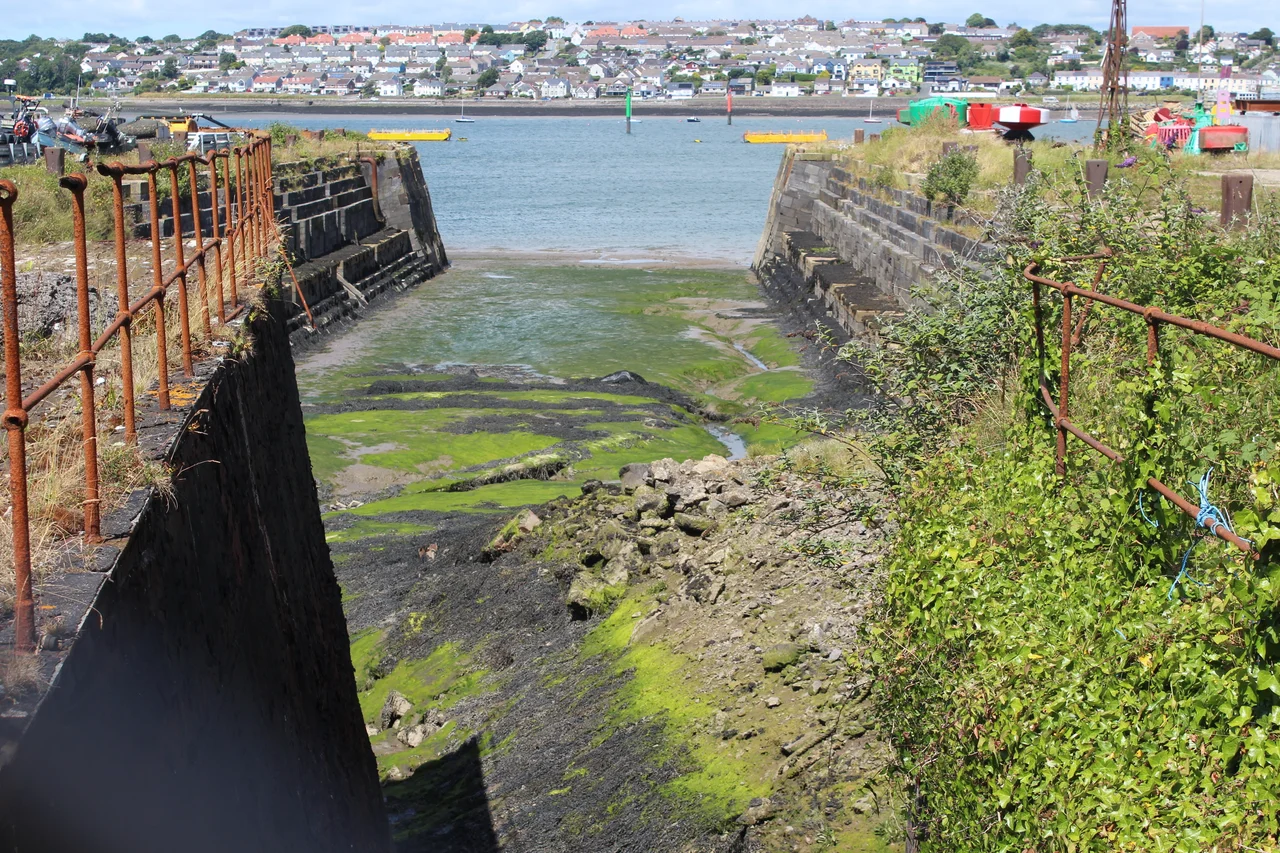
The dockyard wall is substantially intact, recently repaired with dressed stone and lime mortar by craftsmen working as their predecessors did. The dry dock remains. Two of the original ten building slips survive. The Terrace, a row of Georgian houses where the dockyard officers lived, still stands inside the walls, along with several other Georgian and Victorian buildings. The Dockyard Chapel at the end of the Terrace was rebuilt with European funding and reopened as the Pembroke Dock Heritage Centre. The Paterchurch Tower, a medieval lookout that pre-dates everything else by half a millennium, is Grade I listed - the only Grade I structure on the site. Eighteen other buildings are Grade II*. 107 listed buildings in total. In 2021, despite protests from SAVE Britain's Heritage, the Georgian Group, the Victorian Society, the Naval Dockyards Society, and the Society for the Protection of Ancient Buildings, planning permission was granted for a 60 million pound marine energy redevelopment that will demolish or infill significant heritage assets, including the Grade II* graving dock and Grade II timber pond. The Commodore Trust called the plan the destruction of 'a rare, if not unique, group of listed monuments that are a testament to the industry that gave birth to Pembroke Dock.' Pembrokeshire County Council judged the economic benefits would outweigh the heritage loss. The yard that built the Royal Navy will become a yard that builds offshore wind components. The change of name will be quieter than the change of purpose.
From the Air
Pembroke Dockyard occupies the south shore of the Milford Haven Waterway at 51.70 N, 4.95 W, immediately west of Pembroke Dock town. From the air, the rectangular walled enclosure is visible against the waterfront, with two large former RAF hangars near the center and the Cleddau Bridge to the east. The dry dock and remaining slipways read as dark rectangles cut into the shore. Best viewing 4,000-8,000 feet. Nearest airports: EGFE (Haverfordwest) 7 nm north, EGFH (Swansea) 60 nm east. Maritime weather - low cloud and rain are common, but visibility is often better over the haven itself.
Nearby Stories
- Abercych 1.3 km away
- Pendine Sands 6.4 km away
- HMS H47 20 km away
- HMHS Glenart Castle 43 km away
- Ilfracombe Lifeboat Station 45 km away
- Johnstown Castle 67 km away
- Hook Lighthouse 98 km away
- 1979 Fastnet Race 142 km away