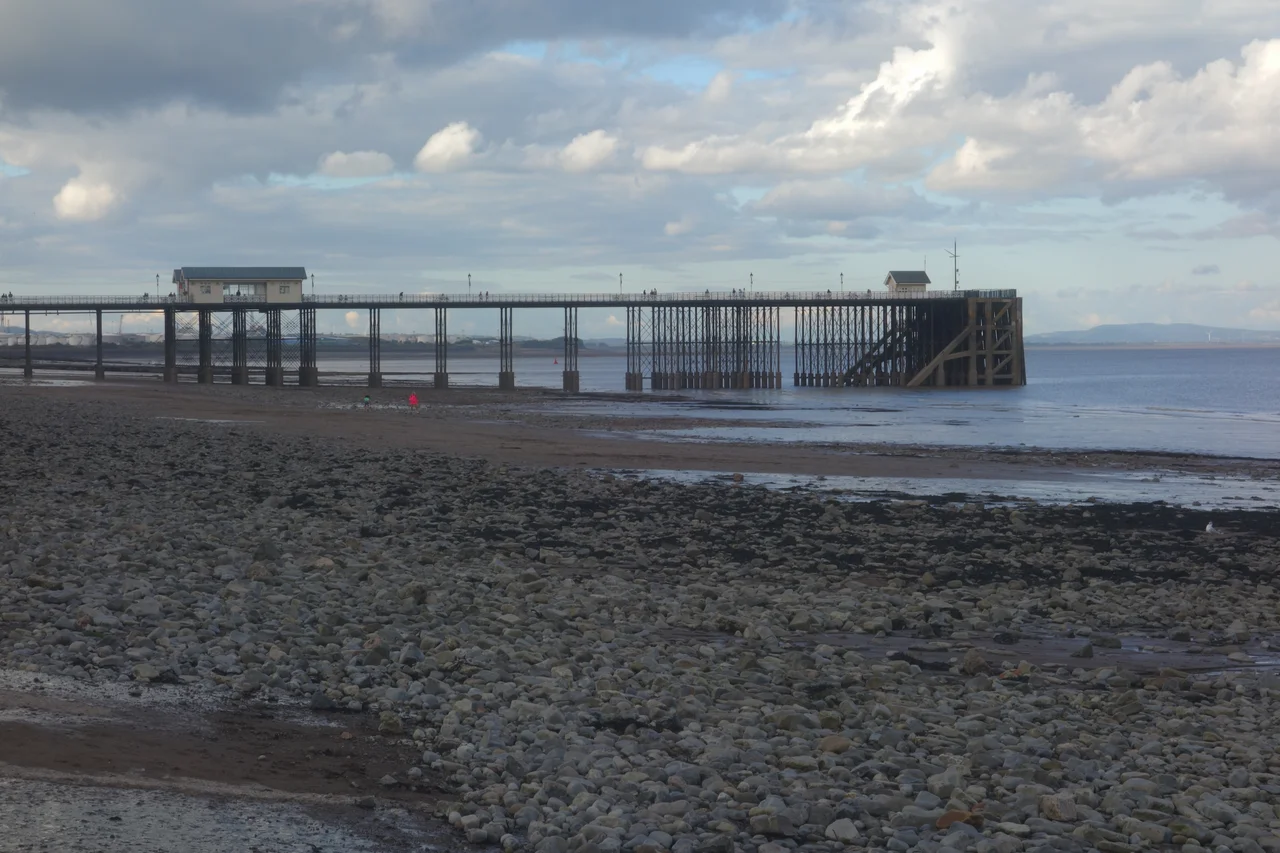

Penarth Pier
On August Bank Holiday 1931, the Penarth Pier was on fire. The wooden Concert Party theatre at the far end had gone up, and the flames were threatening to take the rest of the structure with it - over 800 holidaymakers needed to get off the burning pier and back to land. They all made it. The fire then proceeded to crack the decking and fracture or displace more than seventy of the main cast-iron supports holding the pier above the Bristol Channel. The wooden pavilion was never rebuilt. The pier was. Today the Penarth Pier still juts 658 feet out into one of the most ferocious tidal ranges in the world, and was voted Pier of the Year in 2014 by the National Piers Society. It is shorter than its builders wanted because the deep-water channel into Cardiff Docks would not let them make it any longer.
The Cardiff-Penarth Ferry
Penarth sits across the mouth of the Taff from Cardiff, separated by a stretch of muddy estuary that, in the mid-nineteenth century, was a serious commute. From 1856 the Cardiff Steam and Navigation Company ran a regular ferry service between the two towns. The service used a landing stage on wheels that was hauled up and down Penarth beach as the tide demanded - a perfectly ridiculous arrangement that worked anyway, and continued until 1903. As Penarth grew as a seaside resort in the 1880s, the obvious solution was to build a permanent pier. The first attempt failed when the London-based contractors went into liquidation early in construction. The second attempt, by the Mayoh Brothers, began in 1894 - cast iron screw piles driven into the seabed, cast iron columns rising from them, a timber deck on top. The pier opened in 1895, originally 750 feet long.
Short by Necessity
When the pier was formally completed in 1898, it had been shortened to 658 feet - and it was kept short for a specific reason. Any longer and it would have started intruding into the deep-water channel that ocean-going ships used to enter Cardiff Docks. In 1898 Cardiff was the busiest coal port in the world, with shipping movements that could not be obstructed by a pleasure pier. James and Arthur Mayoh built it, assisted by local engineer Herbert Francis Edwards. It served two purposes: a promenade for holidaymakers, and a landing jetty for the pleasure steamers that worked the Bristol Channel. The pier was immediately popular. P & A Campbell of the White Funnel fleet ran cruises from the jetty - day-trips to Weston-super-Mare across the Channel, to Ilfracombe down the Devon coast, or further to Lundy Island. In 1907 a small wooden Concert Party theatre was added at the far end of the pier, hosting variety shows and music-hall acts.
The Bank Holiday Fire
Then came August Bank Holiday 1931 - one of the busiest days of the British seaside calendar. The Concert Party pavilion caught fire. Eyewitness accounts describe the flames spreading rapidly through the wooden structure while crowds on the pier itself moved back toward land. Over 800 people are recorded as having survived the evacuation. The wooden pavilion was a total loss, never rebuilt. The structural damage to the cast iron underneath was more serious: more than seventy of the supporting columns were fractured or shifted. The repairs included underpinning the surviving cast-iron columns and adding new cast-concrete supports. The pier reopened, eventually, with a concrete pavilion replacing the wooden one - a building that would, over the decades, serve in turn as concert hall, ballroom, cinema, and home to the present Penarth Pier Pavilion. The Welsh weather had been kept at bay; the human fire had not.
The End of the Pleasure Steamers
The pier outlived its original purpose. P & A Campbell's last regular paddle steamer service from Penarth, the White Funnel fleet, ran for the final time in 1966. The motor vessel Balmoral - the same MV Balmoral that still operates today as a heritage cruise ship - continued occasional cruises from the pier until 1982, when P & A Campbell ceased operations entirely. After that the pier had no shipping function at all. It became simply what it had always also been: a Victorian iron-and-wood promenade reaching out into the Bristol Channel, owned now by the Vale of Glamorgan Council, open all year, free to walk, with sea fishing permitted from the pier head outside the summer months.
The Restoration
Dr David Trotman became director of the Penarth Pier Pavilion project in 2013 and announced the iconic pier would be used 'to educate, inform and entertain.' Major exterior renovation followed: faded paint on the barrel roof and the four domes was replaced with ornamental zinc tiles, and the building was systematically restored. Inside, the pavilion now contains an art gallery, an auditorium, a cinema seating seventy, retail space, a bar, and a tea room with a view straight out across the Bristol Channel toward the English coast. In 2014 the National Piers Society voted Penarth Pier the Pier of the Year. It is one of the few surviving Victorian pleasure piers in Wales, with a long list of contemporaries lost to fire, storm, or simple economic neglect - Aberystwyth, Rhyl, Tenby and many others gone or damaged beyond recovery. Penarth survives in something close to its original form, and it has had over forty years now to be the version of itself that no longer has to compete with paddle steamers.
On Television
Since 2007 the pier has appeared in idents on S4C, the Welsh-language broadcaster, as part of its on-air branding - usually a slow drone shot of the pier and the Channel at golden hour. In 2008 a Torchwood episode called To the Last Man used the pier as a location, with the characters Tosh and Tommy sharing a brief moment on Penarth Pier - the script noting (correctly) that the pier was built in 1894, the same year Tommy was born. Marta Ghermandi succeeded Trotman as director in 2018. From the air, the pier is a straight line of light brown timber and cast iron crossing the deep brown of the Channel water, the white pavilion at the landward end and the open pier head 658 feet out. The Bristol Channel's tides still rise and fall around the columns. The visitors still come for the view, the fishing, the cinema, the tea room. The wooden theatre that burned in 1931 left only its concrete replacement, and that is enough.
From the Air
Located at 51.44°N, 3.17°W, projecting from the town of Penarth into the Bristol Channel, on the south side of Cardiff Bay. The pier extends 658 feet from the shore at the south end of the Penarth seafront, just south of the Cardiff Bay Barrage entrance. Cardiff (EGFF) is approximately 4 miles northwest. Best viewed at 1,000-2,000 feet AGL with the Bristol Channel opening south toward Steep Holm and Flat Holm islands, and Cardiff city and the bay clearly visible to the north. The bright pavilion dome and the line of the pier make a clear photographic subject from the south.
Nearby Stories
- Aberfan Disaster 1.3 km away
- Glastonbury 6.5 km away
- Quantock Hills 7.4 km away
- Tyntesfield 7.5 km away
- Tintern 9.2 km away
- The Mumbles Lifeboat Station 19 km away
- Carreg Cennen Castle 20 km away
- Appledore Lifeboat Station 26 km away