.jpg)
Penmon Lifeboat Station
On 26 March 1823, the Reverend James Williams and his wife Frances stood on the cliffs of Anglesey and watched a hundred and forty people drown. The vessel Alert had gone aground close enough to hear the shouts and far enough that nothing on shore could reach her in time. Williams was a clergyman at Llanfair-yng-Nghornwy. His wife was as formidable as he was. The two of them spent the next five years raising money and political pressure for an organised lifeboat service on the Anglesey coast. The Anglesey Association for the Preservation of Life from Shipwreck was founded in 1828. Their first boat, stationed at Penmon Point in January 1831, would launch eight times in its first eighteen years and save twenty-seven lives.
Penmon Point
The station sat at the eastern tip of Anglesey, between Black Point and the small green hump of Ynys Seiriol, Puffin Island. The tides rip through this narrow channel. The Lavan Sands lie just to the south, drying for square miles at low water, threading themselves through with channels that change with every spring tide. Liverpool-bound ships caught with the wrong wind on the wrong tide had been wrecking themselves here for as long as anyone could remember. The 26-foot six-oared Palmer-type lifeboat that Harton of Limehouse built for the new station arrived by sea on 28 January 1831, having sailed via Kingstown in Ireland and Holyhead. Sir Richard Williams-Bulkeley, the local landowner, paid for the boathouse, a sturdy 32-by-10-foot stone building with doors at both ends so the boat could go straight into the sound or be hauled out for launching elsewhere along the coast.
The Rothsay Castle and What Followed
The Penmon station had been operating for seven months when the paddle steamer Rothsay Castle, returning from Liverpool to take a day-trip party home from Beaumaris, ran aground on Dutchman Bank in the early hours of 18 August 1831. A hundred and thirty people died on a vessel that should not have left port and was commanded by a captain too drunk to turn her back when the weather threatened. The inquest held at Beaumaris was excoriating. The disaster forced the placement of a permanent lifeboat at Penmon under formal management the following year, 1832, and the building of Trwyn Du lighthouse in 1838. James and Frances Williams had been right to push for what they pushed for. The Rothsay Castle showed why.
Christopher Brown and the Settle Connection
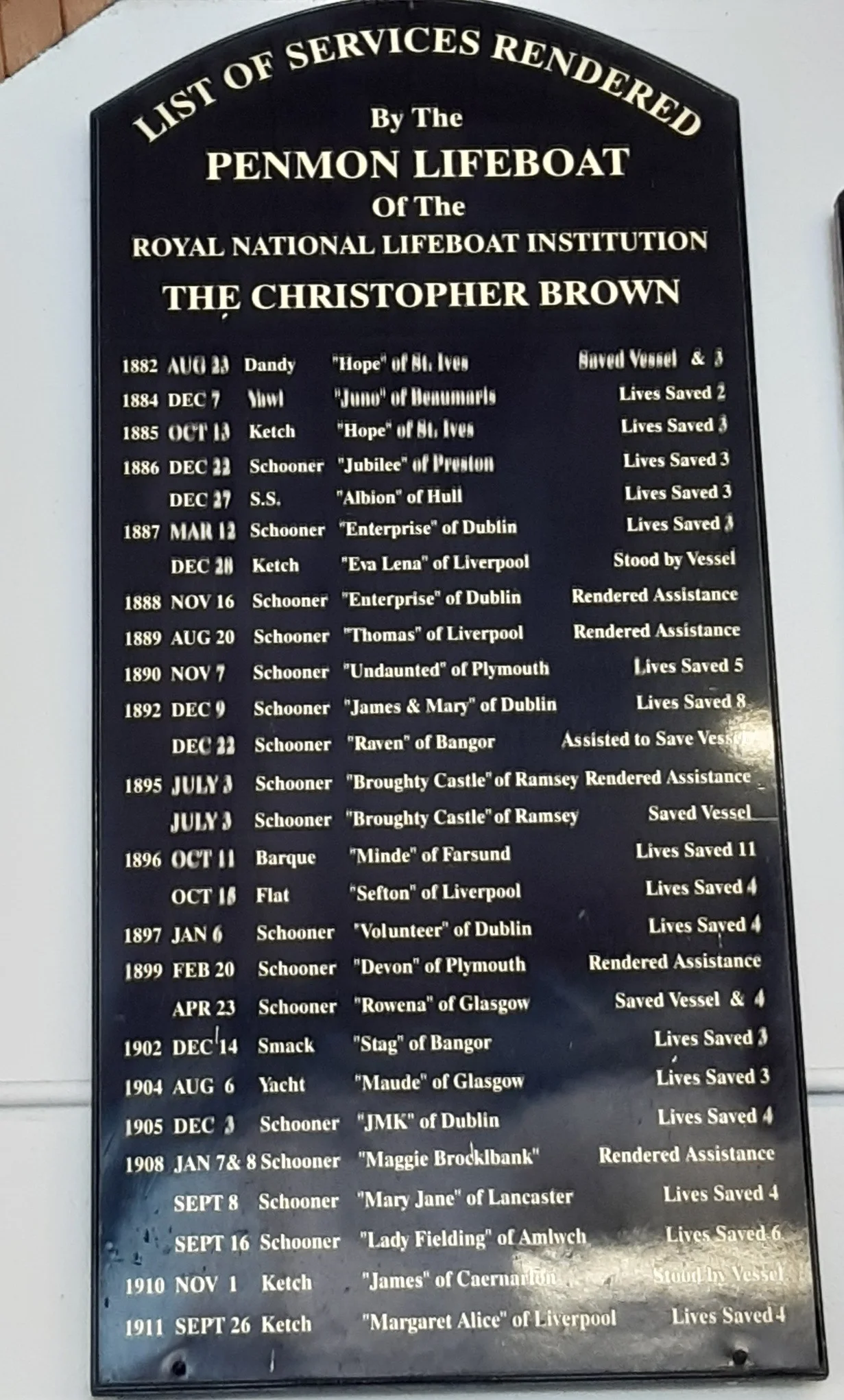
The Royal National Lifeboat Institution took over the Penmon station in 1855. A new self-righting boat arrived in 1868, named Christopher Brown after the principal fundraiser of the Settle, North Yorkshire branch of the RNLI. Settle is nowhere near the sea, but Yorkshire towns far inland raised remarkable sums for coastal rescue, and the Settle branch funded successive Penmon boats over decades. A new boathouse went up in 1880 to receive a 34-foot lifeboat, also named Christopher Brown, also paid for by Settle. The slipway washed away in a storm during the rebuilding and the boat had to be moored afloat for two years. Storms at Penmon Point are not gentle. The men who took the boat out into them earned medals in the conventional way.
The Honours List
Penmon won medals heavily. Owen Roberts, a pilot, received the silver medal of the RNIPLS in 1838. Thomas Price, a fisherman, took the RNLI silver medal in 1854. William M. Preston, the honorary secretary, and Robert Roberts, the coxswain, each received silver medals in 1890 and added second-service clasps in 1893. Coxswain Superintendent William Pritchard received the silver medal in 1909 and a second-service clasp the following year. These were not awards handed out lightly. Each represents a service call in conditions where the lifeboat-men knew the odds were against them and went anyway. The names are worth recording because their owners are not.
Closure
The Penmon station closed in 1915 because Beaumaris had taken delivery in 1914 of the motor lifeboat Frederick Kitchen, a 43-foot vessel with a 60-horsepower petrol engine that could cover the same waters from a base closer to the town and more easily crewed. The transition from oar-and-sail to motor power consolidated the coastline's lifeboats at fewer, more capable stations. The Penmon boathouse, that solid stone building with the double doors, still stands. The lighthouse beyond it, James Walker's elegant sea tower of 1838, also stands. The lifeboat-men's silver medals are in museum collections. The sea between Black Point and Puffin Island is sometimes calm, sometimes not, and continues to draw small craft into trouble. The Beaumaris boat now answers those calls.
From the Air
Penmon Lifeboat Station's site is at 53.31 north, 4.04 west, at Penmon Point on the eastern tip of Anglesey. The original boathouse stands next to the channel between the mainland and Puffin Island (Ynys Seiriol). Recommended viewing altitude 2,000 to 4,000 feet to see the point, Trwyn Du lighthouse just offshore, and the Lavan Sands flats to the south. Tides drop the sands to expansive flats at low water. Nearest airports EGOV Valley on Anglesey to the northwest, EGCK Caernarfon to the south. The Menai Strait reads clearly from the air on a clear day.
Nearby Stories
- Pen-y-Pass 1.6 km away
- Rhyl Lifeboat Station 2.4 km away
- HMS Resistance (1861) 3.1 km away
- Tudweiliog 21 km away
- German submarine U-246 22 km away
- Horseshoe Pass 22 km away
- Celtic Array 30 km away
- Birkdale Palace Hotel 32 km away