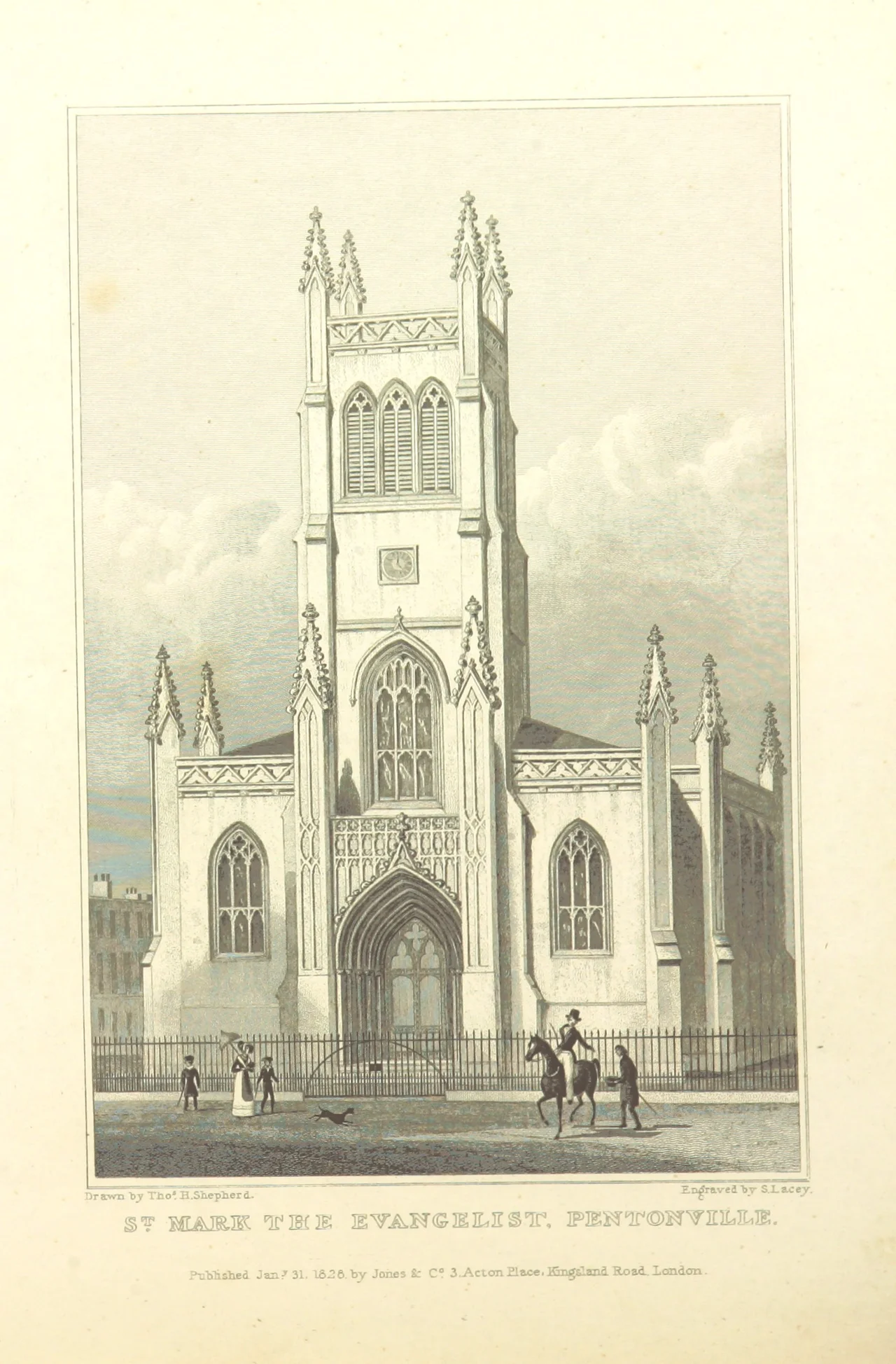
,_p328.jpg)
Pentonville
In 1902, Vladimir Lenin and his wife moved to a flat just off Pentonville Road. It was around this time that Lenin met his fellow exile Leon Trotsky for the first time. Two of the most consequential revolutionaries in modern history, introduced to each other in a quiet North London street — not in Moscow, not in Geneva, but in Pentonville.
Fields to Streets
Pentonville was farmland until the 1770s, when a developer named Henry Penton acquired large parcels of countryside adjacent to the New Road — the first bypass road built around London, running east to west along what is now Euston Road and Pentonville Road. Penton developed a grid of streets on what had been open ground on the northwestern edge of the ancient parish of Clerkenwell, naming the area after himself. The New Road defined the southern boundary; fields pressed in from the north. Georgian terraces went up on the new streets, modest but respectable: the kind of housing that attracted professionals, minor clerks, and people who needed to be within reach of the City but could not afford its centre. By the time the London Government Act 1899 incorporated Pentonville into the Metropolitan Borough of Finsbury, the neighbourhood was settled and unremarkable in the way that long-established places often are.
Notable Births and Arrivals
Pentonville is the birthplace of two figures whose careers bent in opposite directions. John Stuart Mill, the philosopher and political economist, was born here in 1806, in a household already oriented toward rigorous intellectual life — his father James Mill was a significant thinker in his own right. Mill would become one of the 19th century's most influential philosophers, championing liberty, utilitarianism, and the rights of women. Four years after Mill's birth, in 1810, Forbes Benignus Winslow arrived in the world on these same streets. Winslow became a noted Victorian psychiatrist, a figure central to the development of forensic medicine. Two very different minds — one committed to human freedom, the other to understanding its limits — both began in Pentonville.
Dickens and the Literary Imagination
Charles Dickens found Pentonville useful material. Mr Brownlow in Oliver Twist (1838) lives in a quiet shady street near Pentonville, the kind of respectable, slightly-out-of-the-way address that suited a gentleman of means without social pretension. In Bleak House (1853), the law clerk Mr Guppy describes his lodgings at Penton Place as "lowly, but airy, open at the back, and considered one of the 'ealthiest outlets" — a description that captures something of how the neighbourhood was perceived: decent, practical, unfashionable. Henry James later placed Hyacinth Robinson, the troubled central character of The Princess Casamassima (1886), in Pentonville too, living with his adoptive seamstress mother. The fictional tenants of Pentonville are almost all people navigating modest circumstances with dignity — which may be the most accurate description of the place itself.
A Note on Names
Pentonville is not where HM Prison Pentonville is located. That Victorian jail — famous and notorious in equal measure — sits on Caledonian Road, some distance to the north in Barnsbury. The confusion is understandable but persistent. Pentonville the neighbourhood is reached from Angel or King's Cross St Pancras tube stations and lies along the Inner Ring Road that circles central London. Its streets are residential and mixed, neither glamorous nor blighted. The Babyshambles track "Pentonville" from the 2005 album Down in Albion suggests a certain bohemian grit — but the area's most compelling associations remain the invisible ones: the revolutionary encounter in a rented flat, the philosopher born in a Georgian terrace, the novelist passing through in imagination.
From the Air
Located at 51.535°N, 0.1031°W in the London Borough of Islington, North London. The neighbourhood sits between King's Cross and Angel on the Inner Ring Road. No singular landmark identifies it from altitude — look for the grid of Victorian terraces north of the Pentonville Road/Euston Road corridor. Nearest airports: Heathrow (EGLL) approximately 15 miles west; London City (EGLC) approximately 8 miles east.
Nearby Stories
- Stevenage 5.7 km away
- Malling Abbey 5.7 km away
- 1952 Farnborough Airshow Crash 7.7 km away
- Ingatestone Hall 8.2 km away
- Hellfire Caves 9.1 km away
- The Carrington Event: The Solar Storm That Could Happen Again 9.8 km away
- Bletchley Park 16 km away
- Castle Hedingham 23 km away