.JPG)
Peter Pan statue
On the morning of 1 May 1912, children arriving in Kensington Gardens to feed the ducks discovered something new. By the south-western tail of the Serpentine, near the little bay, a bronze boy stood on top of a tree stump playing a thin pipe. Around the stump's base were fairies, squirrels, mice, and rabbits cast in metal. The day before there had been nothing there. The author J. M. Barrie had arranged everything in secret, on the night of 30 April. He erected the statue without fanfare, without ceremony, and - crucially - without permission. So that, as he put it, "it might appear to children that the fairies had put it in place overnight." The next morning he published the announcement in The Times. The boy who would never grow up had arrived in the garden by magic, and the most famous newspaper in Britain had been recruited to confirm it.
The Sculptor Who Disappointed the Author
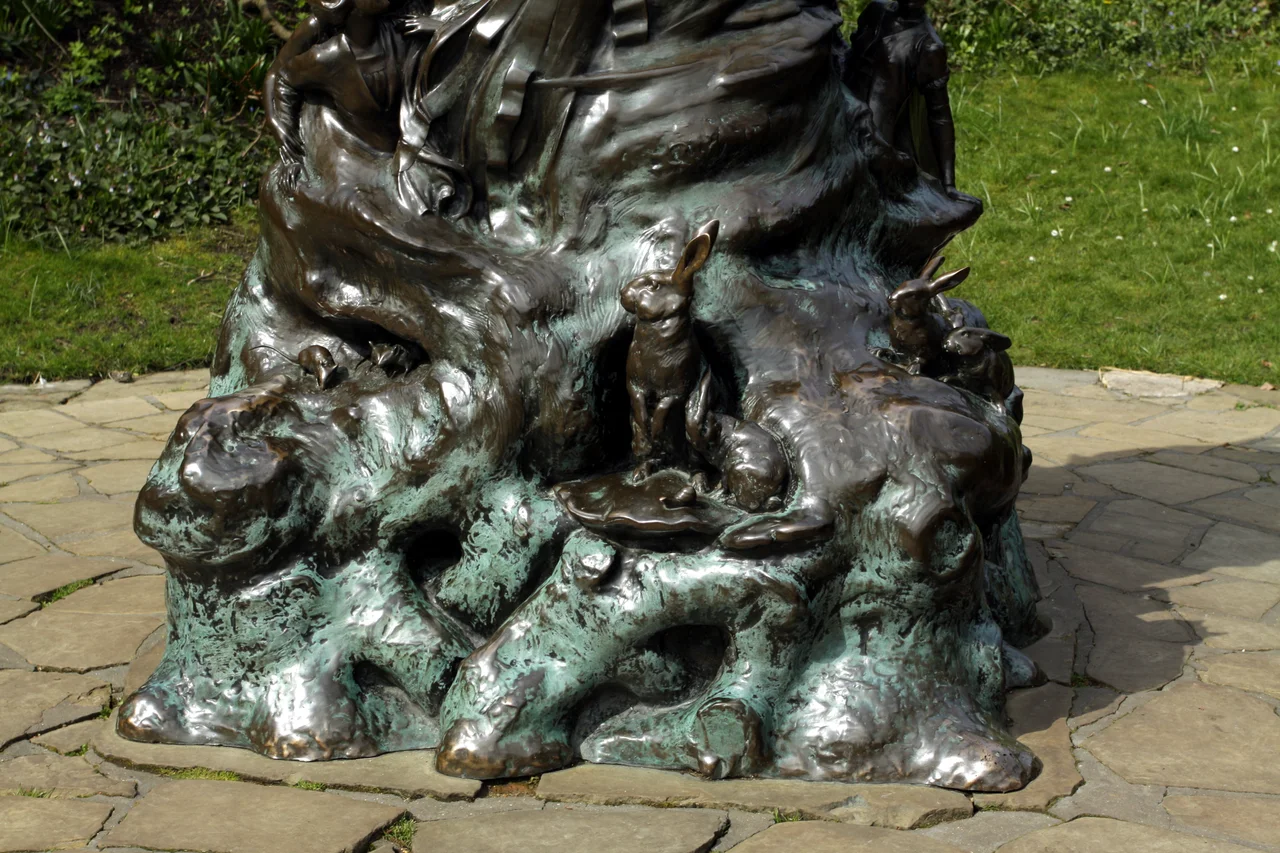
The statue stands about fourteen feet high. The bronze boy on top - life-size for a child of about eight - blows a pipe that has been interpreted as a flute, a trumpet, or pan pipes. The sides of the stump are alive with small figures: squirrels and rabbits, mice and fairies pressed into the bark. The sculpture was commissioned by Barrie and made by Sir George Frampton, a leading sculptor of the period. There was a quiet disagreement at the heart of the work. Barrie wanted the boy to be based on a photograph of Michael Llewelyn Davies, one of the children whose play with Barrie inspired Peter Pan in the first place. Frampton chose a different model instead - perhaps a boy named George Goss, perhaps William A. Harwood. Barrie was disappointed by the result. The statue, he said, "didn't show the Devil in Peter." There is no mischief in this bronze boy. He is too perfect, too clean, too innocent. The Peter of Barrie's imagination was wilder. The Peter of Frampton's bronze is the one the world now remembers.
Where Peter Lands
The location was specific. In Barrie's 1902 book The Little White Bird, Peter Pan flies out of his nursery window and lands in Kensington Gardens at this exact spot - by the little bay on the south-western side of the tail of the Serpentine. The Gardens had inspired Barrie's stories in part because they were what he could see from his own home on Bayswater Road, just to the north. By placing the statue where Peter lands in the story, Barrie was treating fiction and geography as the same thing. He gave the sculpture to the city of London. Some critics objected, predictably, to a famous author erecting a sculpture of his own character in a public park without permission - effectively turning the gardens into a piece of advertising for his books. In 1928 vandals tarred and feathered the bronze. It was cleaned. It survived. In 1970 it was Grade II* listed. In 2019 Royal Parks replaced the plinth, prompting some controversy about whether the new base properly honoured the original installation. The boy on top of the stump goes on playing his pipe, indifferent to the arguments below.
Brussels, Newfoundland, Liverpool
Frampton kept the moulds. Between 1913 and his death in 1928, he produced a series of small bronze reproductions; one sold in Scotland in 2016 for £60,000. He also cast six other full-size versions, which he distributed around the world like a slow international gift. In 1924 he gave one to the Belgian state, where it now stands in Brussels - a recognition of Anglo-Belgian friendship during the First World War. The Brussels statue suffered bullet damage during the Second World War and was listed as a Belgian historical monument in 1975. On 29 August 1925, another cast was installed in Bowring Park in St. John's, Newfoundland - a tribute to Betty Munn, who had died aged three on 23 February 1918 when SS Florizel sank off the Newfoundland coast. Her father John Shannon Munn paid for the memorial. A third cast went to Sefton Park in Liverpool in June 1928, unveiled by Pauline Chase, who had played Peter Pan on stage and reprised the role for the opening. It was Grade II listed in 1985 and moved to the Palm House in 1990 after repeated vandalism.
Perth, Toronto, New Jersey
Three more casts crossed the Atlantic and the Pacific. On 10 June 1929 - again overnight, in the Kensington Gardens tradition - Rotary International installed a Peter Pan in Queens Gardens, Perth, Western Australia, marking the centenary of the state's founding as the Swan River Colony in 1829. On 14 September 1929 a cast went to Toronto, erected by the College Heights Association in what became Peter Pan Park, later renamed Glenn Gould Park for the pianist who grew up nearby. The same year, Eldridge R. Johnson - the founder of the Victor Talking Machine Company - paid for a cast to be placed on the grounds of what is now Rutgers University, Camden, New Jersey, outside the Walt Whitman Arts Center. Frampton's six full-size copies are scattered now across three continents. A memorial to Frampton himself stands in the Crypt of St Paul's Cathedral, sculpted by Edward Gillick in 1930. It depicts a young child holding in his hand a miniature replica of Frampton's Peter Pan.
Pipes Still Playing
Other sculptors have made other Peter Pans. Paul Montfort cast one for Melbourne in 1925. Mary Elizabeth Cook made a fountain version for Columbus, Ohio in 1927. Charles Andrew Hafner produced a Carl Schurz Park sculpture for New York City in 1928. There are Peters at the Mearnskirk Hospital in Glasgow, at the Red Cross Children's Hospital in Cape Town, in Dunedin Botanic Garden in New Zealand, in Kirriemuir in Scotland - Barrie's birthplace - and at Blenheim Palace, where Catherine Marr-Johnson made one into a drinking fountain in 1988. In 2000 Diarmuid Byron O'Connor sculpted Peter Pan for Great Ormond Street Hospital in London, the children's hospital to which Barrie famously donated the rights to his play and books. Frampton's original in Kensington Gardens has fooled no one for over a century. Children visiting today know perfectly well it did not appear by magic. They climb on it anyway. They reach up to touch the bronze fairies on the stump. The story Barrie published in The Times in 1912 was never really meant to be believed. It was meant, like the statue itself, to invite belief - to make children for a moment consider that the fairies might have done this, and then to let them decide for themselves what to do with the possibility.
From the Air
The Peter Pan statue stands at 51.5086N, 0.1759W in Kensington Gardens, near the south-western end of The Long Water (the upper end of the Serpentine). Recommended viewing altitude is 1,000-2,000 feet AGL to see the gardens, the Serpentine, and the surrounding Hyde Park area. The Round Pond and Kensington Palace lie to the west; the Albert Memorial is about half a mile south. Central London Class A airspace covers the area, with heavy restrictions over the Royal Parks. Nearest airport is London Heathrow (EGLL) approximately 11 nm west-south-west; London City (EGLC) lies about 9 nm east. The statue is small but the Long Water is a reliable visual landmark for orienting toward the site.
Nearby Stories
- Stevenage 5.7 km away
- Malling Abbey 5.7 km away
- 1952 Farnborough Airshow Crash 7.7 km away
- Ingatestone Hall 8.2 km away
- Hellfire Caves 9.1 km away
- The Carrington Event: The Solar Storm That Could Happen Again 9.8 km away
- Bletchley Park 16 km away
- Castle Hedingham 23 km away