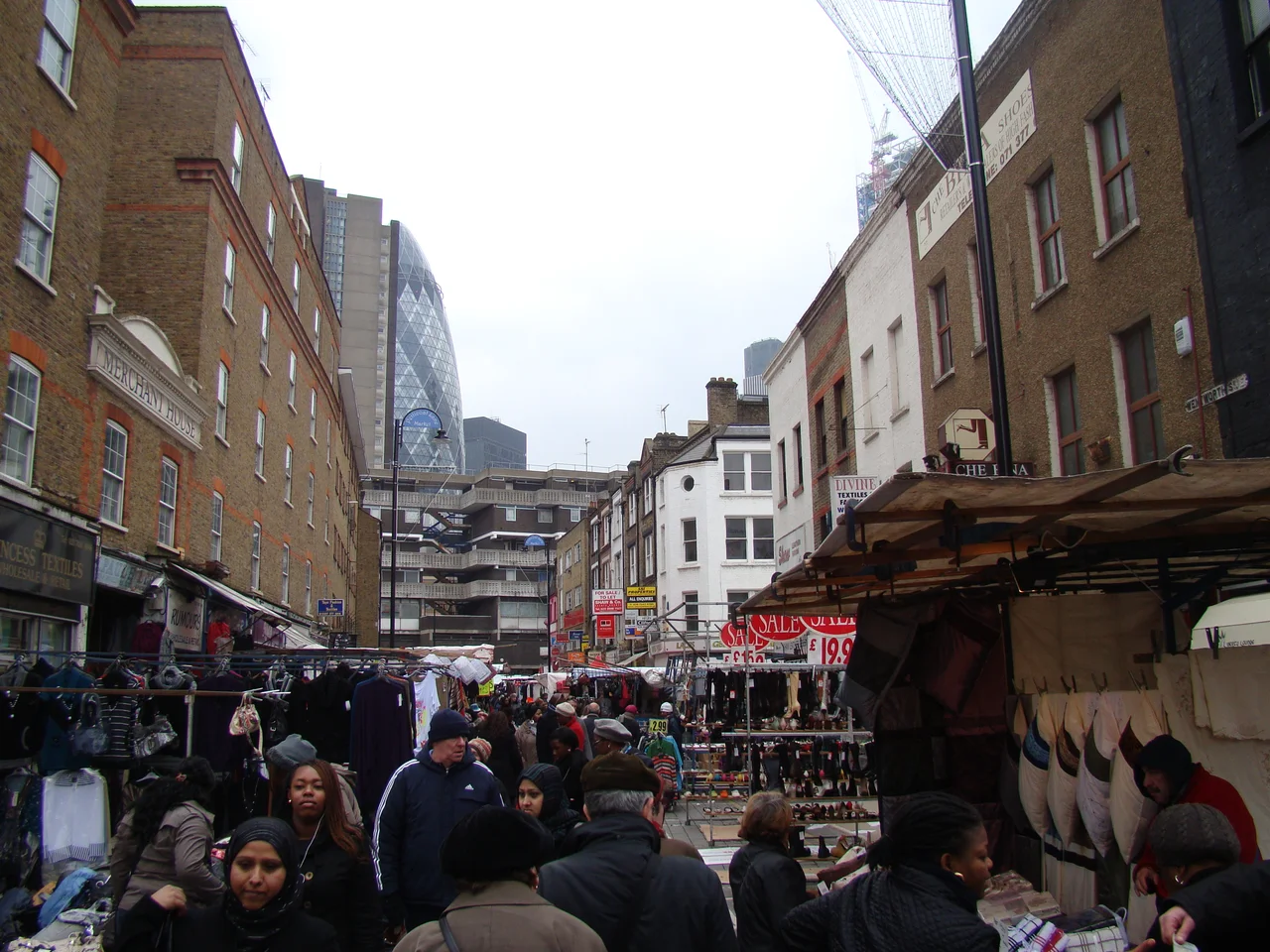

Petticoat Lane Market
The market's most famous legend goes like this: traders would steal your petticoat at one end of the lane and sell it back to you at the other. Whether true or not, the story reveals something real about this place — it has always operated at the edge of regulation, on the boundary between the City and everything beyond it.
Hogs Lane to Peticote Lane
In Tudor times the street was called Hogs Lane, a rural track lined with hedgerows and elms where city bakers were permitted to keep pigs outside the city wall — or possibly an ancient droving route. By 1590, cottages stood where the hedges had been. By 1608, the street had become a commercial district where second-hand clothes and cheap goods changed hands, and it acquired the name Peticote Lane. The Spanish ambassador kept a house here; the area attracted a Spanish community during the reign of James I. Then came the Great Plague of 1665, which killed perhaps a fifth of London's population. The rich fled. The poorer residents stayed, survived, and rebuilt. The market kept going. About 1830, the lane's name was officially changed to Middlesex Street — the boundary it marked between the City's Portsoken Ward and Whitechapel — but nobody used the new name, and nobody does to this day.
A Street of Refugees
Petticoat Lane's history from the 17th century onward is largely a story of communities arriving in distress and finding a foothold through trade. Huguenots fleeing persecution in France came in the late 17th century. Master weavers among them settled in the new district of Spitalfields and helped establish its famous silk industry; the cloth they produced was pegged out in surrounding fields to dry and fix the dye, in an arrangement called a tenterground. From the mid-18th century, the lane shifted from buying used clothes to making and selling new ones. Then, from 1882, Jewish families fleeing violence and poverty in Eastern Europe arrived in large numbers. The chapels built by the Huguenots were adapted as synagogues. Jewish relief societies appeared to support those who had nothing. Jewish traders entered the garment trade and sustained the market's traditions across generations. The Blitz and subsequent bombing dispersed many of these communities to other parts of London, but the market itself continued.
Showmanship and Survival
The Lane was famous for its traders' patter — the practiced, theatrical street selling that turned a marketplace into performance. One particular act involved crockery: a vendor would stack an entire dinner service on a single large plate, send the whole construction spinning into the air, then catch it on the way down. The point was to demonstrate both the quality of the porcelain and the skill of the vendor. It also gave the crowd something to gather around. This kind of showmanship was not merely entertainment; it was the competitive advantage of a market that operated without official recognition until an Act of Parliament in 1936. Before that, the market was technically illegal, and authorities occasionally sent police cars and fire engines down the lane with bells ringing to break it up. The traders dispersed, waited, and came back. The market was not the kind of institution that could simply be shut down.
The Lane Today
On Sunday, the market expands across many of the surrounding streets with over a thousand stalls. Monday through Friday, the smaller Wentworth Street Market operates. It closes on Saturday — the pattern reflects the Jewish Sabbath traditions of the traders who shaped the market's modern form, even as the community itself moved elsewhere in the 20th century. Beginning in the 1970s, immigration from India and East Asia, centred on nearby Brick Lane, brought fresh energy to the area. Alan Sugar, the businessman, got his commercial start as a stall holder here. The market remains one of London's busiest and most visited, a place where the city's successive waves of arrivals have found, and continue to find, a way to trade.
From the Air
Located at 51.5167°N, 0.0733°W in Spitalfields, East London. Aldgate East and Aldgate tube stations are the nearest Underground stops. From altitude, the market is situated between the towers of the City to the west and the residential streets of Whitechapel to the east. London City Airport (EGLC) is approximately 5 miles southeast.
Nearby Stories
- Stevenage 5.7 km away
- Malling Abbey 5.7 km away
- 1952 Farnborough Airshow Crash 7.7 km away
- Ingatestone Hall 8.2 km away
- Hellfire Caves 9.1 km away
- The Carrington Event: The Solar Storm That Could Happen Again 9.8 km away
- Bletchley Park 16 km away
- Castle Hedingham 23 km away