
Pha Taem National Park
Every year on New Year's Day, crowds gather on a cliff edge in northeastern Thailand to watch the sunrise. They come to Pha Taem because this is where the first light of the new year touches Thailand — the easternmost point where the sun, rising over Laos across the Mekong, finds land. But even before that annual pilgrimage became a tradition, people were coming to these cliffs with something on their minds. The evidence is still here: handprints pressed into sandstone, outlines of fish larger than any human, geometric shapes whose meaning has been debated for decades. The paintings at Pha Taem are estimated to be 3,000 to 4,000 years old. Pha Taem National Park — 340 square kilometres of Dipterocarp forest, mushroom rocks, and Mekong riverside established on 31 December 1991 — exists partly to protect them.
What the Artists Left Behind
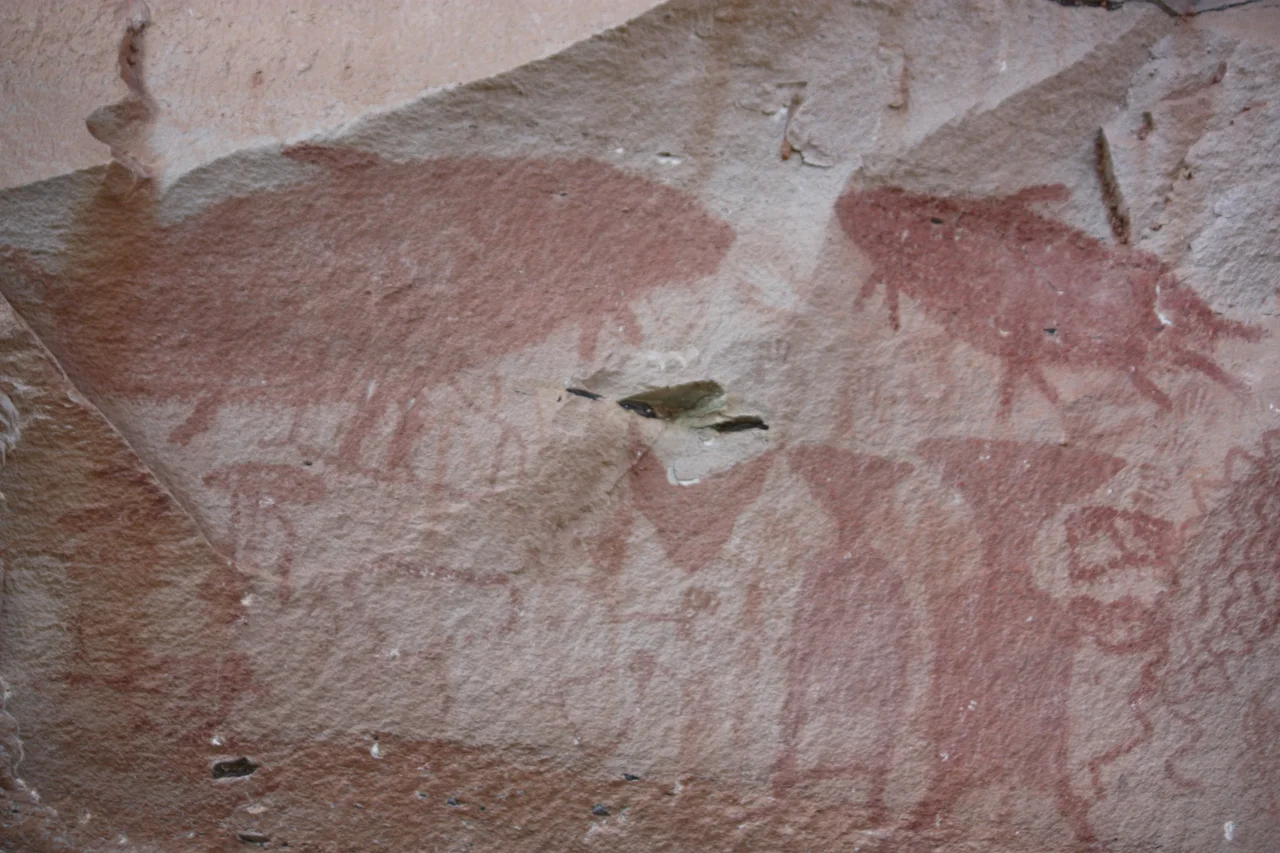
The rock art at Pha Taem covers the cliff face in four distinct groups, the longest stretching 180 metres and containing more than 300 individual images. Among them are anthropomorphic figures — humans in postures that suggest ceremony or ritual — and depictions of the giant Mekong catfish, a creature that can reach three metres in length and carries deep sacred significance in the region's folklore. Handprints appear repeatedly, a gesture that transcends culture and era: someone was here, someone wanted to be remembered. The pigment and the sandstone surface are fragile; conservation work is ongoing to protect the images from natural weathering and the pressure of visitor numbers. The originals cannot be moved, so their survival depends entirely on the cliff face that has held them for millennia. Walking the four-kilometre trail that runs along the clifftop, with the Mekong a hundred metres below and Laos visible across the brown water, the paintings feel less like curiosities and more like correspondence — a message from people who stood in the same place and felt the same pull of the river.
Geology Shaped by Deep Time
The sandstone cliffs of Pha Taem owe their distinctive shape to millions of years of differential erosion. Where softer rock wore away faster than the harder cap above it, the remaining pillars formed broad mushroom shapes — their stems narrowed by wind and water, their tops preserved intact. These mushroom rocks punctuate the park's landscape in clusters, giving the plateau an otherworldly quality that feels at odds with the flat, agricultural plains stretching west toward Ubon Ratchathani city. The same erosion that carved the mushroom rocks also created the cliff system along the Mekong — the dramatic escarpment where the plateau simply drops away to the river below, offering views that on clear days extend deep into Laos. On the Thai side, the park's Dipterocarp forest — a dry deciduous woodland dominated by hardwoods prized by the timber industry across Southeast Asia — covers much of the interior.
Elephants, Catfish, and the Crossing of Seasons
The park is not only a site of archaeology. During February and March, wild elephants migrate across the Mekong from Laos into the park area, moving in search of food — banana leaves, fruit, whatever the season offers — before returning across the river as conditions change. Local farmers living near the park's western boundaries have documented this seasonal movement for generations; it is one of the few places in mainland Southeast Asia where cross-border elephant migration still occurs as a natural behaviour rather than a managed programme. The Mekong giant catfish depicted on the cliff above is no longer common. Listed as critically endangered, it appears in these waters only occasionally now — a living echo of the creature the cliff painters knew well enough to render at extraordinary scale.
The First Light of the Year
Cha Na Dai Cliff, within the park, has become a pilgrimage site of a very modern kind. Because of Thailand's easternmost geography at this latitude, the sun on New Year's Day rises here before it reaches any other point in the kingdom. Thousands of people make the journey each December 31st, camping near the cliff edge overnight to secure a position for the moment the sun clears the Mekong horizon and the light spills westward across Thailand. It is a tradition that blends national feeling with something older — the same instinct that brought people to these cliffs four millennia ago to mark their presence, to record what they saw, to leave something that might outlast them. The cliff has been a place of witness for a very long time.
From the Air
Pha Taem National Park lies at approximately 15.40°N, 105.52°E on the eastern edge of Ubon Ratchathani Province, Thailand. The Mekong River forms the park's eastern boundary; Laos (Phou Xieng Thong National Protected Area) is directly across the water. From the air at 4,000–6,000 feet, the dramatic sandstone escarpment above the Mekong is visible as a sharp cliff edge where the plateau drops to the river. The mushroom rock formations appear as pale shapes on the plateau surface at lower altitudes. Nearest airport: VTUU (Ubon Ratchathani, ~90 km west). Pakse International Airport (VLPS) in Laos is approximately 50 km southeast.
Nearby Stories
- Pakse 15 km away
- Tadlo 20 km away
- Bolaven Plateau 29 km away
- Ubon Royal Thai Air Force Base 30 km away
- Sam Phan Bok 31 km away
- Saravan 32 km away
- Amnat Charoen 59 km away
- Sisaket 85 km away