
Piccadilly Circus
The British have a phrase for any place too crowded to navigate: it's like Piccadilly Circus. The expression has the same useful imprecision in 2026 as it did a century ago, because the junction it describes has never stopped being overrun. Built in 1819 as Regent Circus South - the southern hinge of John Nash's grand processional Regent Street - the Circus lost its circular form in the 1880s when Shaftesbury Avenue cut through. What it kept was its talent for accumulating people. During the Second World War, the Allies code-named the D-Day invasion fleet's assembly point in the English Channel "Piccadilly Circus," because every ship in the operation had to pass through it. The metaphor was already there, ready to use.
Collars, Tailors, and Lady Hutton's Garden
The name Piccadilly first appears in 1626, when a tailor named Robert Baker built a house called Piccadilly Hall on the road. Baker had made his fortune selling piccadills - a term used for various kinds of fashionable collars in the early seventeenth century. The street was briefly called Portugal Street in 1692, in honour of Catherine of Braganza, the queen consort of Charles II, but by 1743 it was Piccadilly again. The junction itself was created in 1819, when John Nash laid out Regent Street through what had been the house and garden of a Lady Hutton. For decades it was called Regent Circus South, with Oxford Circus to the north known as Regent Circus North. The name Piccadilly Circus did not become standard until the mid-1880s, when Shaftesbury Avenue was driven through the junction's eastern side and the original round shape was destroyed. Charles Dickens Jr., writing in 1879, described the broader Piccadilly as "the nearest approach to the Parisian boulevard of which London can boast."
Eros Who Isn't Eros
In 1893, the Shaftesbury Memorial Fountain was erected in the centre of the Circus to commemorate the philanthropic work of Anthony Ashley Cooper, the 7th Earl of Shaftesbury - a Victorian politician and social reformer. On top of the fountain stands a winged archer in aluminium, generally and incorrectly called Eros. The figure is actually his brother Anteros, the Greek god of selfless love, and his official name is The Angel of Christian Charity. The misidentification has stuck for more than a century, in part because the work of Lord Shaftesbury - factory reform, child labour laws, mental health legislation - made Anteros, the god of love returned without selfish demand, more fitting than tourists realised. The fountain has been moved more than once. In 1922 it was lifted out so that Charles Holden's new tube station booking hall could be built directly beneath the Circus. It returned in 1931, was removed again during the Second World War (replaced by advertising hoardings), came back in 1948, and was finally relocated from the centre of the junction to its current south-western corner during the 1980s reconstruction.
The First Neon Sign
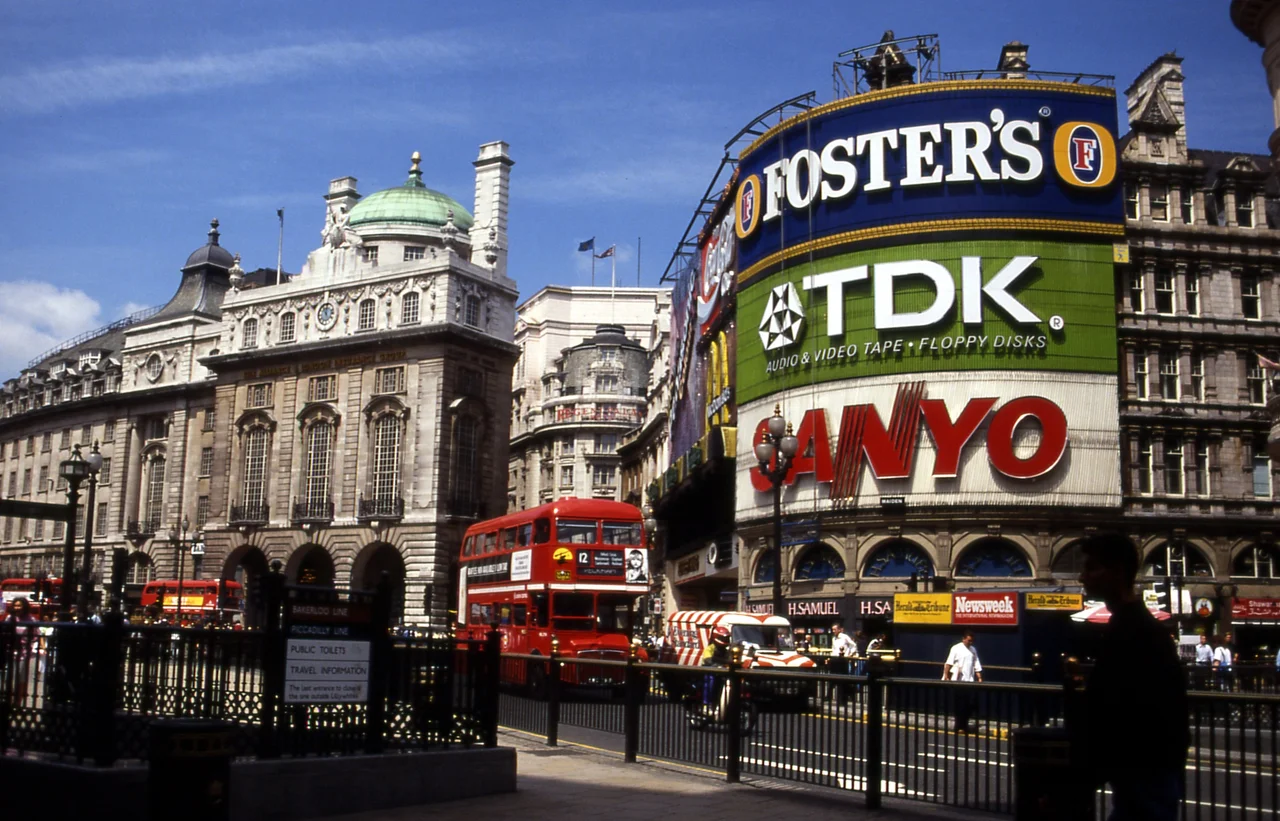
The advertising signs that define modern Piccadilly Circus began in 1908 with an electric Perrier sign. Electric billboards followed on the facade of the London Pavilion from 1923. The first neon sign was for the British meat extract Bovril, installed in 1910. Coca-Cola has had a sign at Piccadilly Circus continuously since 1954. Other brands rotated through the decades: Schweppes occupied one corner from 1920 to 1961, replaced by BP, then Cinzano, then Fujifilm, then Kodak, then TDK. Sanyo held a spot from 1978 until 2011, when Hyundai took over and switched from neon to LED. The last neon was retired from the building around 2011. In January 2017 the six remaining advertising screens were switched off for the longest time since the 1940s while a single ultra-high-definition curved Daktronics display replaced them. The new screen lit up on 26 October 2017. The lights have gone dark deliberately a few times. They were switched off after the deaths of Winston Churchill in 1965 and Diana, Princess of Wales in 1997. On 21 June 2007 they went out for an hour as part of the Lights Out London environmental campaign. After Elizabeth II's death in 2022, all advertising was replaced with a single image honouring the Queen.
Piccadilly Commandos and a Plan That Failed
During the Second World War, American servicemen stationed in Britain used the West End's clubs and bars, and so many sex workers gathered at Piccadilly Circus to find them that they earned the nickname "Piccadilly Commandos." Both Scotland Yard and the Foreign Office worried about possible damage to Anglo-American relations. The Circus had always attracted exactly the people authorities preferred elsewhere. The greater threat in the post-war years came from planners. Lord Holford proposed in 1962 a "double-decker" Piccadilly Circus - an elevated pedestrian concourse above a lower deck dedicated entirely to traffic, with most of the ground-level pedestrian space removed. The plan would have demolished much of what made the place distinctive. A 1972 scheme called for three octagonal towers, the tallest 240 feet, replacing the Trocadero, the Criterion, and the Monico buildings. The plans were finally rejected by Sir Keith Joseph and Ernest Marples - not for heritage reasons, but because Holford's scheme allowed only a twenty-percent increase in traffic capacity when the government required fifty. Piccadilly Circus was saved by a calculation. Apart from extensive pedestrianisation in the 1980s, it has escaped major redevelopment ever since.
The Junction That Catches Everything
Surrounding the Circus today is a small constellation of significant buildings. The Criterion Theatre - Grade II* listed, designed by Thomas Verity, opened in 1874 - sits on the south side; nearly all of its 600 seats are underground, reached by descending a tiled stairway. The London Pavilion on the north-east, originally an 1859 music hall, was rebuilt in 1885 when Shaftesbury Avenue was constructed; it became a cinema in 1934, then a shopping arcade preserving the 1885 facade in 1986, and is now connected to the Trocadero next door. The County Fire Office on the north side carries a statue of Britannia on its roof - designed by John Nash as the southern end of his Regent Street Quadrant, rebuilt in 1924 by Reginald Blomfield, the only building in the Circus damaged during the Blitz. Beneath everything is Piccadilly Circus tube station, opened on the Bakerloo line on 10 March 1906 and rebuilt by Charles Holden in 1928. The Circus has been bombed by Irish republican terrorists multiple times - in 1939, 1974, and 1992. It has hosted the February 2003 anti-Iraq War protest and many demonstrations since. It has appeared in paintings by Charles Ginner and L. S. Lowry, and in songs by Jethro Tull and Bob Marley. The phrase still holds. Spend long enough at Piccadilly Circus, the saying goes, and you will eventually bump into everyone you know.
From the Air
Piccadilly Circus is at 51.5100N, 0.1344W in the West End of London, at the meeting of Regent Street, Piccadilly, Shaftesbury Avenue, Haymarket, Coventry Street, and Glasshouse Street. Recommended viewing altitude is 1,500-2,500 feet AGL to take in the surrounding theatres, the Shaftesbury Memorial Fountain (at the south-western corner since the 1980s), the London Pavilion, and the curved neon-screen building on the north-west. Central London Class A airspace covers the area, heavily restricted. Nearest airport is London City (EGLC) approximately 7 nm east; Heathrow (EGLL) lies about 13 nm west. Trafalgar Square lies a few hundred yards south.
Nearby Stories
- Stevenage 5.7 km away
- Malling Abbey 5.7 km away
- 1952 Farnborough Airshow Crash 7.7 km away
- Ingatestone Hall 8.2 km away
- Hellfire Caves 9.1 km away
- The Carrington Event: The Solar Storm That Could Happen Again 9.8 km away
- Bletchley Park 16 km away
- Castle Hedingham 23 km away