.jpg)
Piccadilly line
On 15 December 1906, a small group of Edwardian engineers, financiers, and London Electric Railway officials watched the first electric train run between Finsbury Park and Hammersmith. The official name was the Great Northern, Piccadilly and Brompton Railway - GNP&BR for short, a clumsy acronym that no Londoner ever wanted to say twice. Within four years the company would be merged into a larger system, and within twenty the line would carry a single name on the tube map: dark blue, officially Pantone 072, the Piccadilly. Today it runs 73.97 kilometres beneath London, branches at Acton Town, reaches Heathrow's Terminal 5, and carries more than 218 million passengers a year - the sixth-busiest line on the Underground. The trains running on it now date from 1973, making them older than many of the passengers they carry.
Yerkes and the Ox-Blood Stations
The Piccadilly line owes its existence to Charles Tyson Yerkes, an American financier who consolidated London's underground railway companies under the Underground Electric Railways Company of London in 1901. Yerkes died before his railway opened, but his consortium pushed the project through Parliament and into the ground. The line was formed from the merger of two earlier, unbuilt projects - the Great Northern & Strand Railway and the Brompton & Piccadilly Circus Railway. Linking sections were added, including a stretch from a District Railway scheme, to produce a continuous route from Finsbury Park through Holborn, Covent Garden, Piccadilly Circus, and Knightsbridge to Hammersmith. The architect Leslie Green designed the surface stations: ox-blood red terracotta facades with semi-circular windows above the ground floor, a deliberately uniform look meant to make the line instantly recognisable above ground. Many of Green's stations still survive. Initial ridership was disappointing - new electric trams and motor buses competed hard for passengers - and on 1 July 1910 the GNP&BR was merged with two other tube railways to form the London Electric Railway Company.
Charles Holden and the 1930s Extensions
The Piccadilly line's character changed in the early 1930s. Extensions to Cockfosters in the north, Hounslow West in the west, and Uxbridge in the far west took the line out into the new suburbs that were growing along with the Underground itself. Charles Holden, working for the architectural practice Adams, Holden & Pearson, designed many of the new stations. Where Leslie Green's terracotta was Edwardian and ornate, Holden's stations were modernist and rectangular - brick bases with large tiled windows, topped by concrete slab roofs. Southgate, Arnos Grove, Cockfosters, and Sudbury Town became some of the most distinctive examples of inter-war British architecture. Holden also rebuilt Piccadilly Circus station itself in 1928, replacing the original lifts with eleven escalators and adding a new booking hall located entirely below ground - a configuration that defines the station today. The Western extensions took over certain existing District line services, which were fully withdrawn in 1964. Earl's Court had already seen the first escalators ever installed on the Underground, connecting District and Piccadilly platforms on 4 October 1911.
War, Shelters, and the Victoria Line
During the Second World War many Piccadilly line stations were equipped with shelters and basic amenities for the bombing campaign that hit London hard. Some stations were fitted with blast walls. The disused Down Street station, between Hyde Park Corner and Green Park, was covertly transformed into the Railway Executive Committee's bomb-proof headquarters - the body that coordinated the entire British railway network during the war. Today London Transport Museum runs guided tours of Down Street through its Hidden London programme. After the war the line struggled with overcrowding. The first sections of the Victoria line opened in 1968, and some sections of the Piccadilly had to be rerouted to provide cross-platform interchange with the new line. Down Street had closed in 1932; York Road, Brompton Road, and Aldwych followed at various dates. Aldwych closed on 30 September 1994 and is now regularly used as a film location, with the London Transport Museum running guided tours there too. The Piccadilly line learned to operate around its own abandoned stations - some sealed, some leased to other purposes, some kept ready to be reopened if traffic ever demanded it.
To Heathrow
The most consequential extension was south-west. Approval for a Piccadilly line extension to Heathrow Airport was first given in 1967, and the work opened in stages between 1975 and 1977 - reaching Hatton Cross on 19 July 1975 and the central terminal area on 16 December 1977. The station that served the old Terminals 1, 2, and 3 was originally called Heathrow Central, then renamed Heathrow Terminals 1, 2, 3 in 1986, and finally Heathrow Terminals 2 & 3 in January 2016 after Terminal 1 closed. A loop extension to Terminal 4 opened on 12 April 1986. A direct branch to Terminal 5 opened on 27 March 2008, the same day the new terminal received its first flights. The line is the only direct rail link to Heathrow apart from the express services, and the Tube map's dark blue line stretching out to a cluster of terminal stations has become one of the most familiar pieces of geography in London. The Piccadilly's electric power was once generated at the Lots Road Power Station in Chelsea - the giant brick power station that loomed over the Thames. Lots Road was taken out of use in 2003, and the line now draws from the National Grid.
Old Trains, New Trains
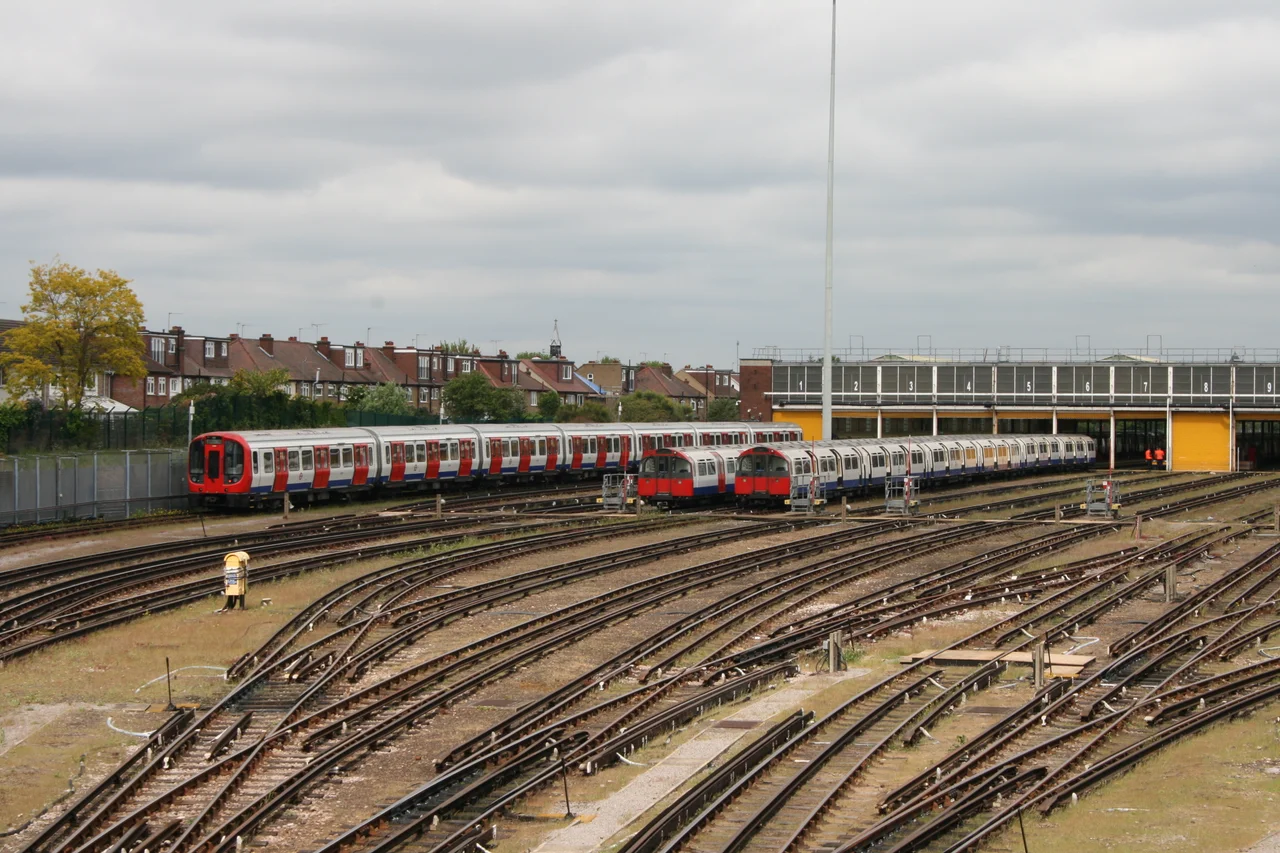
The trains running on the Piccadilly line in 2026 are the 1973 Stock, ordered specifically for the Heathrow extension. Seventy-eight of them are needed to operate a 24-trains-per-hour peak service - a train roughly every two and a half minutes. They are some of the oldest passenger trains in regular service in the United Kingdom, and they have been showing their age. Siemens Mobility was awarded a £1.5 billion contract in June 2018 to produce replacement 2024 Stock at a factory in Goole, East Yorkshire. The new trains will feature lower floors, higher passenger capacity, air-conditioning, battery power to enable a train to limp to the next station if the third or fourth rail loses power, and a weight saving of about thirty tonnes per train. Delivery has been delayed repeatedly - originally promised for 2023, then 2025, and in June 2025 Transport for London reported the new date would be at least the second half of 2026. The full upgrade also depends on new signalling, which is currently unfunded. Plans exist to extend the line beyond Heathrow Terminal 5 to Slough, passing close to but not through Windsor. The Piccadilly line, like every part of the Underground, has always lived between the ambitions of its planners and the patience of its passengers. The trains are old. The tunnels are older. The line still runs, and most days it runs on time.
From the Air
The Piccadilly line runs 73.97 km from Cockfosters in north London (51.6517N, 0.1489W) through central London to two western branches - to Heathrow Airport (51.4700N, 0.4543W) and to Uxbridge in the far west. Heathrow itself is an active controlled airport (EGLL) - approach via standard arrival procedures only. Recommended viewing altitude for the central London portion is 2,000-3,000 feet AGL to follow the line's path - though most of it is in tube tunnels and invisible from the air. The Heathrow branch and the northern surface sections through Arnos Park (over the Piccadilly line's distinctive 1933 viaduct) are visible. London City (EGLC) approximately 9 nm east of central London; London Heliport (EGLW) covers some of the line's central sections.
Nearby Stories
- Stevenage 5.7 km away
- Malling Abbey 5.7 km away
- 1952 Farnborough Airshow Crash 7.7 km away
- Ingatestone Hall 8.2 km away
- Hellfire Caves 9.1 km away
- The Carrington Event: The Solar Storm That Could Happen Again 9.8 km away
- Bletchley Park 16 km away
- Castle Hedingham 23 km away