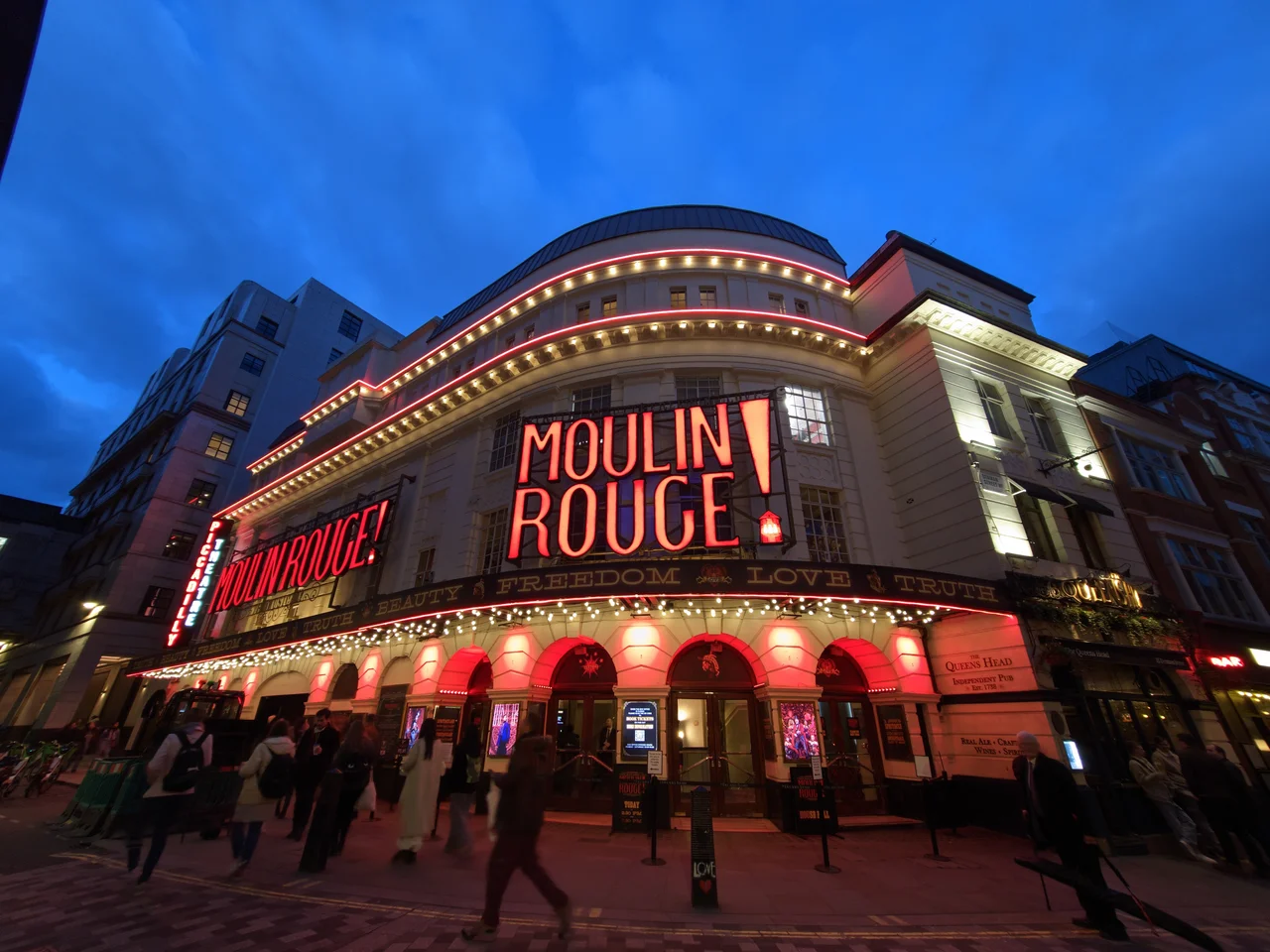

Piccadilly Theatre
Walk past 16 Denman Street and you might miss it entirely. The facade is almost shy, a calm stone front tucked between Sherwood Street and the neon roar of Piccadilly Circus. Then you push through the doors and the building shows you what it has been hiding since April 1928: a 1,232-seat Art Deco auditorium painted in shades of pink. The impresario Edward Laurillard built it on the site of some derelict stables. He gave the front to the city's nineteenth-century rhythms; the inside, designed by Marc-Henri Levy and Gaston Laverdet, belongs to the Jazz Age.
A Theatre Born in the Jazz Age
The Piccadilly opened on 27 April 1928 with Blue Eyes, a musical scored by Jerome Kern and headlined by the soprano Evelyn Laye. The show ran 276 performances split between this house and Daly's. Architects Bertie Crewe and Edward A. Stone designed a building meant to be heard as much as seen. The simple stone elevation was a feint, drawing eyes upward to Piccadilly Circus while keeping the elaborate interior as a kind of private surprise. Laye, photographed in eighteenth-century costume on opening night, became the house's first leading lady; she would return again during the war, when the same auditorium that opened with Kern's tunes would shake under German bombs.
Bombs, Blithe Spirit, and a Lavish Macbeth
The Second World War found the Piccadilly hosting some of the most ambitious theatre in London. Noel Coward's Blithe Spirit had its premiere here in 1941, and John Gielgud staged a lavish Macbeth on the same boards. The theatre took a hit during the late stages of the war, closing for months after German bombing damaged the building. It reopened in March 1945 with Agatha Christie's Appointment with Death, led by Mary Clare with Joan Hickson and Carla Lehmann in support. Coward returned that year with the revue Sigh No More, starring Cyril Ritchard and Joyce Grenfell; songs like "Matelot" and "That Is the End of the News" outlived the show itself, which managed only 213 performances.
The House of Famous Flops and Glittering Revivals
Histories of the Piccadilly tend to dwell on its appetite for the spectacular failure. The 1989 musical Metropolis, adapted from Fritz Lang's 1927 silent film, became one of the West End's most expensive shows of its era and closed at a loss of GBP 2.5 million. The Daily Telegraph would later rank the Piccadilly's 1991 production of Moby Dick - in which sixth-form girls performed Melville's epic in a school swimming pool - as the sixth-worst West End musical ever made. Yet the same stage gave a long-running home to Educating Rita, with Julie Walters opening the role in August 1980 and playing it until September 1982. Frankie Howerd headlined A Funny Thing Happened on the Way to the Forum in 1986. Angela Lansbury, later succeeded by Dolores Gray, anchored Gypsy in 1973 for 300 performances. The theatre keeps trying things, and that willingness to gamble is part of its character.
An American in London: Henry Fonda's West End Debut
In July 1975, Henry Fonda made his British stage debut at the Piccadilly in Clarence Darrow. He was seventy years old. The one-man play about the famous American defence attorney ran just 47 performances, but Fonda was the headline, and the house had drawn him. The Piccadilly had a knack for that kind of crossing: it gave the British premiere of Edward Albee's Who's Afraid of Virginia Woolf? in 1964 and welcomed everyone from Marcel Marceau (twice in 1962) to Tom Stoppard, whose Rosencrantz and Guildenstern Are Dead played here through the summer of 1987. The list of performers reads like an encyclopedia of twentieth-century theatre: Ian McKellen, Simon Russell Beale, Paul Scofield, Timothy West, Edith Evans, Gladys Cooper, Prunella Scales.
Modern Era: Moulin Rouge! Takes the Stage
The Piccadilly's recent productions tell the story of a house still trying to dazzle. Guys and Dolls played here in 2005, Grease in 2007, Jersey Boys in 2014. The Lehman Trilogy and a revival of Arthur Miller's Death of a Salesman brought serious drama back to its boards. Then in January 2022, Moulin Rouge! The Musical opened at the Piccadilly with The Guardian calling it "wonderfully wild." Almost a century after Evelyn Laye sang Kern's melodies on opening night, the same pink auditorium pulses red and gold for a story set in another belle epoque entirely. The Piccadilly has always been a theatre that hides its real face behind a plain door, and it is still rewarding the audience members who push through to find out what is waiting inside.
From the Air
The Piccadilly Theatre sits at 51.5106 N, 0.1342 W in the West End, a block southwest of Piccadilly Circus in the City of Westminster. From low altitude over central London, look for the dense theatre cluster between Regent Street and Leicester Square. Nearest airports are London City (EGLC) about 8 nm east and London Heathrow (EGLL) 13 nm west. Best viewed in clear evening light when the West End signage catches the camera.
Nearby Stories
- Stevenage 5.7 km away
- Malling Abbey 5.7 km away
- 1952 Farnborough Airshow Crash 7.7 km away
- Ingatestone Hall 8.2 km away
- Hellfire Caves 9.1 km away
- The Carrington Event: The Solar Storm That Could Happen Again 9.8 km away
- Bletchley Park 16 km away
- Castle Hedingham 23 km away