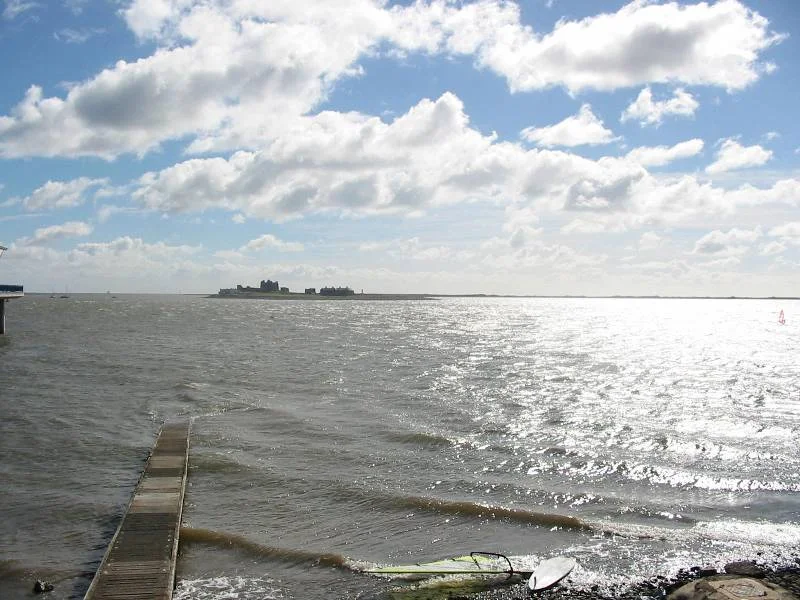

Piel Island
There is a pub on this island, and the man behind the bar is a king. Not a metaphorical king, not a man who feels like a king after his third pint - a man who wears the title King of Piel, voted into the role by Barrow-in-Furness Borough Council along with the licence to run the Ship Inn. The island he reigns over is twenty-six acres in size, lies in Morecambe Bay off the Furness peninsula, and has four permanent residents counting his family. The next nearest neighbour is a ruined fourteenth-century castle.
Fowdray of the Fodder
In the Middle Ages the island was called Fowdray, or Fouldrey, from the Old Norse fouder for fodder and ey for island - a Viking name for a pastoral scrap of land in a Viking-named bay. The Liberty of Furness was granted to Earl Tostig in 1066, the same Tostig who would die that autumn at Stamford Bridge fighting his brother Harold. In 1127, Stephen of Boulogne - not yet king, but lord of Lancaster - gave the same liberty to the Savignac monks, who soon merged into the more famous Cistercians of Furness Abbey nearby. The Cistercians ran the Furness peninsula like a corporation, and Piel was their offshore branch office: a working harbour, a refuge from Scottish raids, and after 1327 the site of Piel Castle. The smuggling started early. By the time the abbey fell to Henry VIII in 1537, His Majesty's customs men were already eyeing the island with suspicion.
Pilots, Painters and Romantics
The eighteenth century turned Piel into a working maritime outpost. As iron ore traffic grew on the Furness coast, harbour pilots and customs inspectors took up permanent residence on the island, formally classified as a creek of the port of Lancaster. Their cottages still stand. Then, in 1805, the painter Sir George Beaumont came to Rampside on the mainland, looked out at Piel, and made Peele Castle in a Storm. William Wordsworth - whose own brother John had recently drowned at sea - saw the picture and answered it with his Elegiac Stanzas. Suddenly Piel was a literary place as well as a working one. Nineteenth-century tourists came to feel suitably stirred. In 1875 the Duke of Buccleuch built fishermen's cottages on the island. In 1920 the 7th Duke gave the whole place to the people of Barrow-in-Furness as a World War I memorial, asking only that they look after it.
The Ship Inn and the King of Piel
There has been an alehouse on Piel since at least 1800. By 1841 the licensee at what would become the Ship Inn was a man named James Hool. The grand title King of Piel began in the nineteenth century as a fishermen's joke that hardened into custom, harking back to Lambert Simnel's brief court at the castle in 1487. The Knighthood of Piel is older and stranger still. A large oak chair sits in the inn. Anyone who takes a seat is knighted by the King or by a fellow knight, and the cost of the honour is a round of drinks for the room. The knight's reward: if they ever wash up on Piel after a shipwreck, the landlord is obliged to give them food and lodging. The longest-serving landlords were Thomas and Elizabeth Ashburner, around 1894 to 1922. The current King is Aaron Sanderson, who took the keys in May 2022.
Getting There, Staying There
Piel is a tidal island, which is a polite way of saying that the route changes depending on the moon. In summer a small ferry runs from Roa Island pier, weather and tide permitting. The harder way is to walk across the sands from Walney Island at low tide, with local guidance - the channels fill quickly and silently behind you. There are no roads, no shops beyond the pub, and the castle, managed by English Heritage, is free to wander once you make it ashore. Campers may pitch a tent on the grass. The TV series Islands of Britain documented the crowning of Steve Chattaway as King in 2008. The whole island can be walked in less than an hour, but you will not want to.
A Small Kingdom
Piel is the kind of place that should have been swept away by the twentieth century and somehow was not. It has no permanent infrastructure beyond the Ship Inn and a handful of cottages. Its monarchy is real in the only way a monarchy can be when no one is forcing you to bow - by consent and tradition, renewed every time someone climbs onto that oak chair and stands the bar a round. From the air it looks like a green parenthesis in a wide grey bay. From the ground, sitting on a bench with the keep at your back and the pub a hundred yards away, it feels stubbornly itself.
From the Air
Piel Island sits at 54.06 N, 3.17 W in Morecambe Bay off the Furness peninsula. From altitude, look for a small triangular cluster: Piel, Roa, and the southern tip of Walney, with the bulk of Walney Island stretching north as a long thin spit shielding Barrow-in-Furness. The ruined three-storey keep of Piel Castle is the prominent landmark. Nearest airport is EGNL Barrow/Walney Island Airport (BAE Systems, private), about 3 nm northwest; EGNH Blackpool lies 50 nm south, and EGNS Ronaldsway, Isle of Man, 50 nm west. Best viewed at low tide when the surrounding sandbanks make pale halos around the islands. Westerly winds and Irish Sea haze can reduce visibility quickly.
Nearby Stories
- Lancaster Priory 0.5 km away
- Kendal 4.5 km away
- Muncaster Castle 5 km away
- Ribble Steam Railway 5 km away
- St Annes Lifeboat Station 21 km away
- Ramsey Bay 28 km away
- Celtic Array 36 km away
- Laxey Bay 38 km away