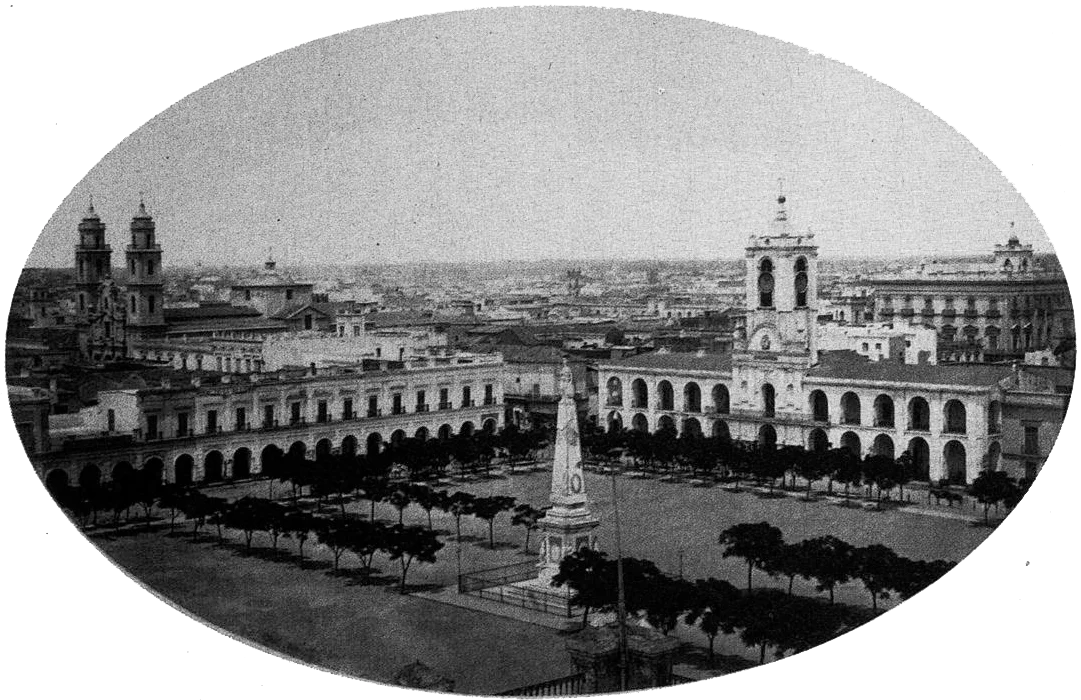

Pirámide de Mayo
Argentina's oldest national monument was nearly torn down, more than once, by the very nation it honours. The Pirámide de Mayo went up in 1811, ordered by the Primera Junta to celebrate the first anniversary of the May Revolution, the uprising that set Buenos Aires on the road to independence from Spain. In the decades that followed, presidents and city officials repeatedly proposed knocking it down to build something grander. Each time, it survived. Two centuries on, this modest white obelisk at the centre of the Plaza de Mayo has outlasted every scheme to replace it, and become something none of its planners could have foreseen: the still point around which a country's conscience turns.
A Monument Raised in Four Days
On 5 April 1811, with the Cabildo's approval, the city resolved to mark Argentina's first national day by building a pyramid in the Plaza de la Victoria. The choice of a pyramid was never explained; some think it echoed the obelisks on the Porte Saint-Denis in Paris. At the insistence of the builders the monument was made not of wood but of solid materials, including hundreds of fired bricks, and the foundation was poured on 6 April amid music and raucous celebration. It was inaugurated on schedule, even though construction was not actually finished, festooned with the banners of the city's regiments. The festivities ran four days and included dancing, raffles, and, tellingly for a revolution that spoke of liberty, the freeing of enslaved people. The first pyramid stood about thirteen metres tall and was, to save time, left hollow inside.
Liberty in a Phrygian Cap
The structure visible today is largely the work of the painter and architect Prilidiano Pueyrredón, who reworked it in 1856, building the new monument directly over the old. He crowned it with a statue of Liberty by the French sculptor Joseph Dubourdieu, a robed female figure wearing the Phrygian cap, the soft conical hat that has signalled freedom since the Roman manumission of slaves and the French Revolution. From the ground to the peak of that cap the pyramid now rises 18.76 metres. A golden sun was set on its eastern face, turned to look toward the Casa Rosada, the pink presidential palace; the other three sides carry laurel crowns in relief. Four allegorical figures of Astronomy, Geography, Navigation, and Industry, long exiled to a distant plaza, were finally restored to the monument's corners in 2018.
Moved Sixty Metres, Saved by Indecision
The plaza changed around the pyramid. In 1883 the old arcade that had split the square in two was demolished, joining the halves into the modern Plaza de Mayo. Mayor Torcuato de Alvear wanted to raze the pyramid and build a more imposing monument, and he canvassed the country's elder statesmen. Former president Bartolomé Mitre saw no reason to keep it; Sarmiento rejected its later additions; only Nicolás Avellaneda argued for restoring and preserving it. The committee favoured demolition, but the national government preferred to leave things alone, and so it stood. In 1912, planners hoping to encase it in a vast new monument instead simply moved it. Between 12 and 20 November, the entire pyramid was jacked onto wheels and winched 63 metres east to the centre of the square. The grand monument meant to surround it was never built.
The Circle the Mothers Walk
On 30 April 1977, fourteen women came to the Plaza de Mayo to demand word of their sons and daughters, seized and disappeared by the military dictatorship. Ordered by police to keep moving, they began instead to walk in a slow circle around the pyramid, white kerchiefs on their heads. From that act grew the Madres de Plaza de Mayo, who have circled this monument every Thursday since, in one of the longest sustained protests in the world. One of their founders, Azucena Villaflor, was abducted in December 1977 and murdered in a death flight over the river. Her remains were identified in 2005, and on 8 December that year her ashes were buried at the base of the pyramid, on the very spot where she had organized her first protest. The sidewalk around the monument is painted with the Mothers' kerchiefs. An obelisk built to mark a nation's birth now also marks its deepest wound, and the refusal to forget it.
From the Air
The Pirámide de Mayo stands at the centre of the Plaza de Mayo at 34.609 degrees south, 58.372 degrees west, in the Monserrat district at the historic core of Buenos Aires. The nearest airport is Aeroparque Jorge Newbery (ICAO: SABE), about five kilometres north along the Río de la Plata; Ministro Pistarini International at Ezeiza (ICAO: SAEZ) lies roughly 28 km southwest. The monument is small from the air, a white point at the hub of the plaza, but its setting is unmistakable: the pink Casa Rosada to the east toward the river, the colonnaded Cabildo and the Metropolitan Cathedral framing the square, and the broad Avenida de Mayo running west toward the Congreso. Because the pyramid itself is modest, low-altitude clear-weather passes over the historic centre give the only meaningful view; look for the painted ring of Mothers' kerchiefs on the pavement around its base.
Nearby Stories
- Ezeiza Massacre 1.9 km away
- Luján, Buenos Aires 5.1 km away
- Curutchet House 13 km away
- Colonia del Sacramento 17 km away
- Martín García Island 28 km away
- Atucha Nuclear Power Plant 37 km away
- Lobos 43 km away
- Cry of Asencio 87 km away