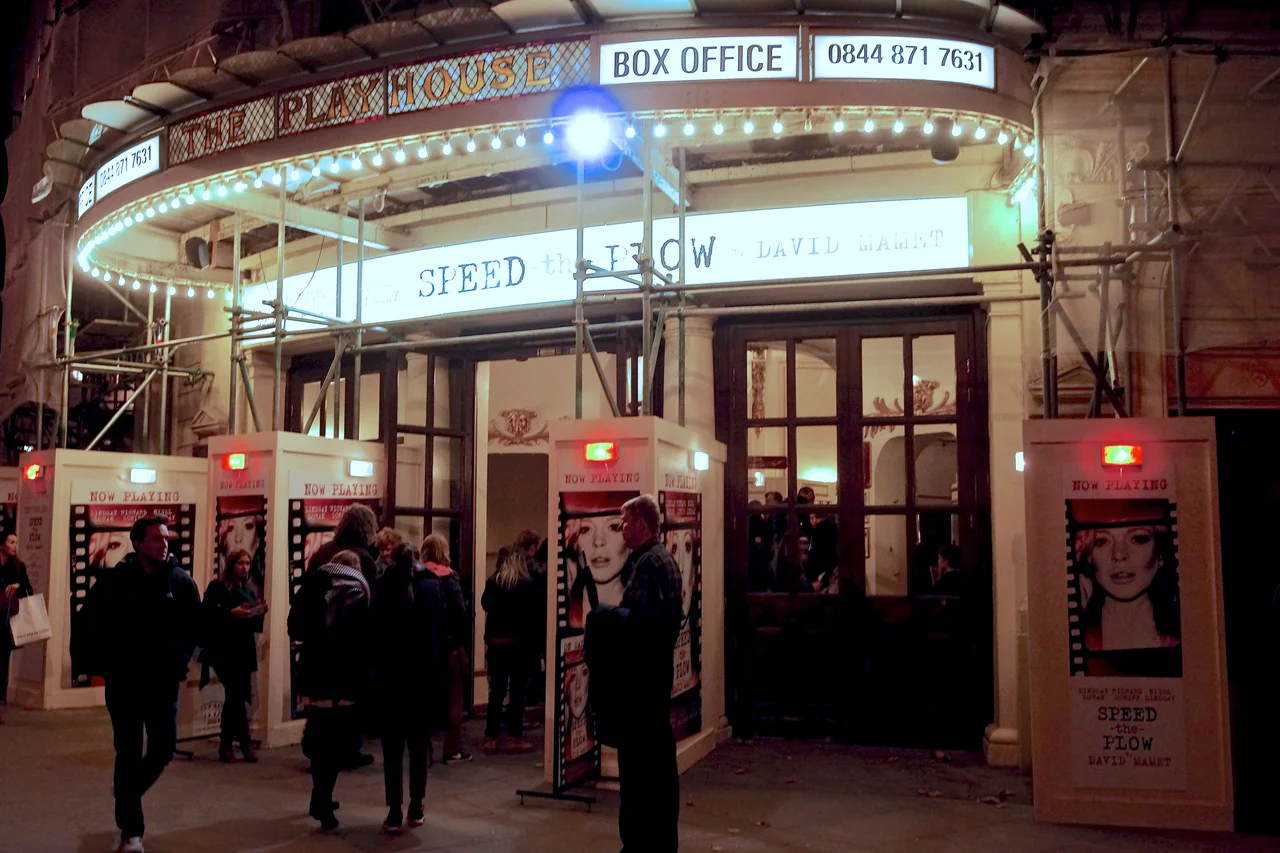

Playhouse Theatre
On 5 December 1905, the roof of Charing Cross railway station collapsed onto the building next door. The neighbour was a Victorian theatre called the Royal Avenue, then being rebuilt to new designs. Roof, girders, and a section of the station's western wall crashed through both buildings, killing three people inside the station and three workmen on the theatre site. The theatre that rose from that rubble - rebuilt, renamed, and reopened as The Playhouse on 28 January 1907 - is still standing on Northumberland Avenue today, just steps from Trafalgar Square. It has been a stage, a BBC recording studio, and is now a cabaret den.
Shaw's Breakthrough
Before the disaster, the theatre had another life. Built by Sefton Henry Parry as the Royal Avenue, it opened in March 1882 with 1,200 seats and Jacques Offenbach's Madame Favart on its bill. For a decade it traded in comic opera and farce. Then in 1894 the tea heiress Annie Horniman anonymously bankrolled a season for the actress Florence Farr. When Farr's first production stumbled, she pressed her friend George Bernard Shaw to finish the play he had been working on. He did. Arms and the Man received its premiere at the theatre that year, and the success freed Shaw to abandon music criticism and write full-time. A small West End house had just launched one of the great careers of modern theatre.
The Station Falls
Architects Blow and Billerey were halfway through rebuilding the theatre in late 1905 when Charing Cross's western wall failed. The collapse turned construction into catastrophe, but the work resumed and the new Playhouse - smaller now, with 679 seats - opened in January 1907 with Tristan Bernard's Toddles and a Shaw curtain-raiser written for the occasion. The substage machinery installed during that rebuild still survives. Alec Guinness made his stage debut on these boards in April 1934, playing in Edward Wooll's courtroom drama Libel! Somerset Maugham's Home and Beauty had premiered here in August 1919 to a 235-performance run. The theatre had quietly become a place where careers began.
When the Goon Show Lived Here
In 1951 the BBC took over the Playhouse and turned it into a recording studio. For twenty-five years, audiences sat where playgoers had sat and watched live recordings of The Goon Show, Hancock's Half Hour, and Steptoe and Son. The stage that had launched Shaw became a microphone-strewn workspace where Spike Milligan and Peter Sellers built British comedy. The same boards hosted live performances by Queen, Led Zeppelin, The Who, The Beatles, and The Rolling Stones. On 3 April 1967 a Pink Floyd concert went out live from the theatre. When the BBC moved out around 1976, the building went dark, and for a while it looked as if the Playhouse might be demolished.
Rescued, Sold, Rescued Again
The impresario Robin Gonshaw saved it in 1987, restoring the 1907 interior with help from theatre consultant Iain Mackintosh. The next two decades read like a real-estate novel: in 1988 the novelist and politician Jeffrey Archer bought the Playhouse for just over GBP 1 million, then sold it in 1992 to writer Ray Cooney for just over GBP 2 million; Cooney sold to American banker Patrick Sulaiman Cole in 1996, who refurbished the auditorium under English Heritage with murals, caryatids, and golden pillars. Through all of it, the productions kept coming. The Peter Hall Company moved in for the early 1990s. Almeida Theatre and Cheek by Jowl staged seasons. James McAvoy starred in Cyrano de Bergerac for Jamie Lloyd's company from December 2019.
Welcome to the Kit Kat Club
The COVID-19 pandemic shut down the Lloyd company's planned run of The Seagull with Emilia Clarke and A Doll's House with Jessica Chastain. While the West End sat dark, the Playhouse underwent the most radical reinvention in its history. When it reopened on 15 November 2021, the building had been gutted, reshaped into theatre-in-the-round, and rebranded as the Kit Kat Club for an immersive revival of Cabaret starring Eddie Redmayne and Jessie Buckley. Capacity dropped to 550. Audiences enter through side doors, drinks in hand, into a recreated Weimar nightclub. Mason Alexander Park and Maude Apatow, then Jake Shears and Rebecca Lucy Taylor, would later take over the leads. The little theatre next to Charing Cross has survived a fallen wall, a generation as a recording studio, and several rescues. Tonight, on a Northumberland Avenue corner, it is selling Berlin in 1929 to anyone who walks through the door.
From the Air
The Playhouse stands at 51.5069 N, 0.1236 W on Northumberland Avenue, immediately south of Trafalgar Square and tucked beside Charing Cross railway station. From central London approaches, look for the Thames bend, Trafalgar Square, and the railway shed of Charing Cross on the north bank. Nearest airports are London City (EGLC) about 7 nm east and London Heathrow (EGLL) 14 nm west. The river lighting at dusk picks the building out against the bridge.
Nearby Stories
- Stevenage 5.7 km away
- Malling Abbey 5.7 km away
- 1952 Farnborough Airshow Crash 7.7 km away
- Ingatestone Hall 8.2 km away
- Hellfire Caves 9.1 km away
- The Carrington Event: The Solar Storm That Could Happen Again 9.8 km away
- Bletchley Park 16 km away
- Castle Hedingham 23 km away