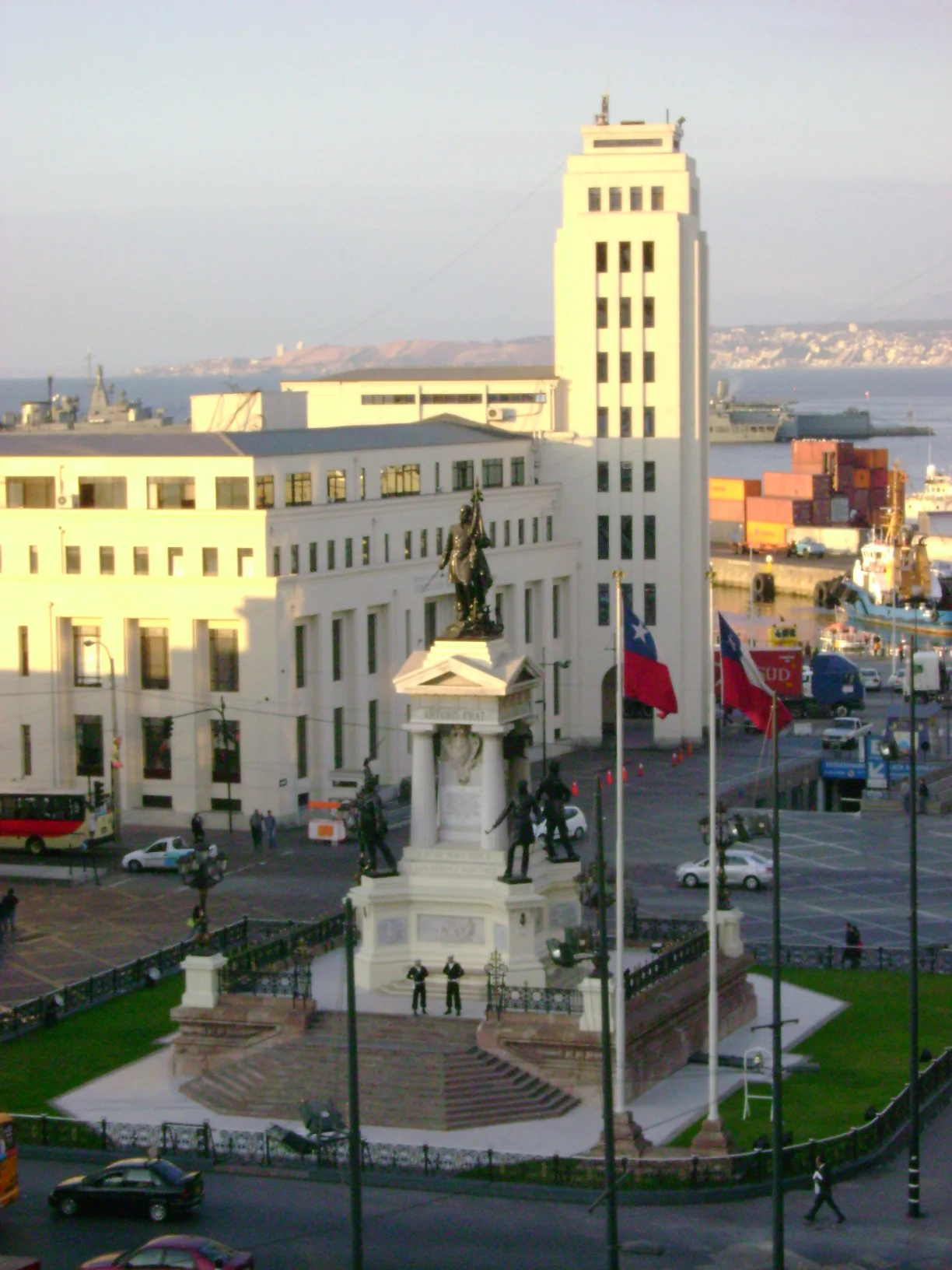

Plaza Sotomayor
"Boarders, after me!" Captain Arturo Prat shouted those words on the morning of 21 May 1879, then leapt from the deck of his wooden corvette Esmeralda onto the iron flank of the Peruvian warship Huáscar. He was cut down almost at once. His outnumbered ship sank with its colors still flying, and a doomed defeat became Chile's most cherished act of valor. Walk into Plaza Sotomayor in Valparaíso today and Prat is there above you, cast in bronze atop a soaring monument, while below your feet, in a crypt beneath the paving stones, lie the actual remains of the men who died beside him.
A Square Wrestled from the Sea
Plaza Sotomayor did not so much get built as get reclaimed. Much of it sits on ground that was once seabed, filled and leveled over generations. It has worn several names, beginning as the Customs Square, becoming the Palace Square, then the Intendancy Square. The story of its making includes one improbable foundation: in June 1825 a storm snapped the cables of the frigate Valdivia and drove her aground on the beach that lay here. Rather than haul the wreck away, the authorities packed her hull with sand and used it as the base for Valparaíso's first passenger wharf. The city quite literally built its front door on a shipwreck.
The Heroes Beneath the Stones
The square's emotional center is the Monument to the Heroes of Iquique. In 1885 the old commercial exchange that stood here was demolished to make way for it, and the towering memorial was inaugurated on 21 May 1886 in honor of the sailors who fell at Iquique and the nearby Battle of Punta Gruesa during the War of the Pacific. Prat stands at the summit. Around the base are his comrades, among them Ignacio Serrano, Ernesto Riquelme, and Sergeant Juan de Dios Aldea, who boarded the Huáscar at Prat's side. Their bodies, first buried in the northern town of Iquique, were brought home and sealed in the crypt below the monument. Each 21 May, a nation that turned a sinking into a symbol gathers here to remember them.
A Gate Between City and Sea
The plaza is framed like a stage. On its northeastern edge rise two matching towers that form a kind of gateway between the city and its port. Opposite them stands the former Intendancy building, an elegant Beaux-Arts pile now serving as headquarters for the Chilean Navy and presiding over the whole square. The trapezoid shape of the plaza is no accident; it stretches the perspective and pulls the eye toward the water. From here a short walk leads to Muelle Prat, the pier where small boats still carry visitors out to see the harbor and where a replica of an early Spanish vessel recalls the first ships to anchor in this bay.
Layers of a Trading City
Few squares pack so much history into so little space. Chile's first bank opened on this spot in 1855, and the commercial exchange that followed in 1858 was built, remarkably, of wood and cane shipped from Guayaquil. In 1866 the Spanish navy bombarded Valparaíso during the Chincha Islands War, and the exchange survived a deliberate attempt to burn it. When workers remodeled the plaza around the year 2000, archaeological digs uncovered the old wharf remains, and a small museum was installed beneath the square to display them. Stand in the center and you are surrounded by buildings from a dozen different decades, each layer a chapter in the rise of the Pacific's great trading port.
The Name on the Square
The plaza honors Rafael Sotomayor Baeza, the civilian minister of war who organized Chile's campaign during the War of the Pacific, the same conflict that killed Prat at Iquique. The square's mood shifts with the hour. By day it bustles as a working civic space; the western terminus of the Valparaíso Metro sits nearby, where commuters pour out where an old railway station once stood. On the still, gray mornings common to this coast, the marine layer drifts in off the bay and the great Navy building and the twin towers loom softly through the haze. Then the sun cuts through, the cobbles brighten, and the monument's bronze sailors stand sharp against the sky once more, keeping their long watch over the port they died defending.
From the Air
Plaza Sotomayor lies at 33.038°S, 71.629°W, at sea level where Valparaíso's historic quarter meets the working port. From the air it is one of the easiest landmarks in the city to identify: a broad open rectangle running back from the waterfront toward the hills, with the twin towers and the large Navy building framing it and Muelle Prat jutting into the harbor alongside. Nearest is Viña del Mar Airport (SCVM), a Chilean Navy field about 16 km north with limited civilian use, and the small Rodelillo airstrip (SCRD) above the city to the southeast. Santiago's Comodoro Arturo Merino Benítez International (SCEL) is the principal gateway, roughly 110 km east across the coastal range. Recommended viewing altitude is 1,500 to 3,000 feet AGL for a clean read of the plaza, port, and surrounding hills; a coastal marine layer commonly lingers in the morning before clearing by midday.
Nearby Stories
- Battle of Papudo 24 km away
- Casa de Isla Negra 28 km away
- Battle of Chacabuco 31 km away
- Battle of Maipú 38 km away
- Aconcagua 94 km away
- Constitución, Chile 237 km away
- Santa Olga 278 km away
- 1687 Peru Earthquake 1982 km away