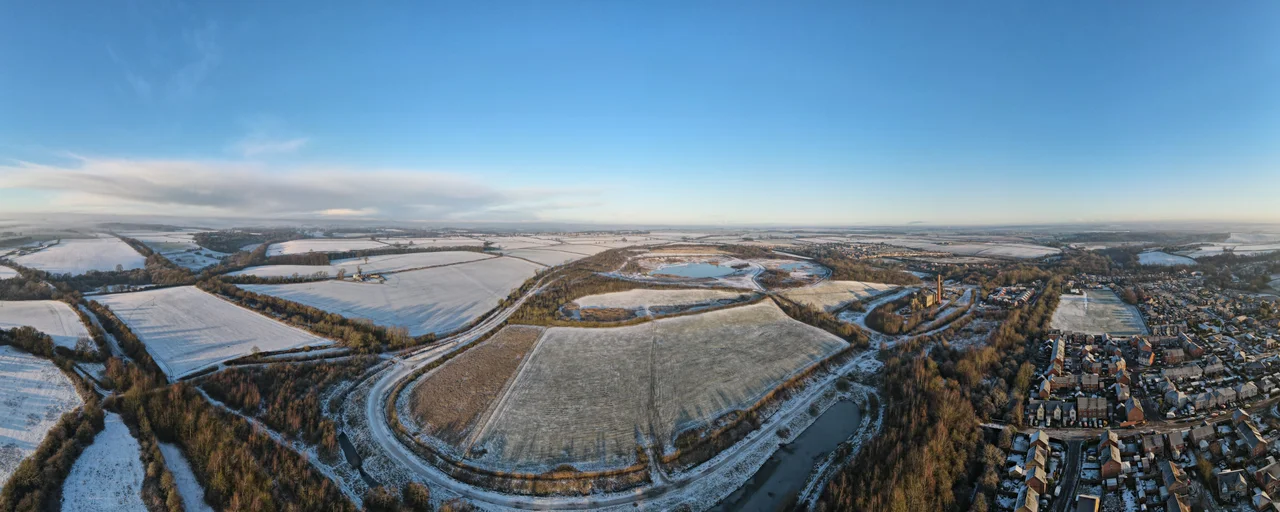

Pleasley Colliery
Most of the coalfield's pits were knocked down so completely you could walk over their footprints without noticing. Pleasley is the exception. Drive north out of Mansfield on the road that climbs out of the River Meden valley and the twin headstocks rise above the trees, still standing where they have stood since the 1870s. The winding wheels at the top no longer turn for coal. They turn when volunteers, on certain weekends, fire up the original steam winders below them and let everything move the way it did for a hundred and ten years.
Why Pleasley Was Sunk
The Stanton Iron Company needed fuel. In 1870, its blast furnaces in Derbyshire were hungry enough that the company started looking north for new coal. Boreholes around the village of Pleasley, on the Nottinghamshire-Derbyshire border, found a good seam, and sinking began in 1873. The colliery took its position on a ridge above the north bank of the Meden, 500 feet above sea level, aligned northeast to southwest to follow the river valley. It would produce coal for the next 110 years. When the pit finally closed in 1983, most of what stood above ground was demolished within a few years, in the standard postwar pattern of erasure. The two headstocks, the engine-house complex and one of the brick chimneys somehow survived.
Two Steam Winders
What makes Pleasley unusual is what is left inside. The engine-house contains two working steam winding engines: one installed in 1905 by the Lilleshall Company, the other in 1922 by Markham and Co. The winders are the machines that did the actual work of lifting men, coal and equipment up the shafts. They are large enough to fill a hall, with polished brass and exposed steel, and they belong to an era when industrial machinery was built to be looked at as well as to do its job. A Friends of Pleasley Pit group formed to save them. The volunteers cleaned, restored and eventually rebuilt the winders to operating condition. On open days, the engines run again under their own steam, the rope drums turning, the linkages clattering through the strokes they made for eight decades.
Listed, Scheduled, Restored
The engine-house complex is a Grade II listed building, and the broader site is a Scheduled Monument under the protection given to nationally important archaeological remains. Both designations followed the work of the Friends. The chimney, forty metres of late-Victorian brickwork that once vented the boiler range, was steadied and repointed. The headstocks were stripped, stabilised and repainted in their original liveries. English Heritage publicly praised the restoration. The Land Trust took on ownership, and the Pleasley Pit Trust began converting the surviving buildings into a mining heritage centre. Around them, the pit tip was reworked to extract residual coal, then landscaped into a country park with lakes and paths.
Footpaths and Cycle Trails
Two adjacent railway lines once carried coal away from Pleasley, part of a dense network that linked the collieries to the iron towns and to ports on the east coast. The lines closed with the pit, and the alignments have been converted into cycle trails. From Pleasley you can ride west through woodland toward former mining villages, or northeast toward Hardwick Hall, the Elizabethan mansion that Bess of Hardwick built in the 1590s and that now stands as a National Trust property only a few miles away. The juxtaposition is local in the literal sense: a Victorian colliery turned heritage centre, an Elizabethan house turned heritage centre, the older grand and the newer industrial, linked by the bicycle paths that replaced their connecting railways.
From the Air
Pleasley Colliery is at 53.174 N, 1.255 W, about 3 miles north of Mansfield in central England. The site sits at roughly 150 m above sea level on the ridge above the Meden. The twin headstocks remain prominent landmarks visible from the south; the 40 m brick chimney is the other reliable identifier. Best viewed from 2,000-3,000 ft AGL. Nearest commercial airports: Nottingham East Midlands (EGNX) about 25 nm south-southwest; Doncaster Sheffield (EGCN) 22 nm north; Sheffield City Heliport. Hardwick Hall sits 4 nm to the northwest along the line of the old railways.
Nearby Stories
- HMS Sherwood (shore establishment) 1.7 km away
- Sudbury Hall 2.7 km away
- Grantham Rail Accident 3.8 km away
- Conisbrough Castle 5.2 km away
- Doddington Hall, Lincolnshire 6 km away
- Litton Mill 8.9 km away
- Flixborough Disaster 20 km away
- Astley Deep Pit Disaster 22 km away