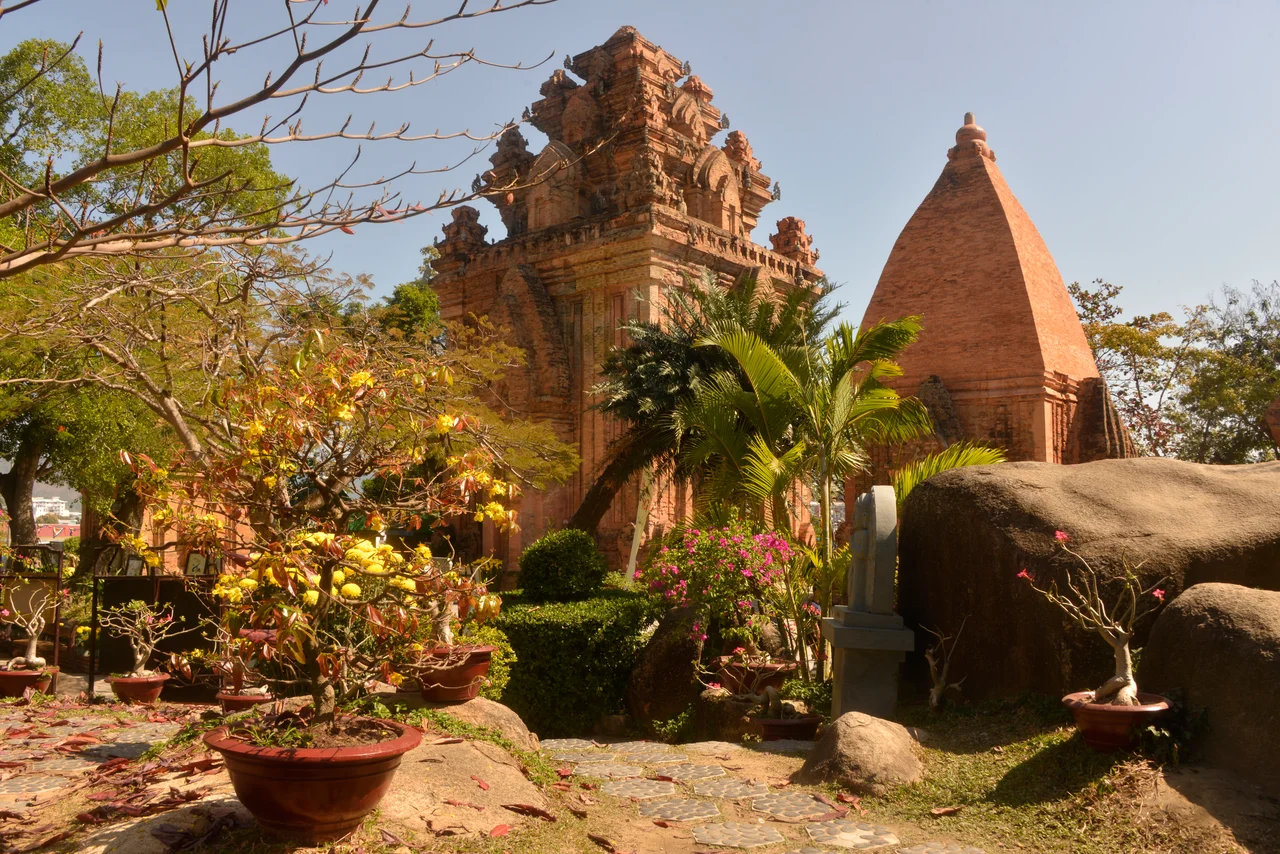

Po Nagar
The oldest written record of this place is a story of loss. A stele dated 781 CE records that King Satyavarman restored a temple that had already been ransacked — its sacred mukhalinga broken, its jewels stolen by seaborne raiders described in the inscription as men "completely black and gaunt, dreadful and evil as death." The temple had existed before 781. Before how long before, the stone does not say.
The Goddess of the Country
Po Nagar is dedicated to Yan Po Nagar — a name that translates roughly as Lady of the Country, or Lady of the City. She is the presiding deity of the Cham people's homeland, a goddess whose identity gathered other identities to it over the centuries. The Cham understood her through the Hindu framework of Bhagavati, the divine feminine, and as Mahishasuramardini — Durga, the slayer of the buffalo-demon, depicted in powerful relief above the entrance to the main tower. When Vietnamese speakers moved south in the seventeenth century and absorbed Champa into their expanding kingdom, the goddess did not disappear; she became Thiên Y Thánh Mẫu, the Holy Mother of Heaven. The name changed. The reverence did not. Today, Vietnamese worshippers bring flowers and incense to a deity their ancestors would have called by a different name, honoring a continuity of sacred space that spans more than a millennium.
Raids, Gifts, and the Khmer
The steles that survive from Po Nagar read like a ledger of devotion and violence. In 817, the Cham military leader Senapati Par made endowments to the temple under King Harivarman I — gifts of land, wealth, and labor that expressed the political as much as the spiritual authority of the Cham state. In 918, King Indravarman III ordered a golden statue of the goddess Bhagavati cast for the temple. But by 950 that gold statue was gone, carried off by the Khmer king Rajendravarman II during a period of conflict between the two great Southeast Asian powers. The Cham replaced what was taken; rebuilt what was broken. The main tower standing today, approximately 25 metres high, belongs to a rebuilt and expanded complex — the product of endowments, reconstructions, and additions across several centuries of Cham rule.
What the Towers Hold
The Po Nagar complex sits on three levels on Cù Lao Mountain, rising above the Cái River just north of the modern city. Two rows of towers occupy the highest level. The main tower's central image is a stone statue of Yan Po Nagar, 1.2 metres tall, seated cross-legged and dressed only in a skirt, her ten hands holding symbolic objects — weapons, flowers, a vessel. Vietnamese scholar Ngô Vǎn Doanh has identified these attributes as connecting her to Durga, slayer of the buffalo-demon. In the pediment above the entrance, a four-armed version of that goddess stands atop a buffalo, holding a hatchet, a lotus, and a club. This carving belongs to the Tra Kieu style of Cham art, dated to the late tenth or early eleventh century — a few generations after the temple's first documented destruction, and the artistic tradition that arose to restore what had been lost.
Sacred Ground Across Centuries
In the seventeenth century, Vietnamese expansion brought Champa to an end as a political entity. The people who had built Po Nagar were dispersed, their kingdom absorbed. Yet the temple was not abandoned or torn down. Vietnamese rulers incorporated it into their own religious framework, and local legends about the goddess — now called Thiên Y Thánh Mẫu — began to accumulate. This reinterpretation was neither simple erasure nor pure preservation; it was the complex process by which sacred places survive political change. What the Cham built, the Vietnamese continued to maintain and visit. Today, both Cham descendants and Vietnamese worshippers come to Po Nagar, sometimes for different reasons, honoring different versions of the same divine presence. The smoke from incense sticks rises past towers that have been standing in some form for more than twelve hundred years.
From the Air
Po Nagar stands at approximately 12.265°N, 109.196°E on Cù Lao Mountain, on the north bank of the Cái River at the northern edge of Nha Trang. The towers are visible from 1,500 feet AGL as a cluster of dark brick structures on a vegetated hill above the river. Looking south from above the site, the crescent beach of Nha Trang Bay curves along the coast. Cam Ranh International Airport (VVCR) is approximately 32 km to the south-southeast. Nha Trang Air Base (VVNT) is approximately 4 km south-southwest. The Cái River estuary and the bridge crossings provide clear visual navigation references when approaching from the coast.
Nearby Stories
- Cam Ranh 5.1 km away
- Linh Phước Temple 15 km away
- Đà Lạt Plateau 25 km away
- Chư Yang Sin National Park 49 km away
- Vũng Rô Bay 52 km away
- South-East Asian Theatre of World War II 220 km away
- Kashmir Princess 361 km away
- Battle of the Paracel Islands 494 km away