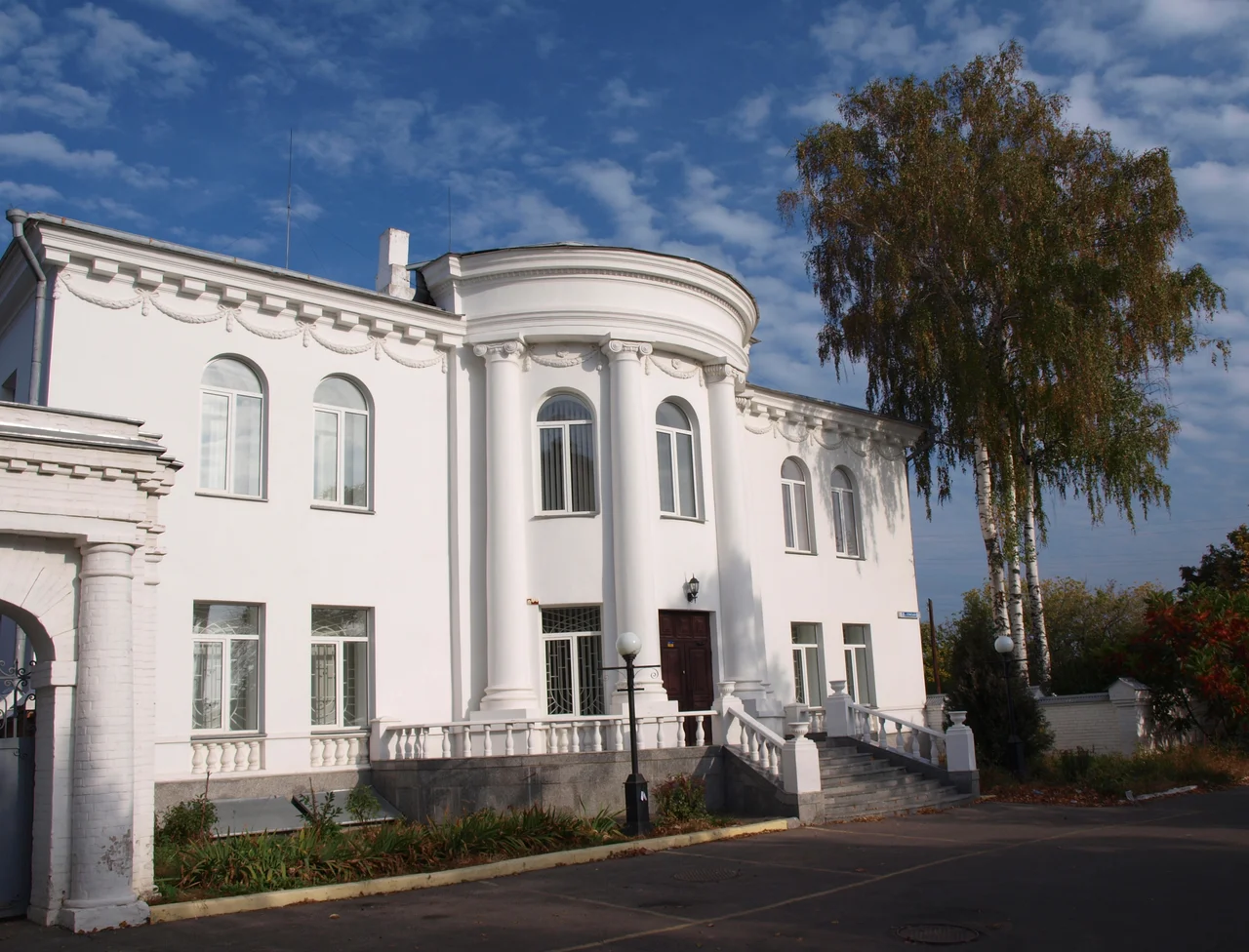

Poltava Art Museum
We know exactly what Poltava lost because one man had written it all down. Before the Second World War, the city's art museum held some thirty thousand pieces, among them canvases by Rubens, Tiepolo, and Vigée-Le Brun. During the Nazi occupation nearly everything on display was destroyed, and the museum's own records burned with them. What remains of that vanished collection lives only in a guidebook written by the museum's founder, Mikhail Rudynsky, a document that now reads like an inventory of ghosts. To understand this museum, you have to understand it as a place that survived its own near-erasure and chose to begin again.
A Painter's Homecoming
The collection began as a gift. In 1917 the painter Nikolai Yaroshenko, a member of the Peredvizhniki, the Association of Itinerants who broke with academic convention to bring art to ordinary Russians, gave his personal collection to Poltava, his native city. It was no small offering: a hundred of his own paintings, twenty-three sketchbooks, and works by the friends he had exhibited alongside, including Ivan Shishkin, Vasily Polenov, Vladimir Makovsky, and Ilya Repin. The museum opened to the public on April 27, 1919, in a mansion built in 1912 by the architect Aleshin in a quiet corner of the city. Rudynsky, who would go on to become a noted archaeologist, called it simply the Museum of Arts. Its walls filled quickly with treasures from the nationalized estates of the region's old aristocratic families, the Kochubeys of Dykanka among them.
What the War Took
By 1939 the museum had won independent status as a regional art museum, and its holdings had swelled toward thirty thousand objects. Then came occupation. Almost all of the displayed collection was ruined or lost, along with the records that catalogued it. The scale of the loss is staggering to read even secondhand: the Western European paintings by Rubens, Tiepolo, Melchior d'Hondecoeter, Adriaen van Ostade, and Élisabeth Louise Vigée-Le Brun; the Ukrainian works of the seventeenth and eighteenth centuries; the finest Russian canvases of the nineteenth and twentieth. Only the treasures that had been evacuated survived. In November 1944, with Poltava still lying in ruins around it, the museum reopened its doors, an act of stubborn continuity while the rubble was barely cold.
Rebuilt From What Was Left
The postwar staff faced an almost impossible task: to reconstitute a great collection from its wreckage. In 1951 the museum returned to its restored original building, and the count of works, including the 4,187 that had survived the war by being elsewhere, climbed back above nine thousand. That figure carries its own quiet weight. Every piece added afterward was a deliberate act of recovery, a museum rebuilding itself object by object rather than mourning what it could not replace. Decade by decade, the staff filled the gaps left by the fire, refusing to let the loss have the final word.
The New Rooms
By 2000 the hastily repaired original building had deteriorated, and the collection moved again, this time to the art gallery on what was then Frunze Street, where the exhibition occupies two suites of rooms on the ground floor. The chronological arrangement stayed intact. In the left suite hang Western European works, among them paintings by Lucas Cranach the Younger, Clara Peeters, Jean-Baptiste Greuze, and Francesco Guardi. The right suite holds Ukrainian and Russian art, church utensils of the seventeenth and eighteenth centuries, sculpture, and furniture. Two rooms are given entirely to Yaroshenko, including a self-portrait paired with one of his wife, a fitting anchor for a museum that his generosity first set in motion.
From the Air
The Poltava Art Museum sits in the city center at about 49.59°N, 34.56°E, in Poltava, north-central Ukraine. From roughly 3,000 to 6,000 feet the city's leafy central district and the White Rotunda on the hills above the Vorskla River help orient the eye. Poltava International Airport (UKHP) lies just west of the city.
Nearby Stories
- Velyki Sorochyntsi 16 km away
- Krasnokutskyi Arboretum 18 km away
- Gelonus 19 km away
- Deriivka 59 km away
- Battle of the Vorskla River 66 km away
- Borki Train Disaster 70 km away
- Hadiach 79 km away
- Samar 85 km away