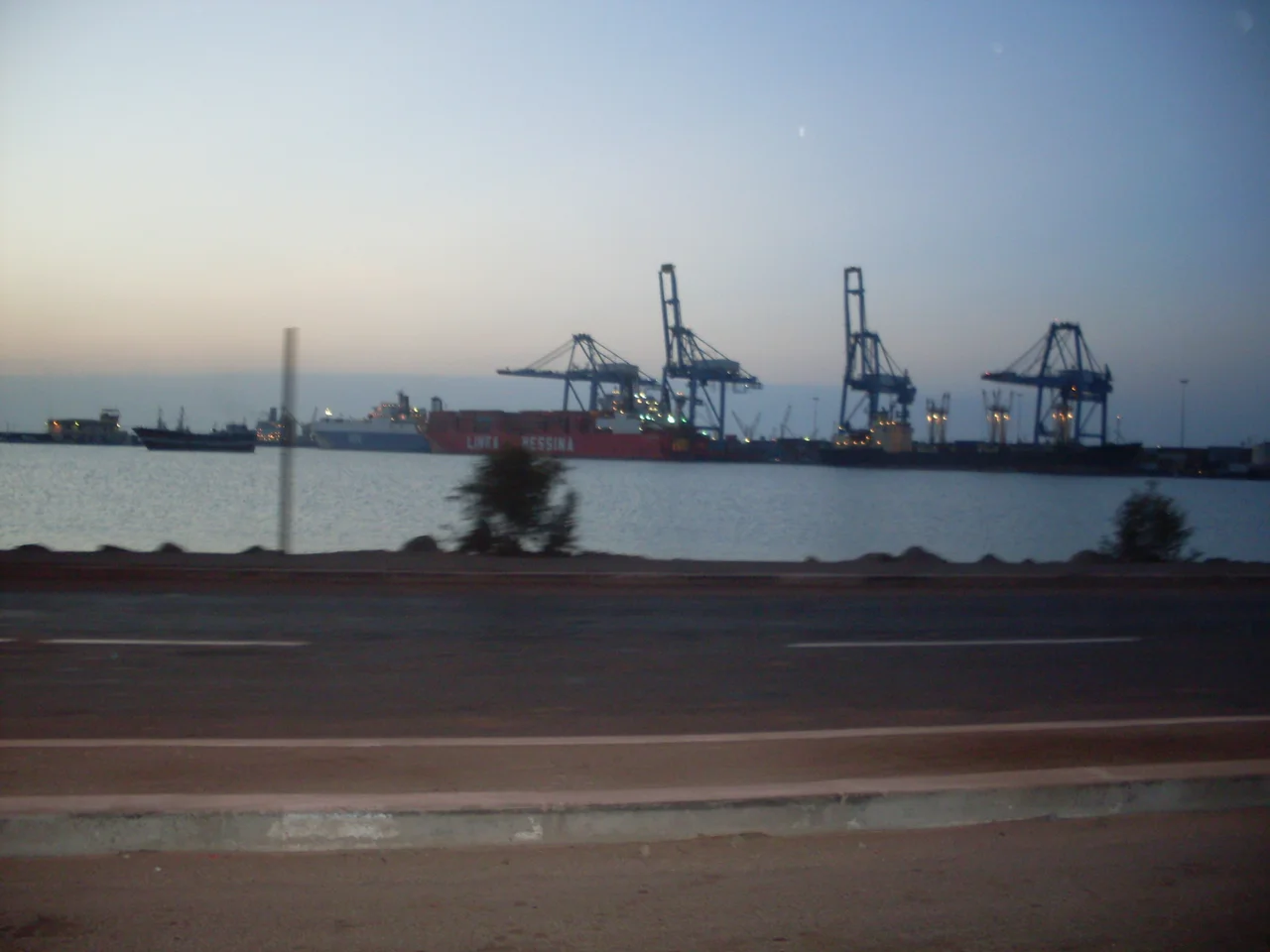

Port of Djibouti
About 2,500 ships call at the Port of Djibouti each year. Seventy percent of their cargo is headed to or from Ethiopia - the landlocked neighbor whose 120 million people depend on this small Djiboutian coastline for more than 95 percent of their foreign trade. A third of the world's daily shipping passes the nearby edge of Africa. The port ranked the best container port in Africa in a 2021 World Bank index, and 61st globally, with ships spending less than a day on average to turn around. And since 2018, the port has been at the center of one of the most contentious port disputes in recent commercial history.
The Maritime Outlet
Djibouti's geography was the port's origin story long before Djibouti existed as a country. The Red Sea has been a trading corridor for 3,500 years - Egyptians, Phoenicians, Ptolemies, Romans, Byzantines, Arabs, and Europeans in pursuit of the spice route all passed through. Its modern apogee came with the opening of the Suez Canal in 1869. But what turned this particular stretch of coast into a major port was Ethiopia's search for a way to the sea. Work on the Franco-Ethiopian railway began in 1897 and finished in 1917, linking Addis Ababa to Djibouti through 781 kilometers of mountain and desert. The railway did not just carry trade - it created it. By 1952 the French oil company Petroles de Somalie was bunkering ships. Four deep-water quays were built between 1948 and 1957. Djibouti's first modern container terminal opened in February 1985.
The French, the Americans, the Chinese
Djibouti's port cannot be separated from Djibouti's role as a hub of foreign military bases. The French Navy keeps 5,000 troops here, making Djibouti France's largest overseas base. The Americans run Camp Lemonnier next to the airport, their main counter-terrorism base in the region. Since 2017, China has operated its first overseas military base near the Port of Doraleh, a few kilometers west of the original port. All of these nations rely on Djibouti's port for logistics. All of them use it to counter the al-Shabaab terrorist threat from Somalia and the piracy that, though reduced since its 2008-2011 peak, has never entirely vanished from the Gulf of Aden. The French colonial railway was replaced between 2011 and 2016 by a Chinese-built standard-gauge electrified line - the first modern electrified railway in East Africa - which terminates at the Port of Doraleh and restored Ethiopia's rail access to the sea.
The DP World Fight
In 2006, Dubai-based DP World won a 30-year concession to run the Doraleh Container Terminal. The partnership was productive at first. Then in 2012, Djibouti began selling pieces of Doraleh to China Merchants Ports Holdings, a Chinese state-owned company. In February 2018, a presidential decree revoked DP World's concession entirely, citing a new law that allowed termination of contracts involving strategic infrastructure. DP World sued. The London Court of International Arbitration ruled in DP World's favor in 2020, declaring the expropriation illegal and ordering the original concession restored. Djibouti ignored the ruling. A quarter of the port's stake went to China Merchants. By 2021, six separate tribunal rulings had gone in DP World's favor. Djibouti has ignored them all. For a country whose economy runs on being a trusted gateway, this is a reputation risk - one that critics argue serves the political regime rather than the broader interests of Djiboutians.
A Small Country's Largest Asset
Djibouti is roughly the size of New Jersey with fewer than a million people. It has little agriculture, few minerals, and one of the harshest climates on Earth. What it has is this coastline - 314 kilometers of it, at the chokepoint where the Red Sea meets the Gulf of Aden. The port generates a substantial share of national revenue. Foreign bases pay rent. Chinese investment totaling $853 million between 2005 and 2019 has built railways, a water pipeline from Ethiopia, and now a new multi-purpose port at Doraleh that adds 29 million tons of annual capacity. The debt to China is real - by one estimate 30 percent of Djibouti's foreign debt - and critics worry about dependency. Supporters note that no other partner has offered comparable scale. In June 2020, when the pandemic stranded merchant seafarers worldwide, the Djibouti Ports Authority organized the first crew change in over a year for 18 Ukrainians and a Russian who had been stuck at anchor. Small acts, at a pivot point.
Aerial Geography
From altitude Djibouti looks like one continuous infrastructure complex - the runways of Djibouti-Ambouli International, Camp Lemonnier, the container cranes of the original port directly north of the city, and the new Doraleh terminals and the PLA Navy base further west. Across the Gulf of Tadjoura, the northern coast runs toward Obock and the mountainous interior. South of the city the Americans, French, Japanese, and Italians keep their facilities. Ships anchor offshore waiting for berth space. The Bab-el-Mandeb narrows to the east, the point where Perim sits between continents.
From the Air
Located at 11.61°N, 43.14°E at the eastern approach to Djibouti City. Djibouti-Ambouli International Airport (HDAM/JIB) serves the region, shared with Camp Lemonnier military operations. Active commercial and military airspace - coordinate carefully. Recommended viewing altitude FL200-300. Container terminals, naval facilities, and the adjacent Port of Doraleh are all visible from altitude. Expect haze and high temperatures year-round; visibility often best at dawn. Gulf of Tadjoura to the north, Bab-el-Mandeb strait visible to the east.
Nearby Stories
- Camp Lemonnier 12 km away
- Lake Assal (Djibouti) 14 km away
- Bab-el-Mandeb 76 km away
- Lake Abbe 87 km away
- Aden 180 km away
- Berbera 190 km away
- USS Cole Bombing 197 km away
- Southern Red Sea region 229 km away