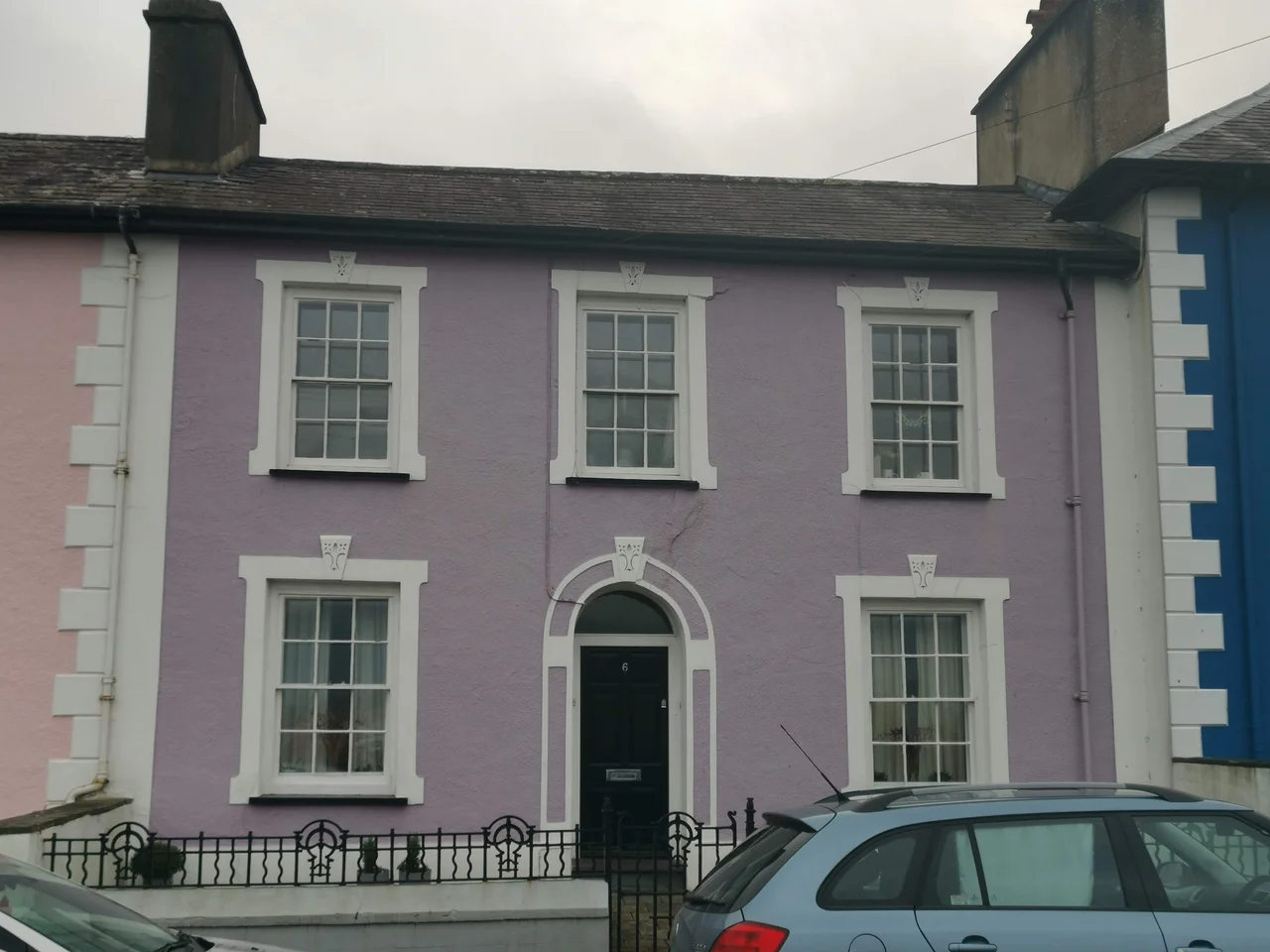

Portland Place, Aberaeron
An inscription on the lintel of number one tells you almost everything you need to know. Portland House, 1855. Benjamin Evans, architect. Look up as you cross the bridge over the River Aeron and the date is right there, cut in stone, daring you to dismiss the building as ordinary. The terrace it begins, numbers 1 to 7 Portland Place, is anything but. Thomas Lloyd, Julian Orbach and Robert Scourfield - the editors of the Carmarthenshire and Ceredigion volume of Pevsner's Buildings of Wales - call this 'the finest single terrace' in the town. They have a lot of terrace in Aberaeron to choose from. The town is full of them.
The Planned Port
Aberaeron is not the sort of Welsh town that grew up by accident. It was made on a drawing board. In 1807 the Reverend Alban Thomas Jones Gwynne, who had married well into a large local landholding, secured an Act of Parliament to develop a port at the mouth of the River Aeron. Work on the harbour began promptly. Work on the residential blocks behind it did not - in 1819 Gwynne died with the streets still mostly unbuilt. His widow held the land but did nothing with it. When she in turn died in 1830, the project passed to their son, Colonel A.T.J. Gwynne, who promptly engaged the Shrewsbury-based architect Edward Haycock Sr. Haycock laid out a grid plan, and leases on plots began selling from the 1830s onward. The bones of every street in old Aberaeron come from his drawings.
The Late Block
Portland Place came later, in the 1850s, when the town was at its commercial peak. By then Aberaeron was a centre of shipbuilding and small-port trade, and the people commissioning Portland House and its neighbours were not gentry but men who had done well out of the sea. The seven houses form a continuous run on the south-west side of the bridge over the Aeron, their identical fronts presenting a uniform, dignified face to anyone arriving in town across the water. They are Regency in spirit even though Regency had ended decades earlier - tall, plain, symmetrical, with the kind of pared-down classical detailing that marks Welsh provincial taste in the middle of the nineteenth century. They are Grade II* listed, the second-highest grade Cadw awards, indicating 'particularly important buildings of more than special interest.'
The Railway Killed It
Aberaeron's commerce did not die suddenly. It withered. The arrival of the railway at Aberaeron in 1911, half a century after Portland Place was built, removed the reason the port existed. Coastal trade had been the town's lifeblood; rail was faster, drier, and went to places ships could not. The shipyards closed. The warehouses found other uses. By the early twentieth century Aberaeron was reinventing itself as a seaside resort - the very same role Welsh coastal towns up and down Cardigan Bay were taking on as Victorian and Edwardian tourists discovered them. Portland Place, built in the year of greatest confidence, found itself in the year of decline. The houses stayed. The town stayed. What changed was who lived in them.
The Town Today
Aberaeron has aged remarkably well. The whole town is now a kind of conservation showcase - the pastel-painted terraces, the harbour basin, the bridge over the Aeron, the grid that Edward Haycock drew in 1830. Walk Portland Place at any tide and the proportions still work. Cars park along the pavement. The river runs out into Cardigan Bay just beyond. Across the water you can see the National Trust's Llanerchaeron estate, where the Aeron also flows. The headquarters of Ceredigion County Council, Neuadd Cyngor Ceredigion at Penmorfa, are now in Aberaeron - a small consolation: the town that lost its trade became the town that runs the county. Number 1, Portland House, still wears its 1855 inscription. Benjamin Evans, architect, would not need to apologise for any of it.
From the Air
Portland Place is at the heart of Aberaeron, on the south-west side of the bridge over the River Aeron, coordinates 52.24 degrees north, 4.26 degrees west. From the air the town is unmistakable: a tight rectangular grid of pastel-painted streets immediately south of a small horseshoe harbour basin. Cruise altitude 2,000 to 2,500 feet AGL gives an excellent view of the town plan; the Aeron itself winds inland through green farmland. Nearest airports: Aberporth (EGFA) 8 nm south, Haverfordwest (EGFE) 45 nm south, Caernarfon (EGCK) 65 nm north. The MoD Aberporth Range Danger Area extends across most of Cardigan Bay to unlimited altitude - check NOTAMs.
Nearby Stories
- Strata Florida Abbey 2.9 km away
- Machynlleth 3.8 km away
- Fishguard Lifeboat Station 4.7 km away
- Cantre'r Gwaelod 9.8 km away
- Gwili Railway 17 km away
- RAF Towyn 20 km away
- HMS Tyler 33 km away
- Brecon Cathedral 34 km away