_p208_PORTOBELLO_HARBOUR_AND_GRAND_CANAL_HOTEL.jpg)
Portobello, Dublin
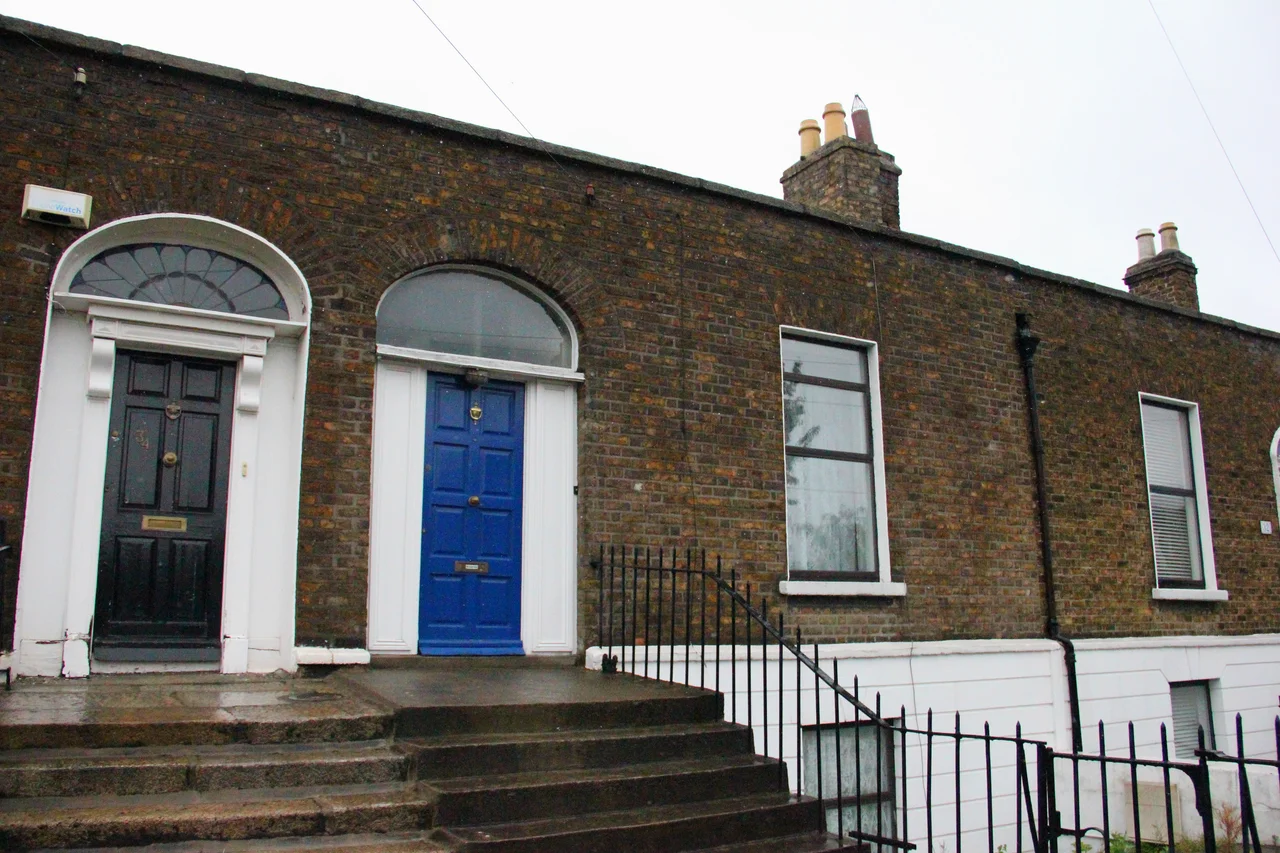
The name does not belong here. Portobelo is a port on Panama's Caribbean coast, and Admiral Edward Vernon captured it in 1739 during a war the British remembered for an ear severed from a Spanish smuggler. The victory was so popular in London that streets, neighbourhoods and entire suburbs were christened in its honour from Edinburgh to Dublin. Two and a half centuries later, Portobelo's name is barely remembered in Panama - but it survives in this strip of Georgian terraces south of the Grand Canal, a Dublin quarter whose own layered history has nothing to do with the harbour it was named for.
The Bridge That Killed Six
On the evening of 6 April 1861, a horse-drawn omnibus driven by Patrick Hardy started up the steep incline of Portobello Bridge. One of the horses reared. Hardy tried to turn the team. Both horses panicked and backed the bus straight through the wooden rails of the bridge into the canal lock below - twenty feet down, with ten feet of water at the bottom. The conductor jumped clear. A passing policeman pulled Hardy from the water. A constable and a soldier from Portobello Barracks broke into the submerged carriage. Everyone inside was dead - six passengers, including two mothers with their daughters, one of them a niece of Daniel O'Connell. For decades afterward, passengers had to step down and walk across the bridge. Locals whispered about a ghost lock-keeper who had drowned himself after being sacked, and blamed him for the horses.
Little Jerusalem
In the early 1870s the first Lithuanian Jews arrived in Dublin, fleeing pogroms in the Russian Empire. They settled along Lower Clanbrassil Street, then spread outward as they prospered - to the South Circular Road, to Longwood Avenue, to Bloomfield Avenue where a Jewish school opened. Within a generation, Portobello was Dublin's Little Jerusalem. Hebrew classes met near Kelly's Corner. A synagogue rose in Camden Street, another in St. Kevin's Parade. Ada Shillman, arrived from Lithuania in 1892, became a midwife, founded a dispensary for Jewish women on Bloomfield Avenue, and helped open Saint Ultan's Children's Hospital. In 1902 the Socialist James Connolly campaigned for Dublin Corporation by distributing election leaflets in Yiddish - the only candidate to do so. The community largely scattered after the Second World War, most heading to New York or Israel, and most who remained in Dublin moved to Terenure. The Irish Jewish Museum on Walworth Road preserves what remains.
Easter 1916: Bowen-Colthurst's Killings
Francis Sheehy-Skeffington was a pacifist. On 25 April 1916, walking home to Rathmines after putting up leaflets that called for citizens to organise against looting, he was arrested at Portobello Bridge because his name was on a list. He was taken to Portobello Barracks and held as an enemy sympathiser. That evening Captain J.C. Bowen-Colthurst of the Royal Irish Rifles led a raiding party with Sheehy-Skeffington in tow as a hostage. They attacked the shop of Alderman James Kelly, mistakenly arresting two journalists who happened to be there. Returning to barracks, Bowen-Colthurst shot two unarmed civilians on the street, including a seventeen-year-old boy walking home from church. The next morning he ordered a firing squad to execute Sheehy-Skeffington and the two journalists, then buried them in shallow graves in the barracks yard. The military tried to bury the story too. Sir Francis Fletcher-Vane, an officer who tried to have Bowen-Colthurst arrested for murder, was instead dishonourably discharged. Bowen-Colthurst pleaded insanity, served eighteen months in Broadmoor, and emigrated to Canada.
Shaw, Joyce and the Bleeding Horse
Two doors and a tram-ride from where Sheehy-Skeffington was murdered, George Bernard Shaw had been born on Synge Street in 1856. The future Nobel laureate attended the Christian Brothers school later immortalised in the 2016 film Sing Street. Down the road, the Bleeding Horse pub on Camden Street - reputedly licensed in 1649 and named for a horse that wandered from the Battle of Rathmines - drew James Joyce, Oliver St. John Gogarty and John Elwood through its doors. Joyce wrote it into Ulysses: 'I saw him a few times in the Bleeding Horse in Camden street with Boylan, the billsticker.' The Beatles' 'Being for the Benefit of Mr. Kite!' connects too - the lyric was lifted from a poster for Pablo Fanque's circus, and Fanque, the first Black British circus owner, performed at the Royal Portobello Gardens in June 1850.
The Canal Still Flows
Walk Portobello today and the layers all show through. La Touche Bridge - everyone calls it Portobello Bridge - still arches over the lock where the omnibus fell. The Bleeding Horse is back to being The Bleeding Horse after a midcentury detour as The Falcon. The South Richmond Street strip is part of Dublin's 'Golden Mile' of music venues and late-opening bars. Cathal Brugha Barracks - the old Portobello Barracks where Michael Collins set up his headquarters after the War of Independence, and from which he left for Cork on the morning of 22 August 1922, the day he was killed - is still in continual military use. The Grand Canal's banks have been restored. Swans nest on the still water. The Bretzel bakery on Lennox Street still bakes kosher under new management, the last working trace of Little Jerusalem.
From the Air
Portobello sits at 53.33°N, 6.27°W, immediately south of Dublin city centre and the River Liffey, bounded to the south by the arc of the Grand Canal. From altitude the canal is the most visible landmark - a thin reflective ribbon curving around the southern edge of the inner city. The grid of Victorian terraces between the canal and the South Circular Road defines the district. Dublin Airport (EIDW) lies 11 km north; the Wicklow Mountains rise to the south.
Nearby Stories
- Wicklow Mountains 12 km away
- Mornington 14 km away
- German submarine U-1051 16 km away
- Abbey of Kells 18 km away
- Irish Military Intelligence Service 20 km away
- HMS Manners (K568) 37 km away
- Templemore 42 km away
- Irish Sea Bridge 43 km away