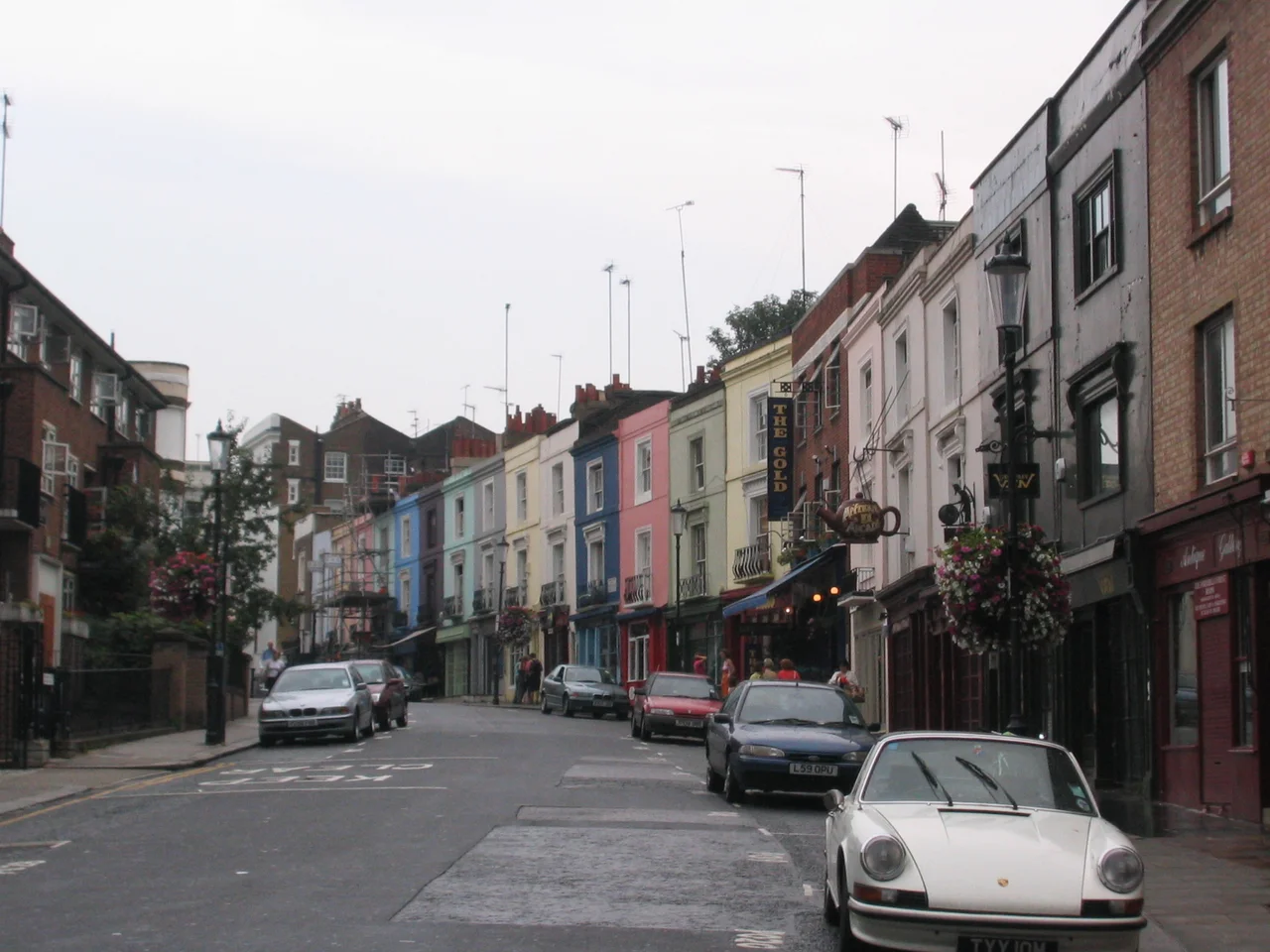

Portobello Road
The name comes from Panama. In November 1739, during the strange and now half-forgotten War of Jenkins' Ear, Admiral Edward Vernon and a British fleet captured the Spanish-held port of Puerto Bello on the Caribbean coast. The news landed in London like a thunderclap. Streets, taverns, and farms were christened in the admiral's honour - and a working farm at the northern end of what was then a winding country lane called Green's Lane took the victory's name. By the time the farm itself vanished beneath Victorian brick, the road had its identity. Vernon Yard still runs off Portobello Road today, still honouring an admiral most Londoners have never heard of.
From Country Lane to Urban Highway
Before 1850, Portobello Road was hayfields, orchards, and open ground. It ran roughly south to north between what is now Notting Hill Gate and Kensal Green, descending from 84 feet above sea level at its northern end to 65 feet at its lowest point before climbing again. The Victorian building boom turned the lane into a street and then into a neighbourhood. Wealthy residents built elegant crescents in Paddington and Notting Hill; their domestic servants, coachmen, costermongers, and tradesmen built nothing, but lived and worked along the corridor between. When the Hammersmith and City Railway opened in 1864 and Ladbroke Grove station appeared, the last fields disappeared under brick. The old Portobello Farm was sold to Dominican nuns, who built St Joseph's Convent on the land - the Black Friars, as the order was known in England.
The Market That Took Over
Like many London markets, Portobello began as fresh-food trade in the nineteenth century. The antiques dealers arrived in the late 1940s and 1950s, found cheap rents and easy crowds, and slowly took over. Today the Saturday market is the largest antiques market in the United Kingdom, with about 1,028 yards of stalls stretching from Golborne Road in the north to Westbourne Grove in the south. Five sections run on Saturday: second-hand goods, clothing and fashion, household essentials, fruit and vegetables and food, and the antiques themselves. Walk a third of the way south from the top and the market dives beneath the bridges of the A40 and the Hammersmith and City line. Under those bridges the trade turns to second-hand clothes and couture, then surfaces again into the fruit-and-veg stalls beyond.
A Street That Films Itself
Portobello Road has been so thoroughly committed to film that visiting it can feel like walking through a script you half-remember. The 1971 Disney musical Bedknobs and Broomsticks staged its title song "Portobello Road" on sets built in Burbank, California, but the lyrics still describe these actual stalls and these actual traders. The 1999 romantic comedy Notting Hill shot extensively on the street; the famous blue door from William Thacker's bookshop was auctioned at Christie's that same year for GBP 5,750, the proceeds going to charity. A replica went up in its place and is still a tourist stop. The 1950 Ealing thriller The Blue Lamp, which introduced P.C. George Dixon - later resurrected for Dixon of Dock Green - filmed a car chase down the road's pre-Westway streets. Paddington Bear's friend Mr Gruber runs an antiques shop along this road in Michael Bond's children's books, and Alice's Antiques at the southern end stood in for Gruber's in the Paddington Bear films.
The Songbook
Songwriters have been at the road too. Cat Stevens recorded "Portobello Road" as the B-side to his 1966 single "I Love My Dog," then put it on his 1967 debut album Matthew and Son. Dire Straits sang of "Portobello Belle" on their 1979 album Communique. Blur's 1993 song "Blue Jeans" opens with "Air cushioned soles, I bought them on the Portobello Road on a Saturday." The Brazilian singer Caetano Veloso, exiled in London at the end of the 1960s, sang on his 1972 album Transa about walking down Portobello Road "to the sound of reggae." In 2024, David Gilmour - of Pink Floyd - put the road into his solo album Luck and Strange: "Found a lifetime ago, down the Portobello Road." Muriel Spark wrote a short story called "The Portobello Road" in 1958 about a murderer haunted, Macbeth-style, by the ghost of his victim through these stalls.
What the Friends of Portobello Want to Save
Behind the Saturday crowds is a quieter, more contested place. The Friends of Portobello campaign against branded chain stores moving in, defending the street's idiosyncratic mix of independent shops, market stalls, and the Grade II*-listed Electric Cinema, one of Britain's oldest cinemas. A 2006 documentary, Portobello: Attack of the Clones, captured the tension. In 2015, Portobello Radio launched as a community station for the neighbourhood, and the Portobello Film Festival has run every August since 1996 in venues around the road. The street that took its name from a forgotten naval victory in Panama has spent the last two centuries becoming everything in turn: farmland, working-class corridor, antiques heaven, film set, songwriting muse. It has done all of it without quite losing the meandering, curving layout that distinguishes it from the regular streets nearby - a country lane still showing through the city it became.
From the Air
Portobello Road runs roughly south to north at 51.5142 N, 0.2039 W in the Royal Borough of Kensington and Chelsea, west of central London. From altitude, look for the dense Victorian terraces of Notting Hill and the elevated A40 Westway crossing the route about a third from the northern end. Nearest airports are London Heathrow (EGLL) 9 nm west-southwest and London City (EGLC) 14 nm east. Saturday market days create distinctive crowd patterns visible from low altitude.
Nearby Stories
- Stevenage 5.7 km away
- Malling Abbey 5.7 km away
- 1952 Farnborough Airshow Crash 7.7 km away
- Ingatestone Hall 8.2 km away
- Hellfire Caves 9.1 km away
- The Carrington Event: The Solar Storm That Could Happen Again 9.8 km away
- Bletchley Park 16 km away
- Castle Hedingham 23 km away